
Since Meta Platforms Inc. (NASDAQ:META) began paying dividends in 2024, its founder and CEO Mark Zuckerberg has received approximately $1.95 billion in pre-tax cash distributions.
The equity research that was provided by George Cooper, a senior researcher at Clover Capital Europe indicated that long-term enterprise value within large-cap technology portfolios depends heavily on balancing aggressive infrastructure reinvestment with disciplined capital returns and cash flow visibility.
Regulatory filings show Zuckerberg holds 341,117,213 shares carrying a financial interest, which at the $2.10 annual dividend rate generate about $716 million per year, or nearly $1.96 million per day and roughly $82,000 per hour before taxes.
That daily run rate reflects an annualized pace across quarterly payouts of $0.525 per share, which began at $0.50 per quarter in 2024 before increasing in February 2025. Across eleven quarterly distributions through 2026, payouts totaled $689 million in 2024, $719 million in 2025, and $538 million across the first three payouts of 2026.
The figures exclude Class A shares held by philanthropic entities where Zuckerberg retains voting authority without pecuniary interest, while accounting for prearranged trading sales and estate planning transfers.
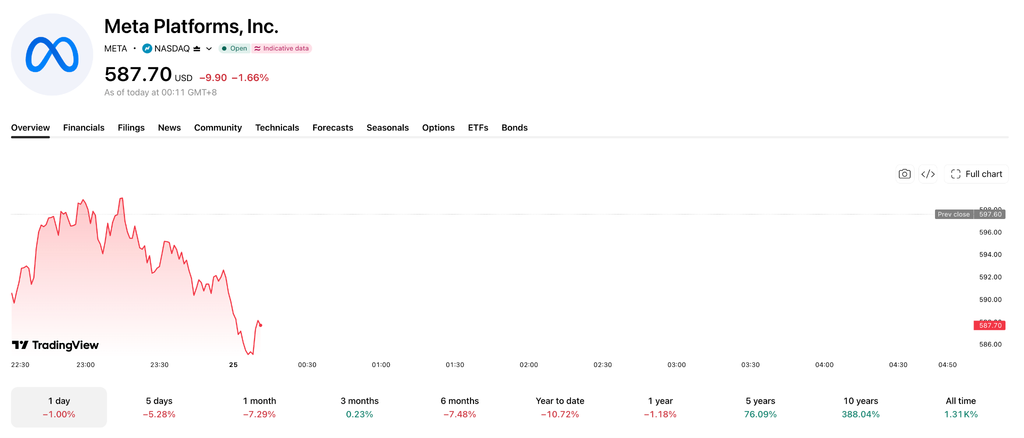
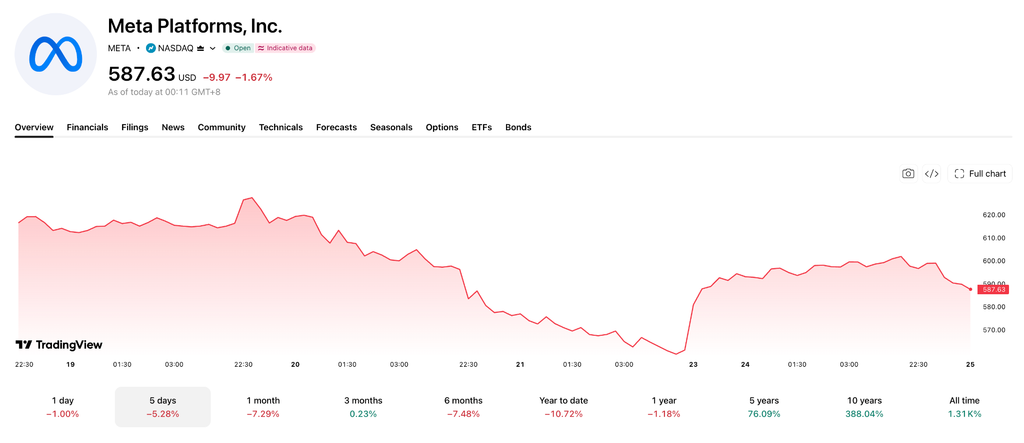
Market observers noted that the steady dividend stream stands out alongside heavy capital outlays for artificial intelligence data centers and shifting equity valuations. Shares closed at $597.60 on November 23, 2026, down 23.1% from a September 24, 2026 peak of $777.59.
Dividend Payouts Alongside Heavy AI Capital Expenditures
Meta Platforms paid $1.36 billion in dividends in the 3rd quarter of 2026 despite a $2.12 billion free cash flow loss and a pause in share repurchases after $3.33 billion a year earlier. Quarterly capital spending was $34.91 billion, and full-year 2026 capital expenditure was $135 billion to $145 billion to support AI infrastructure.
Despite elevated spending, the company reported third-quarter revenue of $64.60 billion, up 26% year-over-year, alongside operating cash flow of $32.79 billion and $82.45 billion in cash, cash equivalents, and marketable securities as of September 30, 2026.
Total costs and expenses rose 68% to $51.61 billion, incorporating a $9.89 billion charge tied to an agreement with 52 state attorneys general over youth social media litigation.
Analysts reviewing the balance sheet noted that substantial liquidity and strong core advertising growth give management flexibility to fund infrastructure buildouts while maintaining quarterly payouts. Investors continue watching how multi-year capital intensity shapes free cash flow conversion.
Share Structure, Compensation, and Tax Mechanics
Zuckerberg’s financial interest is held primarily through Class B shares carrying ten votes per share via family trusts and limited liability entities, representing 60.8% of total voting power in 2026 proxy disclosures.
His base salary remains $1 per year, while reported 2025 total compensation reached $25,125,904, driven largely by security and personal aircraft expenses that the current dividend pace matches roughly every 13 days.
For an individual investor holding 1,000 shares, the $2.10 annual payout equals $2,100 per year or $525 per quarter, representing a 5.5% yield against the $38 per share initial public offering price from May 2012. At the top federal rate of 23.8% on qualified dividends including the net investment income tax, an annual payout of $716 million would imply roughly $170 million in federal taxes.
Estate planning transfers of appreciated stock allow large holders to shift shares into trusts or philanthropic vehicles without triggering an immediate sale. Careful tax and estate planning remains a standard consideration for concentrated founders.
New Product Releases and the Current Market Situation
Alongside capital allocation debates, Meta Platforms has continued expanding artificial intelligence capabilities and regional initiatives, including launching a consumer shopping and travel assistant tool in the United Kingdom and signing an online safety agreement with digital authorities in the Philippines.
Management has also pointed toward reducing Reality Labs operating losses over time while evaluating share structure adjustments to support long-term artificial intelligence funding.
Market sentiment around large-cap technology stocks has remained sensitive to spending trajectories, regulatory developments, and broader equity market swings. While core advertising metrics such as ad impressions and average ad price continued expanding in the third quarter, investors weigh near-term margin pressure against multi-year product monetization.
Digital platform competitiveness, capital expenditure discipline, and recurring cash generation are the three most important factors to consider when making long-term portfolio decisions for significant technology holdings. Market participants can better gauge long-term risk and reward by reviewing regulatory disclosures and quarterly filings.
Third-quarter family daily active people were 3.64 billion, up 3% year-over-year, operating income was $12.99 billion, and diluted earnings per share was $3.83, including a $3.57 legal settlement charge. As Meta Platforms executes globally, market participants monitor quarterly cash conversion, AI infrastructure returns, and governance updates.