
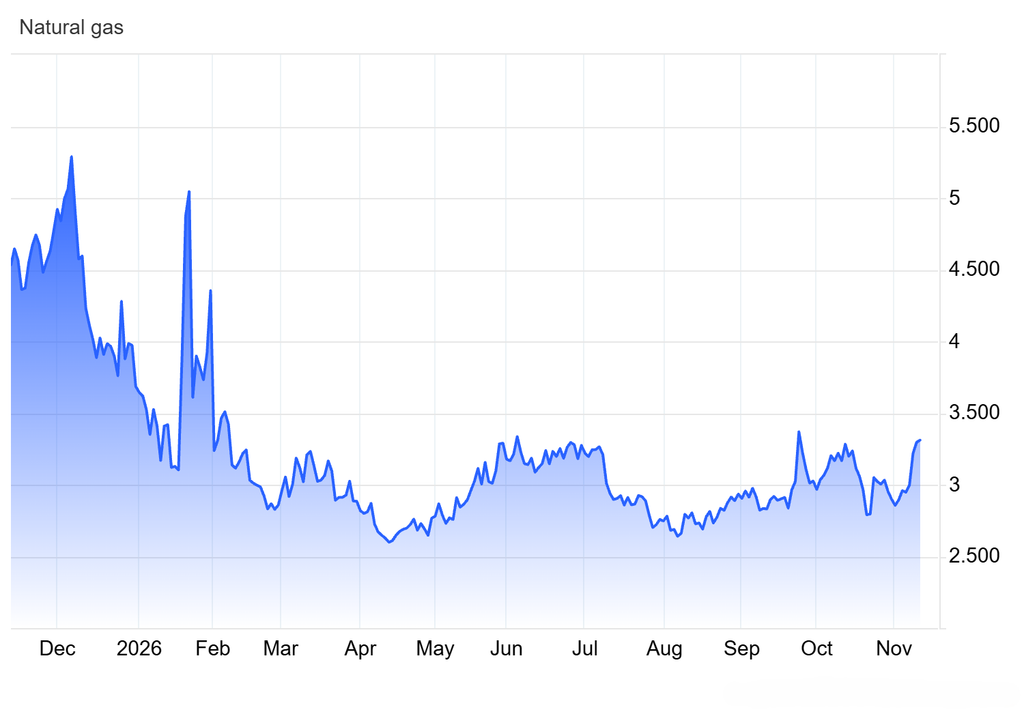
US natural gas futures have pulled back sharply after touching a near three-year high of $4.65 per MMBtu in mid-November, with the December contract settling around $3.03 to $3.06.
The retreat, amounting to more than 34% from peak to trough, highlights a market caught between strong seasonal demand expectations and the relentless expansion of domestic supply.
Sylverix points out that the natural gas market is experiencing one of the most dynamic supply-demand battles in recent years. Record production levels are colliding with surging export demand and the uncertain timing of the heating season, creating conditions ripe for sharp directional moves in either direction.
The November contract expired at $2.776 per MMBtu, while the rollover to the December contract introduced a notable premium that reflects forward-looking tightness expectations.
Record Output Meets Surging LNG Demand
US dry gas production has reached an unprecedented 112.2 Bcf/d, a record that continues to climb as operators in the Permian Basin, Haynesville Shale, and Appalachian region expand drilling activity.
This prolific output has kept the supply side well-stocked, acting as a natural ceiling on domestic prices and frustrating attempts by bulls to sustain rallies above the $4.00 threshold.
Simultaneously, LNG feedgas deliveries have surged to near-record levels at approximately 20 to 21.2 Bcf/d, reflecting robust global demand for US liquefied natural gas.
European benchmark prices remain dramatically elevated relative to US domestic prices, with the TTF trading near €101 per megawatt-hour, equivalent to roughly $24.50 per MMBtu. The US benchmark, by contrast, sits near $3 per MMBtu, creating one of the widest transatlantic price differentials on record.
This eight-to-one price differential between European and US gas creates a powerful economic incentive for continued export expansion.
Every new LNG terminal that comes online effectively diverts domestic supply to international markets, tightening the balance for US consumers, power generators, and industrial users.
The structural shift toward higher LNG export capacity represents a permanent change in the domestic supply-demand equation.
Storage Surplus and the Weather Wildcard
Working gas in storage stood at 3,351 Bcf in the latest reporting week, sitting 95 Bcf above the five-year seasonal average. This surplus has provided a buffer against price spikes, reassuring markets that physical supply remains adequate heading into the winter heating season.
However, storage draws during a cold December and January could quickly erode this cushion.
Weather models hold the key to the next major directional move. Above-normal temperatures across the eastern United States have delayed the onset of sustained heating demand, suppressing residential and commercial gas consumption.
Extended forecasts suggest this warmer-than-average pattern could persist through late November, potentially adding to the storage surplus before genuinely cold weather arrives in December.
The spread between front-month and second-month contracts has been a reliable gauge of short-term supply anxiety throughout 2026. A widening contango structure signals comfortable near-term supply, while a shift toward backwardation would indicate that traders expect imminent tightening.
Currently, the modest December premium over January suggests cautious optimism about winter demand without the urgency that characterised the pricing around the November spike.
Power generation demand adds another dimension to the balance sheet. Natural gas’s share of US electricity generation has continued to rise at the expense of coal, with several ageing coal-fired plants retiring ahead of schedule during 2026.
Industrial consumption has also strengthened, with petrochemical facilities along the Gulf Coast operating at elevated utilisation rates to capitalise on the cost advantage that cheap US feedstock provides relative to global competitors.
Price Levels and Seasonal Catalysts to Monitor
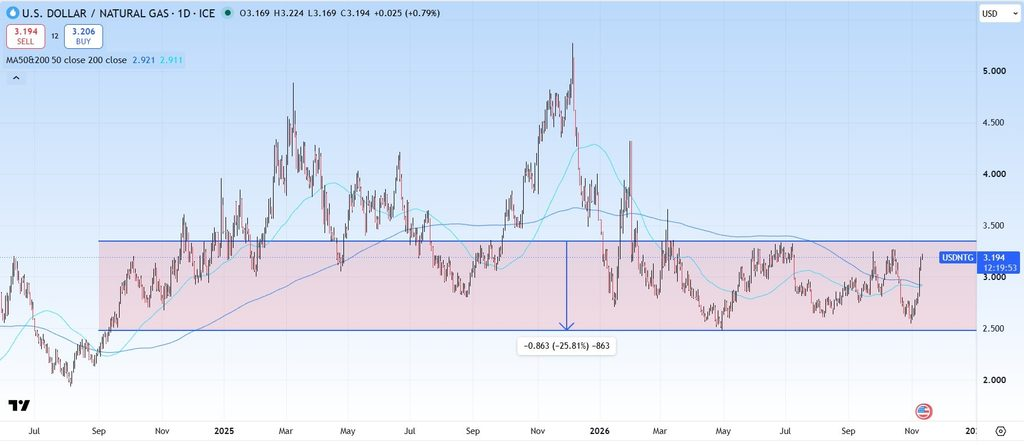
Technically, natural gas faces immediate resistance at the $3.20 to $3.25 range, which corresponds to the declining trendline drawn from the November spike high.
A break above $3.50 would suggest a renewed bullish impulse, with the $4.00 level coming back into focus as the next major target. Support sits at $2.80, near the November contract expiry level, and then at $2.50, a major floor tested repeatedly during the summer months.
The catalysts for a directional resolution are well-defined. A sustained cold snap across the northern tier of the United States would rapidly draw down storage inventories and push prices higher, potentially revisiting the $4.00 area.
Conversely, continued mild weather combined with record production could drive prices back toward the $2.50 to $2.80 range, where summer lows provided a floor.
Natural gas remains one of the most volatile energy commodities, and the current setup amplifies that tendency considerably. The convergence of record production, surging LNG exports, elevated global prices, and seasonal weather uncertainty creates a market where positioning carries outsized risk in both directions.