
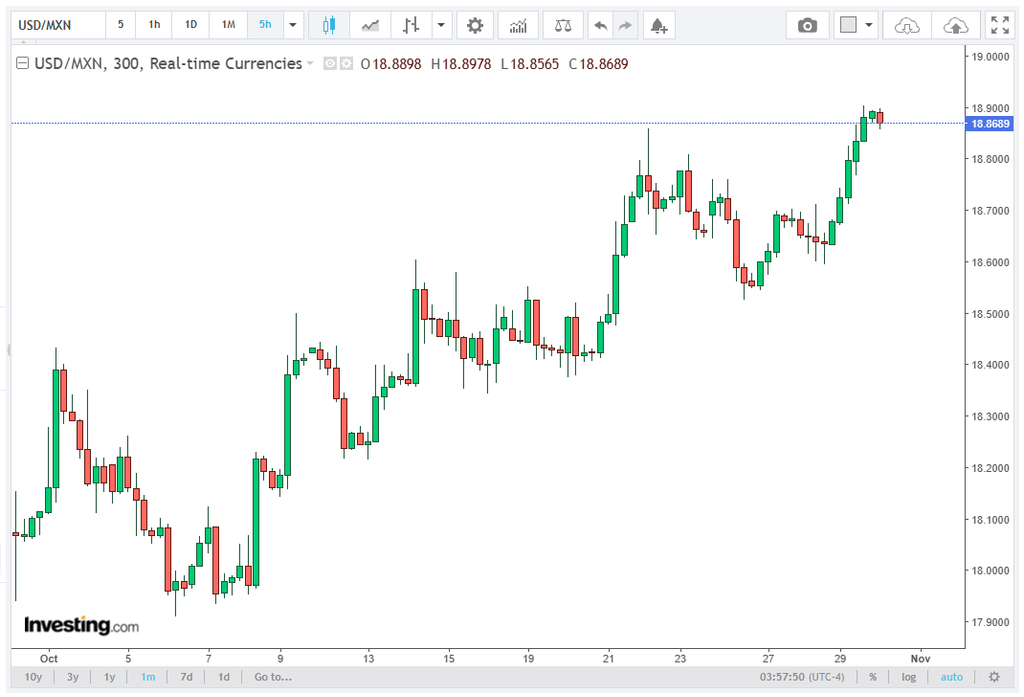
The Mexican Peso (MXN) depreciated more than 1.20% against the US Dollar (USD), pushing USD/MXN to 18.86 and bringing the exchange rate closer to the psychologically significant 19.00 level.
The advance reflects renewed US Dollar demand following stronger economic growth, accelerating inflation and expectations of further Federal Reserve (Fed) monetary tightening.
This article takes a closer look at the topic, highlighting insights gained from Aurelstein’s industry experience.
The latest economic indicators demonstrate the resilience of the US economy despite restrictive financial conditions. The combination of strong GDP growth, elevated Core PCE inflation and stable labour market conditions has reinforced uncertainty surrounding the Fed’s interest rate trajectory, weighing on emerging-market currencies.
USD/MXN initially retreated towards 18.60 following the Fed’s latest policy decision before reversing higher as incoming economic data triggered renewed Dollar buying. This movement highlights the sensitivity of the Mexican Peso to US monetary policy expectations and international capital flows.
US GDP Growth Accelerates to 3.4%
The US economy expanded by 3.4% year over year, exceeding market expectations of 3.2% and accelerating from the previous quarter’s 2.2% growth rate. The stronger reading demonstrates that economic activity remains robust despite elevated borrowing costs.
From a monetary policy perspective, resilient economic growth reduces pressure on the Fed to ease financial conditions. Stronger activity can sustain aggregate demand, corporate investment, and employment, potentially prolonging inflationary pressures.
For currency markets, expectations of higher US interest rates increase the attractiveness of USD-denominated assets, encouraging international capital allocation towards the Dollar. This dynamic creates additional pressure on emerging-market currencies, particularly the Mexican Peso.
Core PCE Inflation Rises to 3.1%
The US Core Personal Consumption Expenditures (PCE) Price Index increased to 3.1%, compared with 3.0% previously, matching market expectations.
The acceleration highlights persistent underlying price pressures and complicates the Fed’s progress towards its 2.0% inflation target. Core PCE excludes volatile food and energy components, providing policymakers with an important measure of underlying inflation dynamics.
Meanwhile, initial unemployment claims declined to 194,000, from 195,000, remaining below forecasts of 199,000. This relatively stable labour market supports the case for maintaining restrictive monetary conditions.
The combination of 3.4% GDP growth, 3.1% Core PCE inflation and 194,000 jobless claims reinforces expectations that interest rate reductions may remain limited. Markets are also assessing the possibility of another 25-basis-point Fed rate increase.
Federal Reserve Expectations and Interest Rate Differentials
The Fed maintained its benchmark interest rate at its latest meeting, while forward guidance remained limited. Chair Kevin Warsh outlined seven monetary policy decisions in 2027 and six in 2028, leaving investors focused on incoming economic indicators.
Money markets currently price a 76% probability of another Fed rate increase, down from 84% previously. Despite this reduction, additional monetary tightening remains an important consideration for currency traders.
Banxico Maintains Its 6.50% Benchmark Rate
In Mexico, Banxico Deputy Governor Galia Borja defended the central bank’s 6.50% policy rate, describing the current monetary position as appropriate while inflation gradually approaches the 3.0% target.
The upcoming Mexican third-quarter GDP report represents another important catalyst. Economists expect 0.7% quarter-over-quarter growth, while annual expansion is projected to accelerate from 2.1% to 2.5%. The figures will help investors evaluate domestic economic momentum and Banxico’s future policy direction.
USD/MXN Technical Analysis: 19.00 in Focus
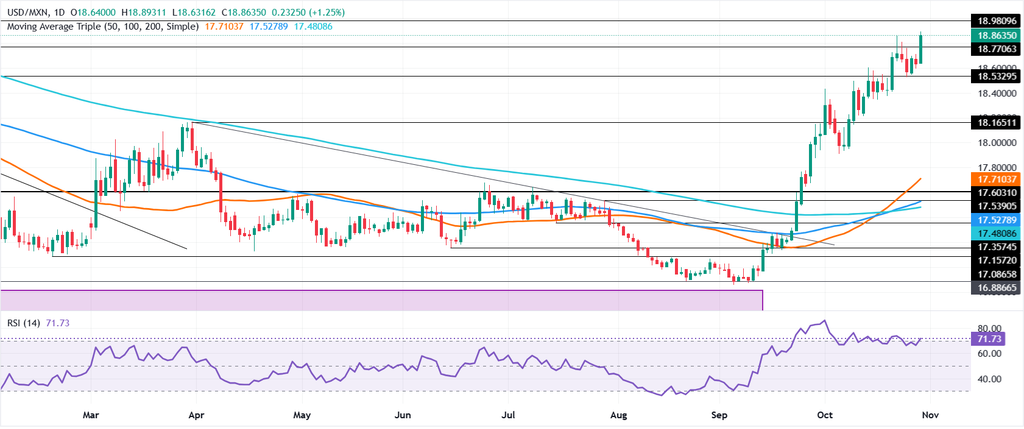
From a technical perspective, USD/MXN trades around 18.8635, maintaining a firmly bullish structure. The exchange rate remains above its 50-day, 100-day, and 200-day Simple Moving Averages (SMAs), clustered around 17.7104.
The distance between spot prices and the moving-average cluster reflects strong upward momentum. Meanwhile, the 14-day Relative Strength Index (RSI) stands at 71.7, exceeding the conventional 70 overbought threshold and signalling stretched bullish conditions.
Immediate psychological resistance stands at 19.0000. A sustained daily close above this level could reinforce bullish positioning and expose the pair to further upside exploration.
On the downside, initial technical support is concentrated around 17.7104, where the three moving averages converge. A deeper correction could bring the structural support level at 16.8866 into focus.
Conclusion
The Mexican Peso faces renewed depreciation pressure as stronger US economic growth and accelerating Core PCE inflation reinforce expectations of restrictive Federal Reserve policy.
With USD/MXN approaching 18.86, the 19.00 psychological threshold remains the immediate technical focus.
Meanwhile, Banxico’s 6.50% benchmark rate and Mexico’s upcoming GDP figures provide important counterbalancing factors. The exchange rate’s trajectory will depend on the US-Mexico yield differential, inflation expectations, economic growth, and speculative positioning.
Although the RSI at 71.7 indicates overbought conditions, trading above all three major moving averages preserves the pair’s bullish technical bias.