
Hyperliquid (HYPE) has strengthened its bullish market outlook following a major strategic agreement between Trade[XYZ], its largest real-world asset (RWA) trading platform, and the Intercontinental Exchange (ICE).
This article takes an in-depth look at the subject, incorporating Aurelgate’s knowledge and industry experience.
The partnership aims to introduce regulated perpetual futures markets in the United States, potentially unlocking substantial trading volume, liquidity, and network activity for the Hyperliquid ecosystem.
HYPE surged approximately 17% within 24 hours following the announcement, reflecting strong investor optimism. The development represents a significant milestone for Hyperliquid, which has established itself as specialized Layer-1 (L1) infrastructure for decentralized derivatives trading.
Under the proposed arrangement, ICE will exclusively operate Trade[XYZ]’s regulated markets and intends to establish a dedicated retail trading and clearing structure. Subject to regulatory approvals, this initiative could connect Hyperliquid-powered markets with a considerably larger segment of traditional financial market participants.
The partnership extends beyond a short-term price catalyst. ICE’s financial market infrastructure and regulatory expertise could accelerate the integration of decentralized trading technology with established financial markets.
HIP-3 Processes $115 Billion as RWA Adoption Accelerates
The partnership will leverage Hyperliquid’s HIP-3 framework, which enables markets for tokenized real-world assets, including equities, commodities, and other financial instruments.
Trade[XYZ] processed approximately $115 billion in trading volume during June 2026, demonstrating substantial demand for on-chain exposure to traditional financial assets.
HIP-3’s open interest reached nearly $4 billion in September, establishing a new record and indicating continued capital commitment despite fluctuations in trading activity.
These metrics provide important insights into adoption. Trading volume measures executed transactions, while open interest (OI) represents outstanding derivative positions. Sustained growth in both indicators would signal increasing liquidity, market participation, and capital deployment across Hyperliquid’s RWA infrastructure.
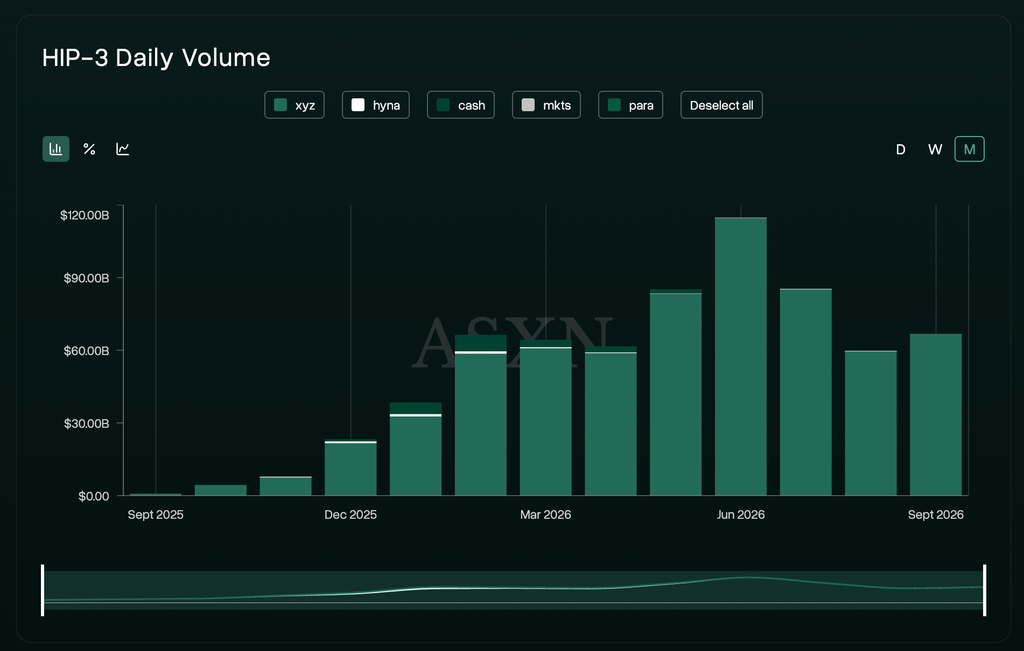
The ICE partnership could accelerate this expansion by introducing regulated access for U.S. retail traders. The proposed market structure will incorporate Know Your Customer (KYC) and Anti-Money Laundering (AML) requirements, potentially reducing regulatory barriers to participation.
Another competitive advantage is 24/7 trading availability. Traditional equity markets generally operate within predefined sessions, whereas blockchain-based perpetual markets can offer continuous trading. This flexibility could attract traders seeking exposure outside conventional exchange hours.
Successful expansion could generate higher transaction throughput, liquidity depth, trading fees, and open interest, strengthening Hyperliquid’s network economics and supporting its long-term valuation.
Hyperliquid Fundamentals Strengthen Beyond Speculation
Hyperliquid’s investment thesis is increasingly supported by measurable network activity rather than token speculation alone. Its purpose-built blockchain combines an optimized trading environment with integrated infrastructure for perpetual futures and tokenized financial markets.
Its competitive positioning is particularly relevant as decentralized derivatives gain traction. High-performance execution, deep liquidity, and continuous market access are essential for attracting professional traders and larger capital allocations.
The ICE agreement introduces another potential growth driver: institutional distribution. Access to a regulated U.S. retail market could significantly expand Hyperliquid’s addressable user base beyond existing cryptocurrency-native participants.
For HYPE holders, the key valuation consideration is whether increased adoption translates into stronger protocol economics. Higher trading volumes could generate additional fees, while expanding open interest could improve liquidity and market depth.
The relationship between these metrics and token value will depend on the protocol’s fee structure, token utility, and value-accrual mechanisms.
HYPE Price Prediction: $100 Becomes the Next Major Target
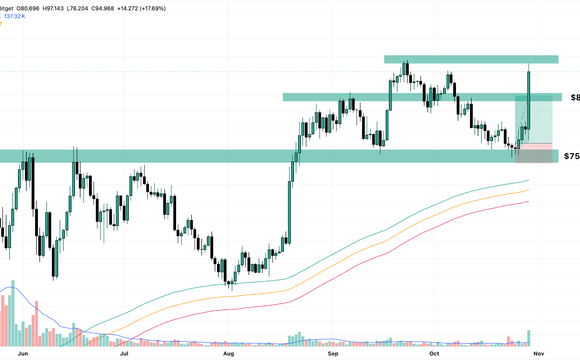
From a technical perspective, HYPE’s 17% rally has improved its short-term market structure. The token rebounded strongly from the $75 support region, while trading volume increased approximately 200% following the ICE announcement.
The move also reached the previously established $89 take-profit target, placing HYPE within striking distance of the psychologically significant $100 level.
On the daily timeframe, HYPE is encountering selling pressure around its previous all-time high. This resistance represents an important technical barrier following the rapid upward move.
A sustained daily close above resistance, accompanied by expanding spot volume and rising open interest, would provide stronger confirmation of a bullish breakout. This could establish $100 as the next major price objective, with additional upside depending on liquidity conditions and broader cryptocurrency market sentiment.
The $75 support zone remains an important technical reference. A sustained breakdown below this level could weaken the bullish structure and increase the probability of extended consolidation.
Conclusion: ICE Could Accelerate HYPE’s Path Toward $100
Hyperliquid’s agreement with ICE represents a significant fundamental catalyst that could accelerate decentralized perpetual futures adoption in regulated U.S. markets. With $115 billion in monthly RWA trading volume, nearly $4 billion in open interest, and expanding institutional opportunities, the ecosystem has several measurable growth drivers.
HYPE’s 17% rally, recovery from $75, and achievement of the $89 target have strengthened its technical outlook. A confirmed breakout above major resistance could place $100 within reach, while sustained growth in trading volume, liquidity, and protocol revenue could support higher valuations.
Although regulatory and execution risks remain, Hyperliquid’s strengthening fundamentals make the ICE partnership a potentially important catalyst for its next valuation expansion.