
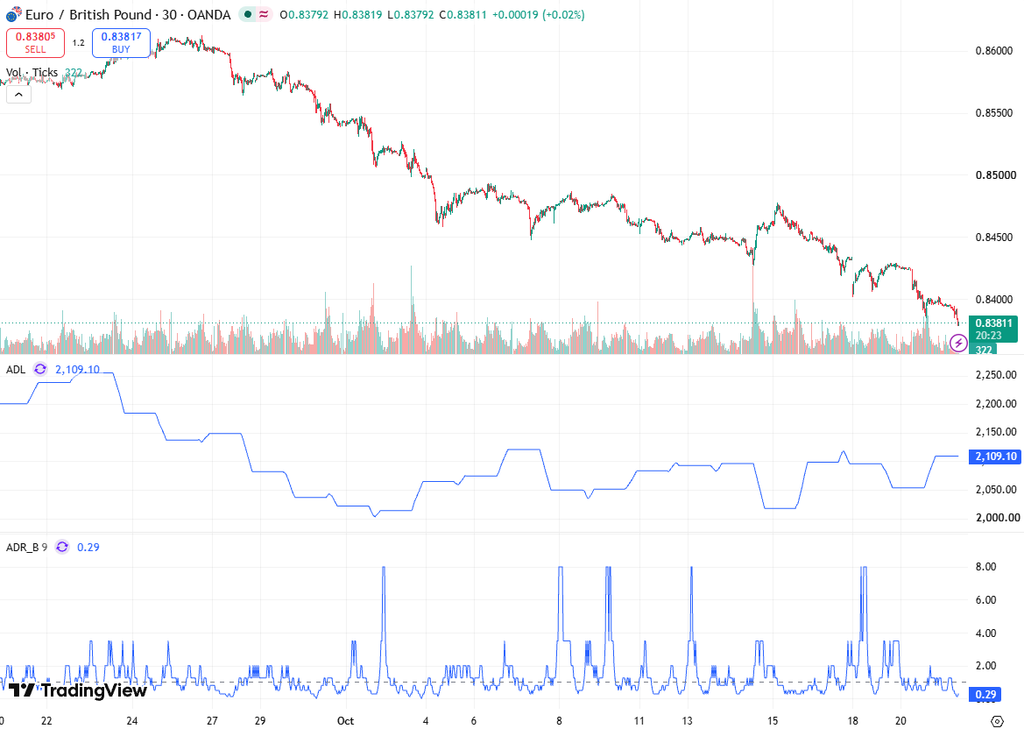
The EUR/GBP exchange rate declined towards 0.8390 during Wednesday’s early European session as stronger-than-expected UK Consumer Price Index (CPI) data reinforced expectations of further monetary tightening by the Bank of England (BoE).
Rising UK inflation and deteriorating French fiscal sentiment have increased downside pressure on the Euro against Sterling. Risance’s professionals provide comprehensive insights backed by industry knowledge and experience.
The pair reflects diverging monetary policy expectations between the BoE and the European Central Bank (ECB). Higher anticipated UK interest rates can widen the yield differential in Sterling’s favour, supporting demand for pound-denominated assets.
Meanwhile, concerns over France’s public finances create an additional fundamental headwind for EUR/GBP.
UK CPI Accelerates to 3.5%, Raising Inflation Risks
Data from the Office for National Statistics (ONS) showed that UK headline inflation accelerated to 3.5% year-over-year (YoY), up from 3.1% and above the 3.4% consensus forecast. The 0.4-percentage-point increase reflected renewed inflationary pressure, partly driven by higher fuel prices.
Underlying inflation also exceeded expectations. Core CPI, excluding food and energy, rose to 2.8% YoY from 2.6%, surpassing the 2.7% forecast. This acceleration suggests that price pressures extend beyond volatile energy components.
Monthly headline CPI increased by 0.4%, compared with 0.5% previously and a forecast of 0.3%. Although monthly inflation moderated, the upside surprise reinforces concerns about persistent price pressures.
For the BoE, sustained increases in core services inflation, wages and household costs could delay the return towards its 2% inflation target, complicating the monetary policy outlook.
BoE Rate-Hike Expectations Strengthen GBP
The inflation report has intensified speculation that the BoE could raise interest rates at its next meeting, potentially marking its first rate increase since 2023. Market pricing cited in the supplied commentary indicates expectations of three additional rate hikes over the following 12 months.
Foreign exchange markets respond to changes in the expected interest rate path, rather than current policy settings alone. A more hawkish repricing of UK rates can increase the relative attractiveness of Sterling-denominated assets and widen prospective yield differentials against the Euro.
Wage inflation adds to these concerns. BoE policymaker Megan Greene has highlighted stalled wage disinflation, resilient economic activity and the risk of second-round inflation effects. Wage growth approaching 3.5% could complicate the return to target unless productivity gains offset labour-cost increases.
The combination of sticky wages, elevated services inflation and resilient demand increases the likelihood that monetary policy will remain restrictive for longer, supporting GBP and limiting EUR/GBP’s recovery potential.
Energy and Food Costs Sustain UK Inflation Risks
The medium-term inflation outlook remains exposed to higher energy and food prices. Rising Brent crude prices, fuel expenses and household utility bills could increase consumer costs over the coming months.
Danske Bank identifies strengthening core-services inflation as a key concern. Its projections suggest annual dual-fuel household bills could approach £2,100, with more substantial relief potentially delayed until the second half of 2027.
Food inflation presents another upside risk. Weather-related supply disruptions, production expenses and transportation costs could increase seasonal and processed food prices despite supermarket competition.
These pressures create a policy trade-off between inflation control and economic growth. Further tightening could support Sterling through interest rate expectations, while raising borrowing costs for households and businesses.
Technical Analysis: EUR/GBP Tests 0.8365 Support
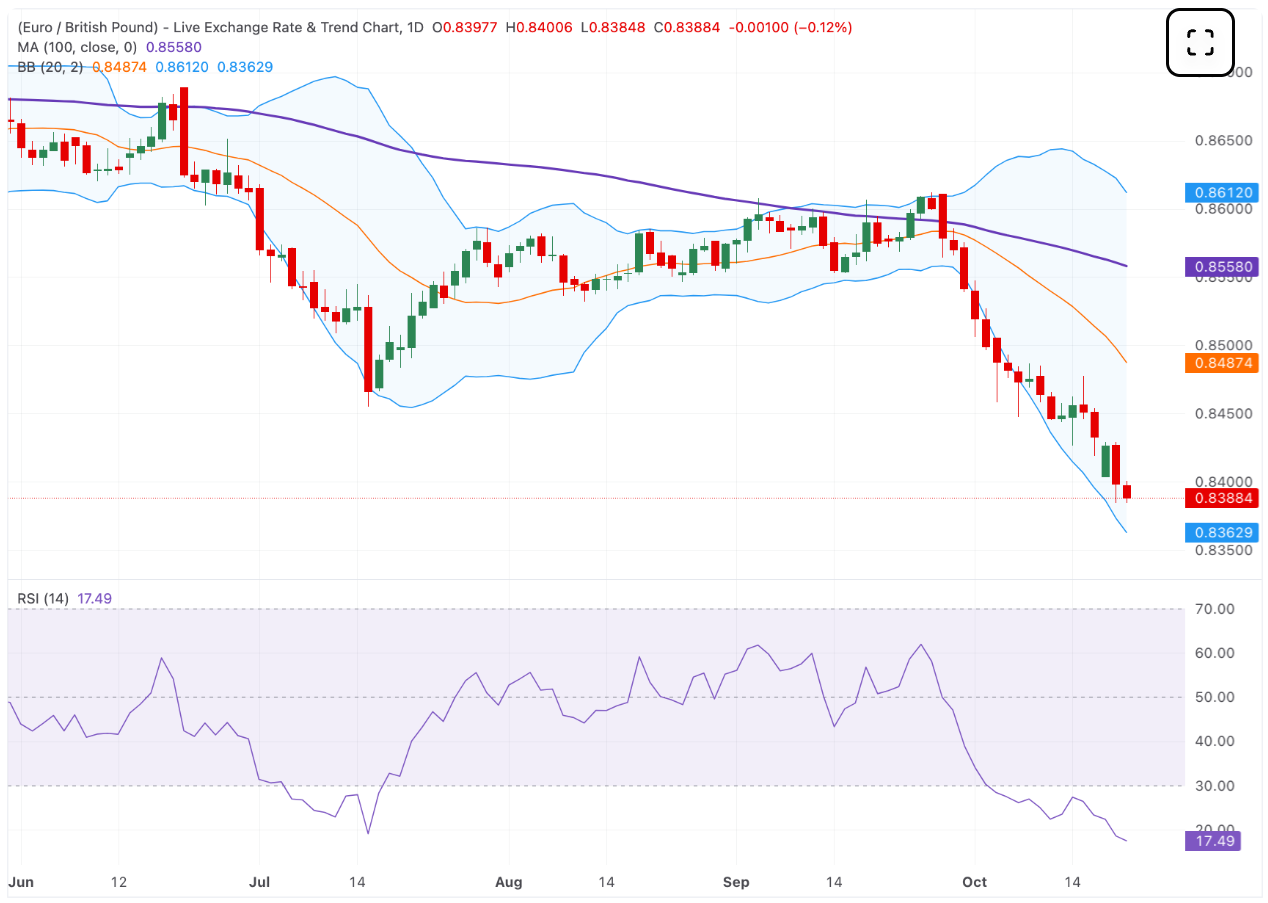
Technically, EUR/GBP remains bearish, trading below the 20-period Bollinger Band middle line at 0.8485 and the 100-day simple moving average (SMA) near 0.8560. This configuration favours sellers, with corrective rallies potentially attracting renewed selling interest.
The 14-period Relative Strength Index (RSI) stands near 17, well below the conventional 30 oversold threshold. This indicates strong downside momentum but also increases the possibility of a short-term rebound. An oversold reading does not independently confirm a trend reversal.
Immediate support lies at 0.8365, near the lower Bollinger Band. A decisive daily close below this level could expose the pair to further losses and reinforce the prevailing downtrend.
On the upside, 0.8485 represents initial resistance, followed by the 100-day SMA at 0.8560 and the upper Bollinger Band at 0.8612. A recovery above 0.8485 would ease immediate selling pressure, while a sustained break above 0.8560 would provide stronger evidence of a broader technical recovery.
Conclusion
The EUR/GBP decline towards 0.8390 reflects UK inflation at 3.5%, rising BoE rate-hike expectations and persistent French fiscal uncertainty. Core CPI at 2.8%, combined with wage and energy pressures, supports expectations of restrictive UK monetary policy and strengthens Sterling.
Technically, 0.8365 remains immediate support, while 0.8485 is the first resistance level. A sustained break below support would reinforce the bearish outlook, whereas a recovery above 0.8560 could signal improving momentum.
Future price direction will depend on inflation data, central bank expectations, and developments in France’s fiscal outlook.