
Gold (XAU/USD) recorded modest intraday gains during the Asian session, supported by declining US Treasury yields, a softer US Dollar (USD), and reduced expectations of an immediate Federal Reserve (Fed) interest-rate hike.
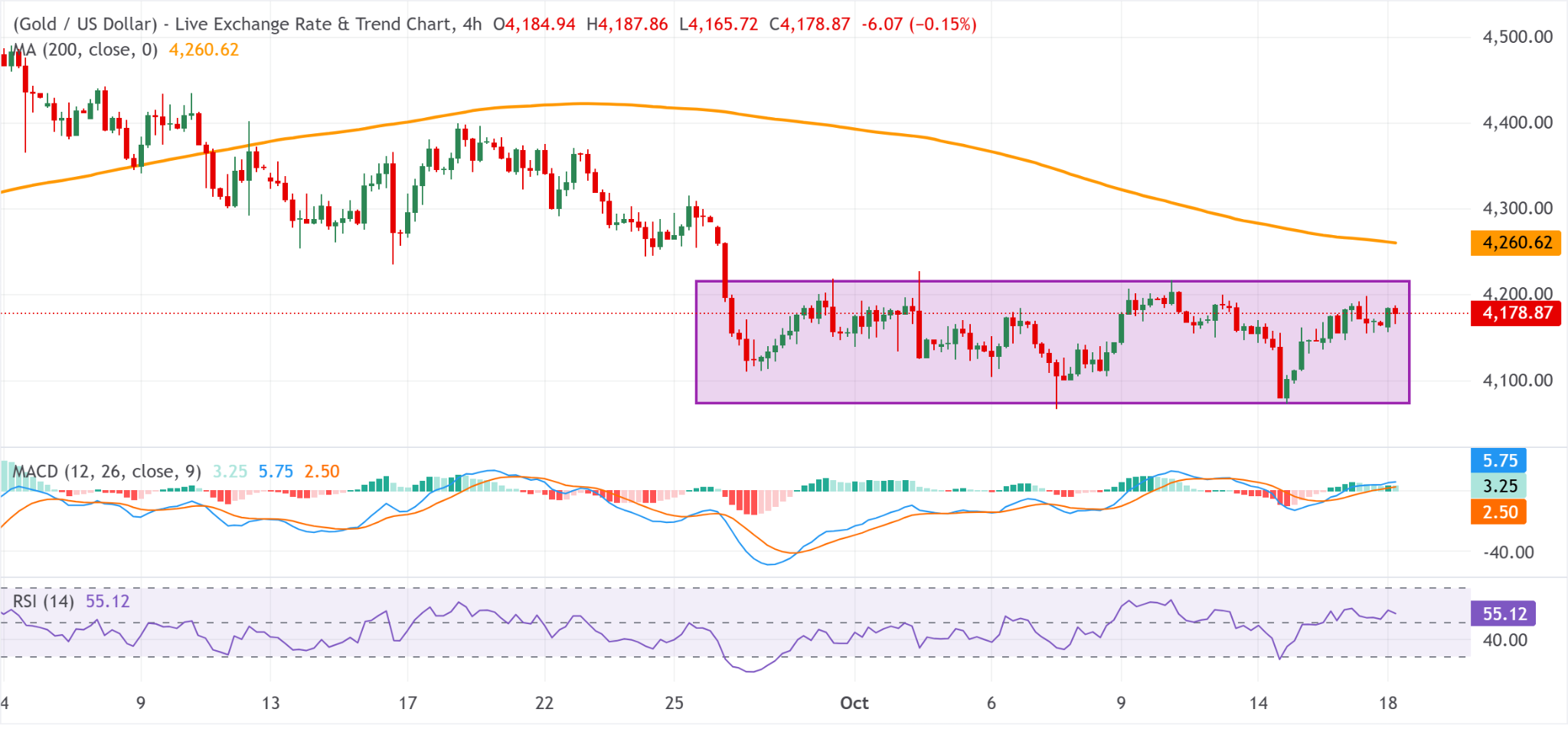
The precious metal remained confined to a narrow consolidation range below the $4,200 per ounce psychological threshold, indicating a lack of decisive bullish momentum.
Vaulltier’s brokers outline the key aspects of this subject in the article.
The recent retreat in US government bond yields from multi-year highs has reduced the opportunity cost of holding non-yielding gold, providing short-term support to bullion.
Simultaneously, the USD weakened toward a two-week low, improving the purchasing appeal of dollar-denominated commodities. Despite these supportive conditions, uncertainty surrounding the Fed’s policy trajectory continues to restrict upward price movement.
Gold’s inability to establish acceptance above $4,200 suggests that market participants remain reluctant to increase bullish exposure without stronger confirmation from monetary policy expectations, real yields, and technical indicators.
Federal Reserve Expectations and Treasury Yield Dynamics
Federal Reserve policy repricing remains a primary driver of near-term gold price action. Following recent inflation data that exceeded expectations, investors initially increased bets on an imminent rate hike. Restrained policy guidance from Fed Chair Kevin Warsh subsequently reduced expectations for an October adjustment.
Market estimates cited by Deutsche Bank strategists indicate that the implied probability of an October rate hike declined from approximately 30% to 15% during Warsh’s remarks. This represents a reduction of 15 percentage points, easing immediate monetary tightening concerns and supporting risk-sensitive assets.
Expectations for subsequent policy decisions remain considerably more hawkish. According to the CME Group FedWatch Tool, traders continue to price in approximately 90% or greater probability of a December rate hike. This divergence between near-term and medium-term rate expectations creates conflicting signals for gold.
Geopolitical Risk and Energy-Driven Inflation
Geopolitical tensions continue to influence gold, crude oil, and the USD through competing safe-haven and inflation channels. Security risks surrounding the Strait of Hormuz, damage to commercial tankers, and disruptions affecting Russian energy infrastructure have intensified concerns about potential supply constraints.
Crude oil prices advanced to a near one-month high, reflecting elevated geopolitical risk premiums and uncertainty surrounding global energy flows. Higher oil prices can increase headline inflation, raise production and transportation costs, and reinforce expectations of additional monetary tightening.
Further instability involving regional military forces and attacks on energy infrastructure has maintained uncertainty across commodity markets. These developments ordinarily support safe-haven gold demand, but they can also strengthen the USD as investors seek liquidity and defensive exposure.
Technical Analysis: Resistance, Support, and Momentum Indicators
From a technical perspective, XAU/USD remains within a corrective consolidation structure following its retreat from the $4,700 region reached earlier in the year.
The price remains decisively below the 200-period Simple Moving Average (SMA) on the four-hour chart, suggesting that the broader trend has not yet transitioned into a confirmed bullish recovery.
The 14-period Relative Strength Index (RSI) stands at approximately 55.1, indicating modest positive momentum without approaching conventional overbought territory near 70.
The Moving Average Convergence Divergence (MACD) remains above its zero line, although its positive profile is softening. Together, these indicators suggest improving short-term momentum but insufficient confirmation of a sustained trend reversal.
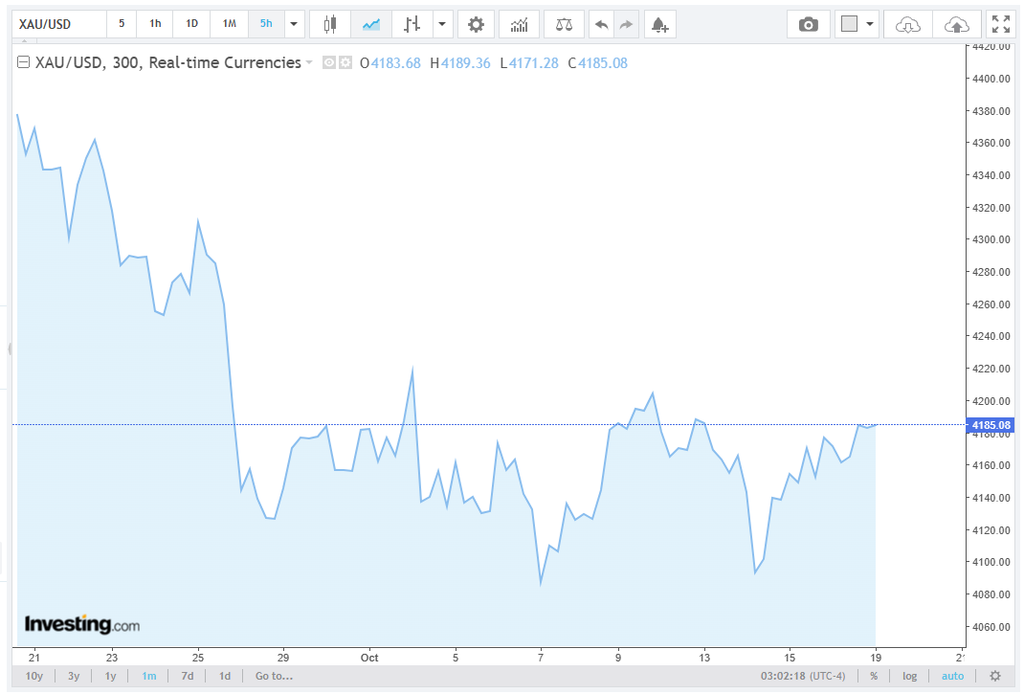
The immediate resistance level is located at $4,200, followed by the more significant 4,215-4,220 breakout zone. A sustained four-hour close above $4,220, supported by expanding momentum, would weaken the prevailing bearish structure and potentially open the way for an extended recovery.
On the downside, initial support lies between $4,145 and $4,150. A decisive break below this zone would expose $4,100, followed by the previous swing-low region at 4,065-4,075. A confirmed breakdown beneath $4,065 would increase the probability of a retest of the $3,957 year-to-date low.
These levels establish a near-term technical framework in which a breakout above $4,220 would improve the bullish outlook, whereas a breakdown below $4,065 would reinforce downside continuation risk.
Conclusion
Gold remains technically vulnerable despite modest intraday gains, as declining Treasury yields and reduced immediate rate-hike expectations compete with the prospect of a December rate increase, energy-driven inflation, and persistent USD demand.
The RSI at 55.1 and positive but weakening MACD indicate limited bullish momentum, while the position below the 200-period SMA preserves the broader corrective bias. A sustained move above $4,220 would provide stronger evidence of recovery, whereas a breakdown below $4,065 could expose the $3,957 support region.
Until either boundary is decisively breached, range-bound trading and heightened sensitivity to Fed expectations, bond yields, and geopolitical developments remain the dominant features of the XAU/USD outlook.