
The GBP/USD pair trades near 1.3330 during early European trading, remaining below the 1.3350 psychological threshold as investors reassess the monetary policy outlook in the United States and the United Kingdom. Vaulltier’s brokers offer a comprehensive overview of this topic in the article.
The pair’s inability to sustain gains above immediate technical resistance preserves a mildly bearish short-term bias, with the 100-day Simple Moving Average (SMA) at 1.3390 continuing to act as a critical barrier.
Market sentiment remains sensitive to evolving Federal Reserve (Fed) interest-rate expectations following recent policy commentary. Interest-rate futures indicate an 84% probability of unchanged US borrowing costs at the upcoming policy meeting, limiting immediate uncertainty surrounding the expected decision.
In the United Kingdom, upcoming labour-market figures and CPI inflation data could significantly influence expectations for the Bank of England (BoE)‘s next policy move. Markets are assessing the possibility of a 25-basis-point rate increase, with additional tightening also under consideration.
A more aggressive rate path may prove difficult to sustain if consumer demand weakens and household debt-servicing pressures intensify.
Fundamental Outlook: Sterling Support Faces Growing Economic Risks
The British Pound remains relatively resilient, supported by stronger-than-expected GDP data and expectations of tighter monetary policy. Recent economic figures indicate that UK output expanded by 0.1% month-over-month, while the three-month growth rate reached 0.7%, outperforming expectations by approximately 0.2 percentage points.
Despite this improvement, underlying economic momentum remains uneven. Services activity has supported aggregate growth, but weakness in consumer-facing sectors suggests that domestic demand remains vulnerable.
Rising borrowing costs and persistent inflation continue to constrain household purchasing power, potentially limiting the sustainability of the recovery.
Credit-market indicators reinforce these concerns. UK credit-card defaults have increased for six consecutive quarters, while consumer credit rose by approximately £2.5 billion in August, reaching a new record high. These developments highlight the sensitivity of household finances to restrictive monetary conditions.
Expectations for cumulative BoE tightening may be vulnerable to downward repricing if economic activity deteriorates. Although higher UK yields can support Sterling through an improved interest-rate differential, a significant decline in growth expectations could reverse that support.
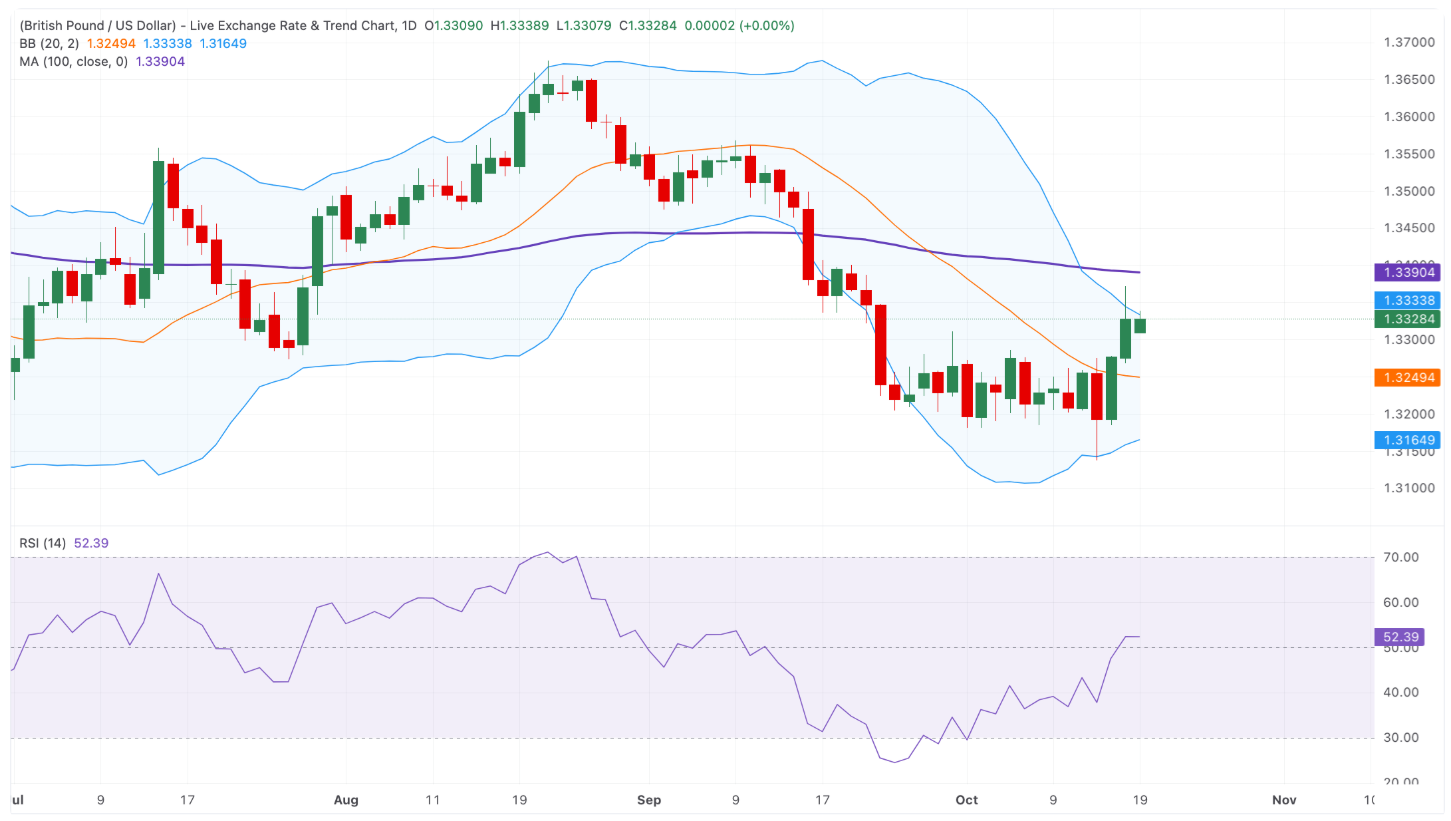
GBP/USD therefore remains exposed to shifts in UK rate expectations, US Treasury yields and broader global risk sentiment.
Inflation remains another critical variable. Persistent price pressures could encourage the BoE to maintain restrictive policy, supporting the Pound in the near term. Evidence of weakening second-round inflation effects or deteriorating employment conditions could reduce expectations for additional tightening, limiting Sterling’s upside.
Technical Analysis: 1.3390 SMA Caps the Recovery
On the daily chart, GBP/USD remains below the 100-day SMA at 1.3390, maintaining a technically vulnerable structure. The pair is trading close to the upper Bollinger Band at 1.3335, suggesting that immediate upside attempts are encountering resistance.
The Relative Strength Index (RSI) stands at 52.4, placing momentum marginally above the neutral 50 threshold. The indicator does not confirm a strong bullish trend, suggesting that the recent recovery lacks sufficient momentum to establish a decisive breakout.
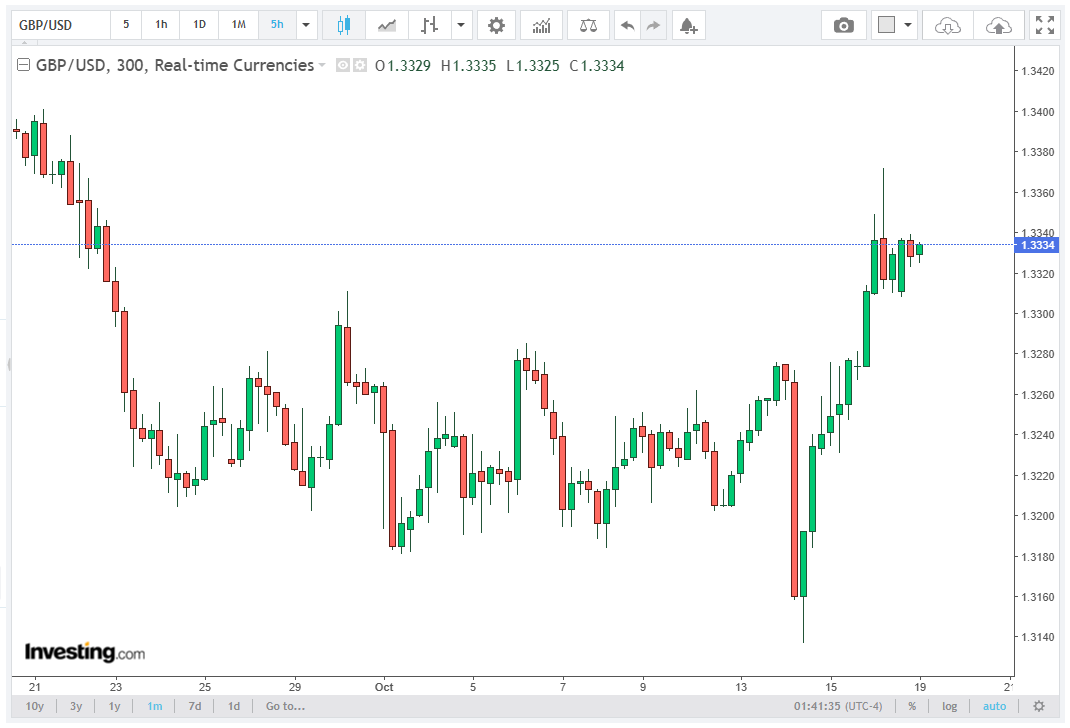
The combination of neutral RSI momentum and resistance below the 100-day SMA favours consolidation with a bearish risk skew.
Immediate resistance is located at 1.3335, corresponding to the upper Bollinger Band. A sustained break above this level could encourage additional buying toward 1.3390, where the 100-day SMA represents the principal trend-defining resistance.
A daily close above 1.3390 would weaken the prevailing bearish structure and potentially expose the 1.3568 level, marking a previous swing high. Such a move would indicate improving bullish momentum, although confirmation would require sustained price acceptance above the moving average rather than a brief intraday breach.
Failure to clear 1.3335 would leave the pair vulnerable to renewed selling pressure. Initial support is positioned at 1.3250, where the 20-day SMA and middle Bollinger Band converge. This level represents an important short-term equilibrium zone.
A decisive daily close below 1.3250 would strengthen the bearish outlook and shift attention toward 1.3165, corresponding to the lower Bollinger Band. Further downside continuation could expose 1.3038, a historical swing-low level that would become relevant if selling momentum accelerated.
Conclusion: Downside Risks Persist Below 1.3390
The GBP/USD outlook remains cautiously bearish while the pair trades below the 100-day SMA at 1.3390. Although expectations of BoE tightening and resilient GDP figures provide fundamental support, rising household credit stress and uncertain economic momentum constrain Sterling’s upside potential.
Technically, 1.3335 is the immediate resistance, followed by 1.3390, while 1.3250 is the key initial support. A breakout above 1.3390 could expose 1.3568, whereas a breakdown below 1.3250 would bring 1.3165 and 1.3038 into focus.
Until price action confirms a sustained breakout, consolidation below resistance with a downside bias remains the dominant technical scenario.