
The Indian Rupee (INR) strengthened sharply against the US Dollar (USD), pushing the USD/INR exchange rate towards 94.95–94.97 as the Greenback surrendered its initial post-inflation gains. Rubinax’s experts break down the key aspects of this topic in the article below.
The reversal followed the release of stronger-than-expected US Consumer Price Index (CPI) data, which failed to generate a sustained repricing of Federal Reserve (Fed) interest rate expectations.
The US Dollar Index (DXY) declined 0.6% to approximately 101.90, retreating from its recent 18-month high of 102.95. Simultaneously, the 10-year US Treasury yield fell towards 5.10%, signalling a deterioration in dollar demand and changing bond-market positioning.
The simultaneous decline in the DXY and Treasury yields supported the INR by reducing the immediate yield-driven advantage of US assets.
US Inflation Accelerates, but Fed Rate Expectations Remain Relatively Stable
The latest inflation report showed that US headline CPI increased to 3.7% year-on-year (YoY) from 3.4%, exceeding the 3.6% consensus forecast. Core CPI, which excludes food and energy, accelerated to 2.6% YoY, compared with 2.4% previously and expectations of 2.5%.
Headline inflation advanced 0.6%, up from 0.4%, while core inflation rose 0.3%, exceeding the projected 0.2%. These readings indicate persistent inflationary pressure and complicate the Fed’s efforts to return inflation towards its 2% target.
Despite the upside surprise, the market response remained inconsistent with a significant hawkish repricing. CME FedWatch probabilities indicated that the likelihood of a rate hike at the next policy meeting increased from 22% to 27%, a rise of just 5 percentage points.
Investors continued to assign substantial probability to another increase at the December meeting, but the latest data did not produce a sufficiently strong shift in near-term expectations to sustain the US Dollar’s initial advance.
From a market-pricing perspective, the distinction between actual inflation and expected monetary policy is critical. Stronger CPI readings typically increase expected policy rates, supporting the currency through higher prospective returns.
However, if investors believe the inflation surprise will not materially alter the Fed’s reaction function, the impact on the US Dollar Index, Treasury yields, and currency risk premiums can remain limited.
Indian Inflation Strengthens the Case for RBI Tightening
Domestic inflation has added another dimension to the INR outlook. India’s retail CPI inflation rose to 5.54% YoY, exceeding the 5.40% forecast and increasing from 4.82% previously. Although inflation remains within the RBI’s 2%–6% tolerance band, it is now only 0.46 percentage points below the upper limit.
Meanwhile, wholesale price inflation accelerated to 11.39%, compared with 9.92% previously, an increase of 1.47 percentage points. The divergence between retail and wholesale inflation highlights significant upstream price pressures, although wholesale inflation does not translate directly into consumer inflation.
The RBI has already raised its repo rate by 25 basis points to 5.50% and shifted its policy stance towards calibrated tightening. Further rate increases could improve the relative attractiveness of INR-denominated assets, provided inflation expectations remain anchored, and risk-adjusted returns are competitive.
Nevertheless, elevated domestic inflation presents a policy trade-off: higher interest rates may support the Rupee, but persistent price pressures can weaken purchasing power and increase production costs. Moreover, higher crude oil prices could increase dollar demand, widen the current account deficit, and offset gains from tighter monetary policy.
USD/INR Technical Outlook: 94.30 Support in Focus
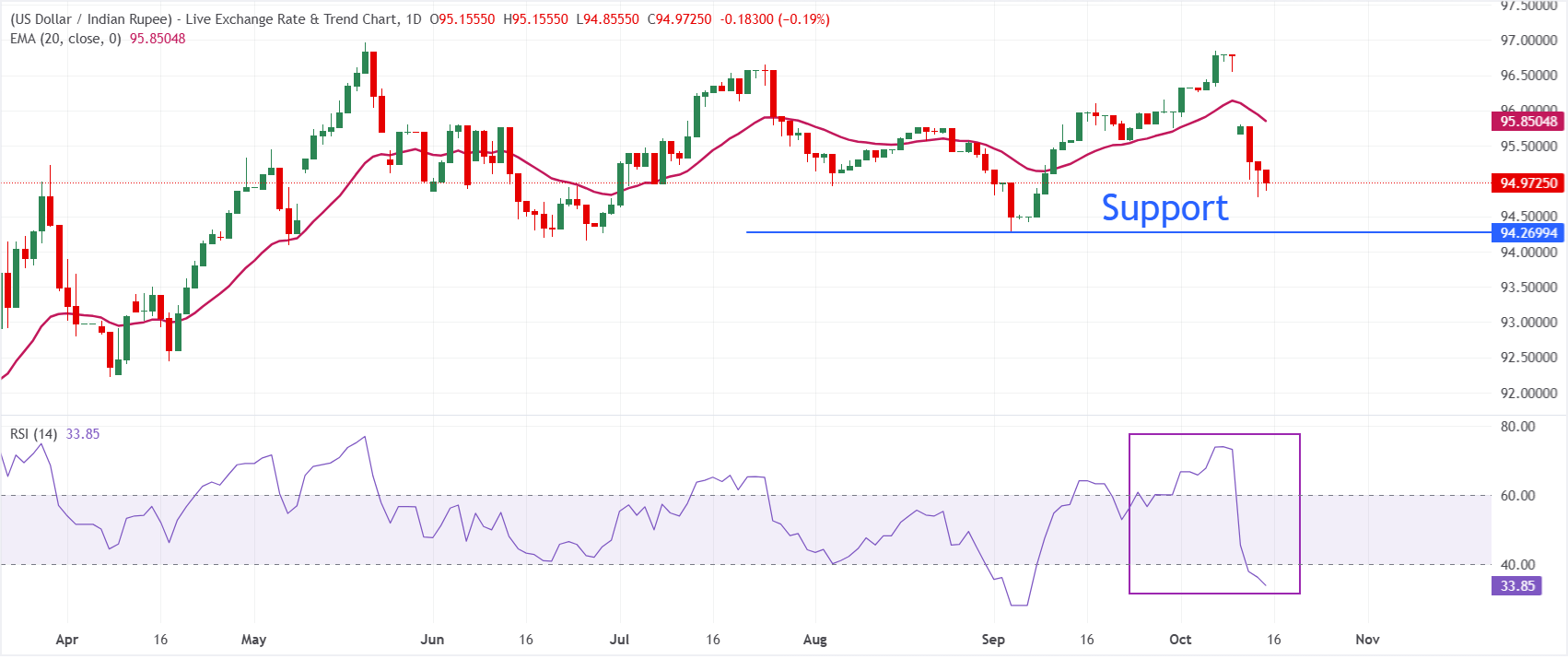
Technically, USD/INR trades near 94.97, below its 20-period exponential moving average (EMA) at 95.85, maintaining a bearish near-term structure. The exchange rate remains approximately 0.92% below the EMA, confirming that the moving average is acting as overhead resistance.
The Relative Strength Index (RSI) stands at 33.9, approaching the conventional oversold threshold of 30. This indicates substantial downside momentum, although proximity to oversold territory raises the possibility of a corrective rebound.
On the downside, 94.30 represents the key support level, corresponding to the September low. A sustained break below this level could reinforce bearish momentum. A recovery above 95.85 would weaken the immediate bearish bias and potentially open the way for a broader technical correction.
Conclusion
The INR’s strength against the USD reflects declining US Treasury yields, limited hawkish repricing following 3.7% headline CPI inflation, and RBI measures designed to moderate dollar demand.
With the DXY down 0.6%, the Fed rate-hike probability rising only 5 percentage points, and Indian retail inflation reaching 5.54%, domestic monetary tightening expectations may provide additional currency support.
Technically, 94.30 remains critical support, while 95.85 defines initial resistance. The next directional move will depend on US inflation persistence, Fed policy pricing, RBI intervention, crude oil prices, and international capital flows.