
The Indian Rupee (INR) opened weaker against the US Dollar (USD) on Wednesday, ending a three-session winning streak as renewed strength in crude oil prices triggered selling pressure on the domestic currency. This article features Vaulltier’s brokers’ insights into the key aspects of this topic.
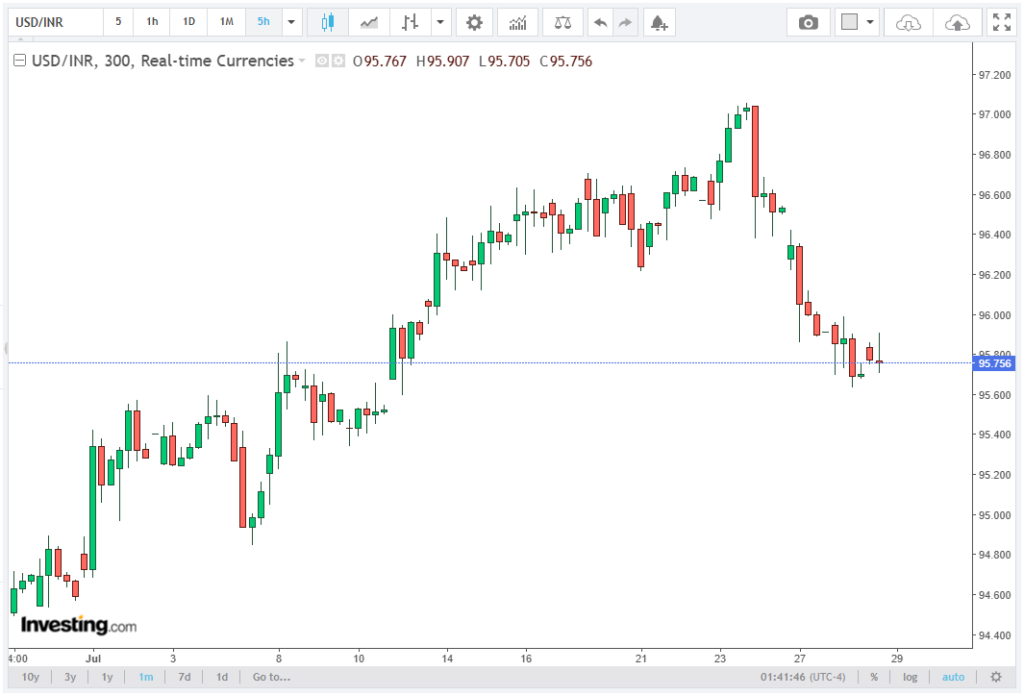
The USD/INR exchange rate moved higher toward 95.85, reflecting a recovery in the Dollar and increased concerns over India’s external balance due to rising energy costs.
The rebound in oil prices remains a key negative factor for the Rupee because India imports approximately 85% of its crude oil requirements. A sustained increase in global energy prices can raise the country’s import bill, increase demand for foreign currency, and place pressure on foreign exchange reserves.
Higher crude prices also create risks for inflation, current account dynamics, and overall macroeconomic stability.
In domestic commodity markets, the MCX Crude Oil August 19 futures contract gained approximately 4.3% to near Rs. 7,930 after declining for three consecutive sessions. The sharp recovery in energy prices has reduced the upside momentum in the Rupee and provided support to the USD/INR pair.
Geopolitical Risks Drive Sharp Recovery in Crude Oil Prices
The latest move higher in crude oil futures has been driven by renewed Middle East supply concerns and uncertainty surrounding energy transportation routes. Market participants are closely monitoring developments around the Strait of Hormuz, a critical shipping channel responsible for nearly 20% of global energy flows.
Reports of military actions targeting Iran-backed groups have increased fears of escalation. Prolonged disruption around the Strait could tighten global supply conditions, supporting Brent crude prices and raising pressure on oil-importing economies.
Federal Reserve Decision Remains the Main Dollar Catalyst
The primary global market event this week is the upcoming Federal Reserve monetary policy decision, scheduled for 18:00 GMT. Currency traders are closely watching the announcement for signals regarding the future path of US interest rates and the direction of the US Dollar Index (DXY).
Market pricing from the CME FedWatch Tool indicates a 69.5% probability that the Federal Reserve will keep rates unchanged in the 3.50%–3.75% target range. A continuation of the current policy stance would mark the fifth consecutive meeting without a rate adjustment.
The absence of significant policy guidance could increase market sensitivity to upcoming inflation data, employment indicators, and economic growth figures. A stronger-than-expected US economic outlook could support the Dollar, while weaker data may increase expectations of future monetary easing.
Ahead of the announcement, the US Dollar Index (DXY) traded 0.13% lower near 101.25, indicating mild Dollar weakness against major currencies. However, volatility could increase sharply after the Fed decision as investors reassess rate expectations.
Indian Equities Could Attract Foreign Capital Flows
The sharp decline in the South Korean KOSPI index, triggered by weakness in major semiconductor stocks, may create a favorable setup for Indian equities. Global investors previously increased exposure to South Korea and Taiwan due to strong demand for Artificial Intelligence (AI) and semiconductor-related assets.
A correction in Asian technology markets could encourage portfolio reallocation toward Indian equities, potentially improving Foreign Institutional Investor (FII) inflows. Stronger foreign capital participation would support domestic stock markets and could provide additional support for the Indian Rupee.
USD/INR Technical Analysis: Resistance Near 95.89 Limits Upside
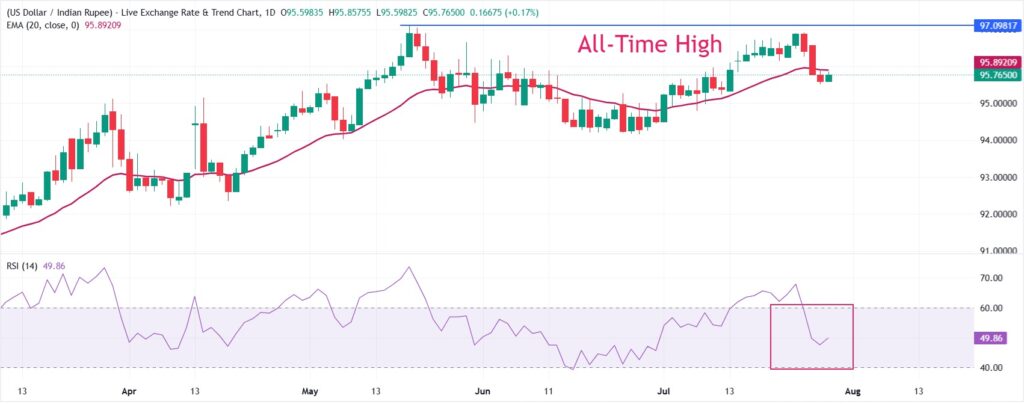
From a technical perspective, the USD/INR pair trades near 95.85, maintaining a slightly bearish short-term structure as it remains below the 20-day Exponential Moving Average (EMA) at 95.8921.
The failure to sustain gains above the 20-day EMA indicates that sellers continue to defend the 95.89 resistance zone. A decisive daily close above this level would improve the short-term outlook and potentially open the path toward the previous all-time high at 97.10.
Momentum indicators remain neutral. The Relative Strength Index (RSI 14) is positioned near 50, suggesting that buying and selling pressure are currently balanced. The indicator does not confirm a strong bullish reversal or a significant bearish breakdown.
On the downside, 95.51 represents the immediate support level based on Tuesday’s low. A break below this zone could accelerate selling pressure and expose the pair toward the next psychological support at 95.00.
Outlook: Rupee Focused on Oil, Fed Policy, and Foreign Flows
The near-term direction of the Indian Rupee will depend on three major drivers: crude oil volatility, Federal Reserve policy expectations, and foreign investment flows into Indian markets.
A continued rise in oil prices could keep the USD/INR pair supported, while stronger foreign inflows into Indian equities could provide a counterbalance. The Fed decision remains the next major catalyst, with traders watching for changes in interest-rate expectations and Dollar momentum.
For now, the Rupee’s recovery has paused as higher energy prices and geopolitical uncertainty weigh on sentiment, leaving 95.89 as the key technical level for the next directional move.