
Gold (XAU/USD) continues to trade in a bearish consolidation phase after declining to a two-week low, while remaining supported above the critical $4,000 psychological level. The metal has entered a period of reduced volatility as investors refrain from establishing significant directional positions ahead of the Federal Open Market Committee (FOMC) decision.
The outcome of the meeting, together with the updated interest rate guidance, is expected to determine the next directional move across precious metals, the US Dollar (USD), and US Treasury yields. Vaulltier’s brokers explore this topic in greater detail throughout this article.
A modest decline in the US Dollar Index (DXY) has provided limited support for bullion during the European session. However, expectations that the Federal Reserve could maintain a restrictive monetary policy continue to limit upside potential for the non-yielding asset, particularly as inflation expectations remain elevated.
Geopolitical Risks and Energy Markets Increase Inflation Expectations
Market sentiment remains influenced by escalating geopolitical tensions across the Middle East, where renewed military activity has increased concerns over regional stability. Although safe-haven demand has provided a degree of support for gold prices, the broader macroeconomic impact has been more favorable for the US Dollar.
The latest developments have also triggered a sharp recovery in crude oil prices, reversing losses recorded earlier in the week. Growing concerns surrounding the security of energy transportation routes, particularly near the Strait of Hormuz, have revived fears of supply disruptions.
As approximately 20% of global oil consumption passes through the strategic waterway, any escalation significantly increases energy market volatility.
Higher WTI and Brent crude prices directly contribute to stronger inflation expectations, increasing the probability that the Federal Reserve will maintain higher policy rates for longer.
Consequently, market participants have reduced expectations for near-term monetary easing, providing additional support for the USD while limiting demand for gold.
FOMC Decision Remains the Primary Market Catalyst
Attention now turns entirely toward the upcoming FOMC statement, where investors will closely evaluate the federal funds rate, updated economic projections, and any changes in forward guidance regarding future policy decisions.
Should policymakers maintain a hawkish stance, expectations for elevated real interest rates would likely strengthen the US Dollar and increase Treasury yields, both of which typically exert downward pressure on gold prices.
Conversely, any indication that inflation risks are moderating or that policy normalization may begin sooner than expected could weaken the dollar and improve the outlook for XAU/USD.
Until the announcement is released, market activity is expected to remain subdued, with trading volumes declining as investors avoid aggressive positioning ahead of a major macroeconomic event.
Technical Analysis Signals Continued Bearish Structure
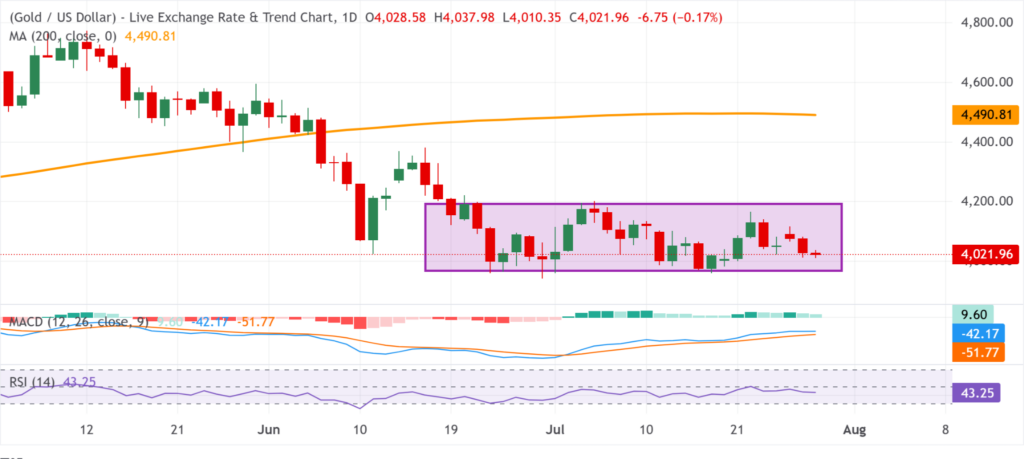
From a technical perspective, XAU/USD continues to trade within a well-defined consolidation range following the recent breakdown below a major 200-day Simple Moving Average (SMA). The inability to recover above this long-term trend indicator reinforces the broader bearish market structure, despite the recent stabilization above $4,000.
Momentum indicators continue to reflect limited buying pressure. The Relative Strength Index (RSI) remains near 43, indicating negative momentum without entering oversold territory below 30.
Meanwhile, the Moving Average Convergence Divergence (MACD) has started to flatten after an extended decline, suggesting that bearish momentum is easing but has not yet reversed.
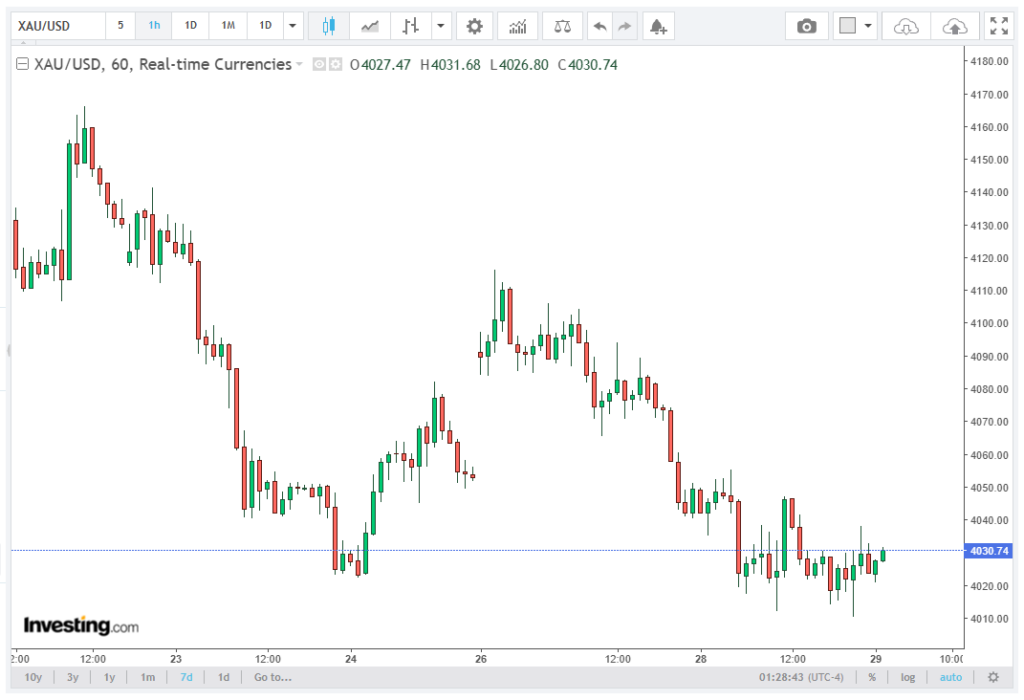
The first resistance is located near $4,050, where previous intraday selling pressure has emerged. A sustained move above this level would expose the upper boundary of the current range around $4,200. However, a confirmed daily close above $4,200 would be required to invalidate the current bearish bias and shift focus toward the 200-day SMA at $4,493.65.
Support Levels Remain Critical for Near-Term Direction
On the downside, immediate support remains positioned at the $4,000 psychological threshold. A decisive break below this level would expose the next technical support around $3,965, representing the lower boundary of the current consolidation channel.
Failure to defend $3,965 could accelerate downside momentum and encourage additional technical selling, potentially extending the broader corrective move. Conversely, continued buying interest above $4,000 would reinforce the ongoing consolidation pattern while markets await stronger macroeconomic catalysts.
Outlook
The short-term outlook for gold remains dependent on the interaction between monetary policy expectations, US Dollar performance, real yields, and geopolitical developments.
While elevated geopolitical risk continues to generate intermittent safe-haven demand, stronger oil prices, rising inflation expectations, and the possibility of higher-for-longer interest rates continue to favor the USD over bullion.
Unless the FOMC delivers a materially dovish surprise, the prevailing technical structure suggests that XAU/USD could remain under pressure, with $4,000 serving as the key support level and $4,050–$4,200 defining the primary resistance zone in the near term.