
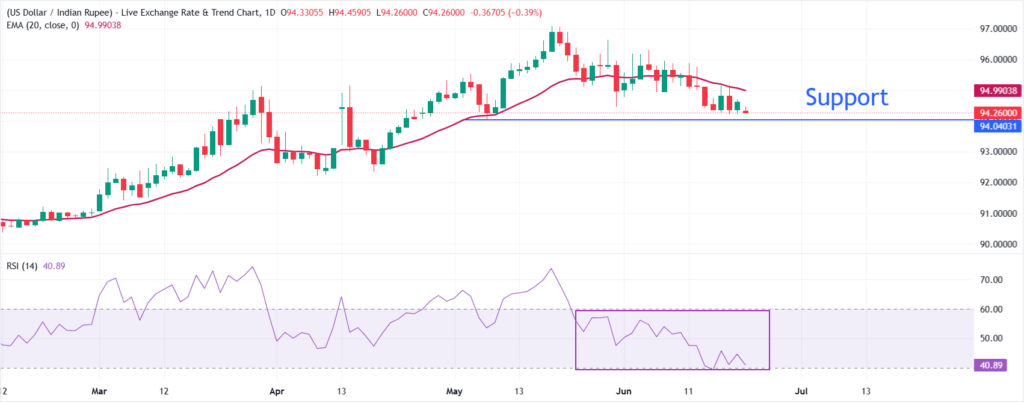
The Indian Rupee (INR) continues to trade with a firm bias against the US Dollar (USD) in early Monday sessions, with the USD/INR pair stabilizing near 94.25, close to its multi-week low at 94.03.
The move reflects a convergence of declining crude oil prices, shifting geopolitical risk premiums, and evolving expectations around global interest rate trajectories. For a closer look at the trends, risks, and opportunities surrounding this issue, see this article by Fonndure’s brokers.
The near-term price action indicates a corrective USD downtrend structure, with spot trading significantly below the 20-day Exponential Moving Average (EMA) at 94.99, reinforcing sustained bearish momentum in USD/INR.
Crude Oil Correction Reinforces INR External Stability
A key macro driver behind INR resilience is the continued weakness in global crude benchmarks. The MCX Crude Oil July contract declined approximately 1.25% to 7,171, extending a broader corrective phase from recent highs.
From a macro-structural perspective, India’s import dependency on crude oil exceeding 85% makes the currency highly sensitive to energy price cycles. The current oil downtrend improves multiple external variables:
Lower crude prices reduce the import bill, compressing USD demand in the spot FX market, while simultaneously improving the current account deficit trajectory. This also reduces imported inflation pressure, indirectly stabilizing real yield expectations within the domestic bond market.
Historically, a $5–10 per barrel decline in Brent crude equivalents tends to translate into measurable INR appreciation pressure of 15–40 paise over short-term FX cycles, depending on capital flow conditions.
Foreign Flows Strengthen INR Demand Function
Foreign Institutional Investor (FII) activity has turned decisively positive, with net inflows into Indian equities reaching approximately ₹4,859 crore in a single session, marking one of the strongest daily inflow readings in recent months.
From a balance-of-payments perspective, such inflows directly increase INR liquidity demand, as foreign capital conversion into rupees strengthens spot FX supply absorption dynamics.
This shift coincides with a broader risk-on rotation across Asian equity markets, supported by stabilizing commodity prices and improved global liquidity expectations. Sustained inflows at this magnitude typically correlate with short-term INR appreciation bias of 0.3%–0.8% over multi-session windows, depending on Dollar Index volatility.
US Dollar Supported by Aggressive Fed Repricing
Despite INR strength, the US Dollar Index (DXY) remains structurally supported, trading near 100.90, reflecting a modest 0.15% daily gain.
The key macro driver is a sharp repricing of Federal Reserve rate expectations. Market-implied probabilities now indicate a 58.5% likelihood of at least two additional rate hikes within the year, a dramatic increase from 17.1% observed just one week prior.
This repricing is driven by updated policy dot-plot distributions, where nearly 9 out of 19 policymakers signal additional tightening requirements. This shift has led to a rise in US real yields, strengthening Dollar demand through interest rate differentials.
Technical Structure: Bearish USD/INR Momentum Intact
From a technical analysis perspective, USD/INR continues to exhibit a bearish corrective structure. Price action remains consistently below the 20-day EMA at 94.99, confirming medium-term downtrend integrity.
Momentum indicators further reinforce this structure. The Relative Strength Index (RSI) is positioned near 40, indicating sub-neutral momentum with downside bias, but not yet entering oversold territory, typically defined below 30.
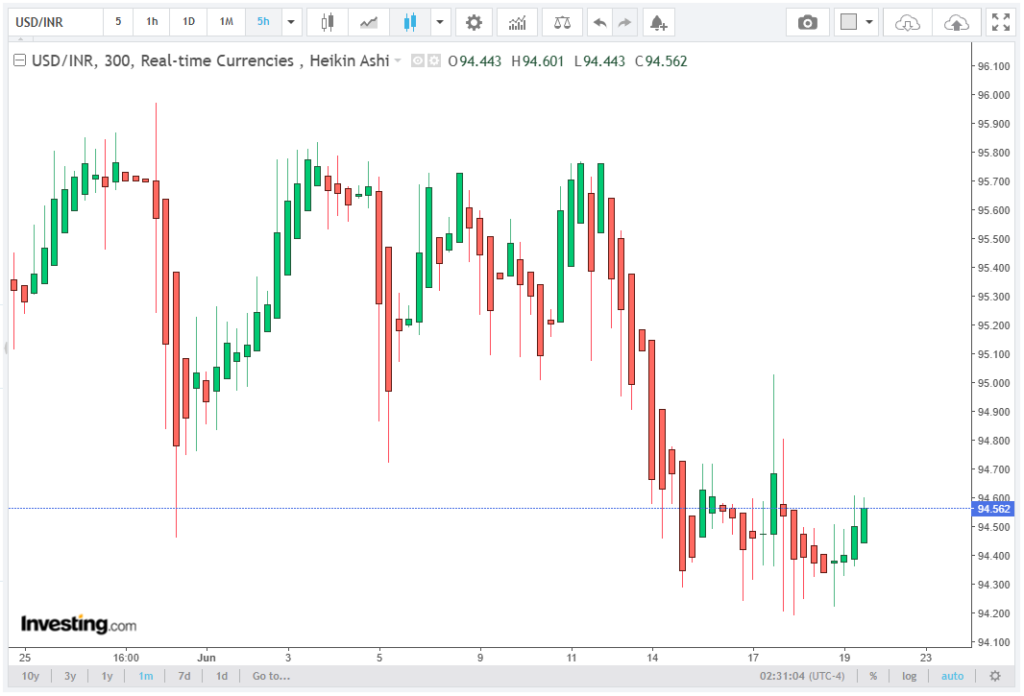
Immediate support is located at 94.03, representing the recent swing low and critical liquidity zone. A decisive breakdown below this level increases the probability of extension toward 93.00, which aligns with a broader fib-based retracement cluster and historical demand zone.
On the upside, resistance remains anchored at 94.99, corresponding to the 20-day EMA, followed by a stronger structural ceiling near 95.76, representing the June 12 swing high. A breakout above this level would indicate a potential trend reversal into a consolidation or bullish retracement phase.
Volatility compression in recent sessions suggests the pair is coiling within a tight 90–120 pip intraday range structure, typically preceding directional expansion phases.
Outlook: INR Stability Driven by External Balance Convergence
The near-term outlook for USD/INR remains shaped by a multi-factor equilibrium involving oil prices, capital flows, and US yield dynamics.
The Rupee benefits from a rare alignment of:
Crude oil deflationary pressure, which reduces external imbalance risk, combined with strong equity inflows exceeding ₹4,000–5,000 crore per session, and a geopolitical risk premium compression cycle.
Against this, the primary counterweight remains a structurally firm US Dollar supported by elevated real yields and increased probability of additional Fed tightening cycles approaching 58.5% implied probability levels.
This creates a range-bound to mildly bearish USD/INR regime, with directional bias skewed lower unless USD strength accelerates beyond current DXY resistance near the 101–102 zone.
Overall, the INR remains supported by macro external balance improvement, favorable commodity dynamics, and sustained foreign inflows, while USD strength acts as a moderating force rather than a dominant trend driver in the current pricing structure.