
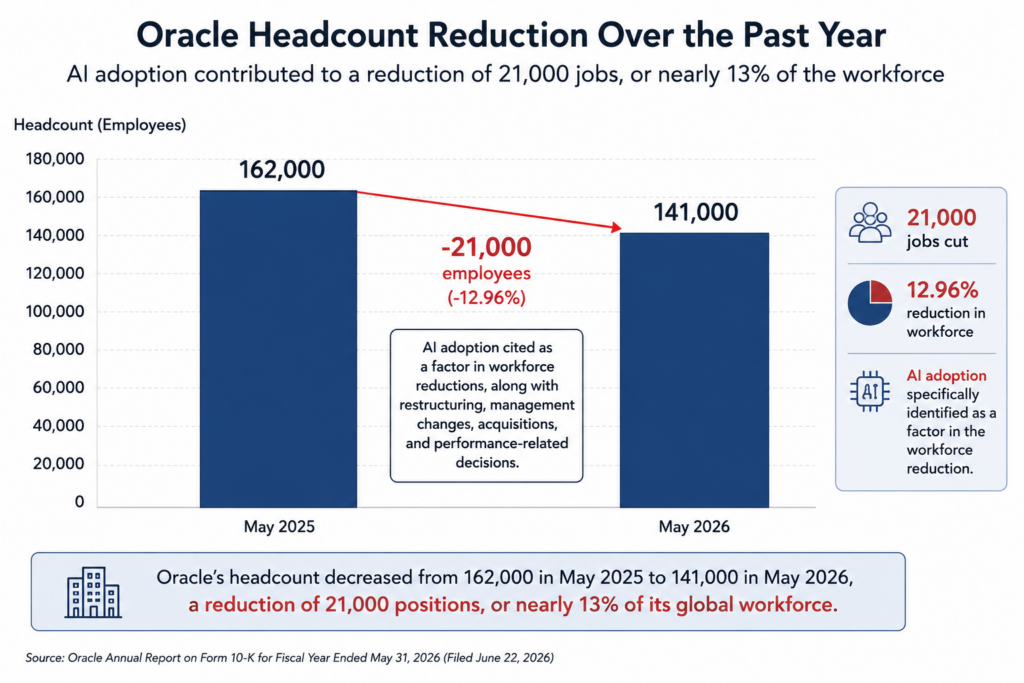
Oracle has provided one of the clearest examples yet of how artificial intelligence is reshaping corporate workforces. In its annual regulatory filing submitted on June 22, 2026, the company disclosed that AI adoption played a direct role in the elimination of approximately 21,000 jobs, representing nearly 13% of its global workforce over the past fiscal year.
According to Findtech Group‘s technology research team, the disclosure offers a rare look at the measurable impact AI is already having on large organizations. Beyond Oracle itself, the filing may serve as an important indicator of how companies across the technology sector are increasingly using automation and AI-driven efficiencies to streamline operations, reduce costs, and reshape workforce requirements.
The Numbers Behind the Cuts
Oracle’s headcount fell from roughly 162,000 employees in May 2025 to about 141,000 by the end of May 2026, a reduction of 21,000 positions. The company pointed to several overlapping causes, including restructuring, management changes, acquisitions, and performance-related decisions, but it specifically called out AI adoption as a factor behind the workforce reduction, a notable departure from the vaguer language most companies use.
AI Gets Named in the Filing, Not Just the Earnings Call
What makes this disclosure particularly significant is not simply the 21,000 job reductions, but the fact that Oracle explicitly linked those cuts to AI adoption in an official regulatory filing.
Unlike comments made during earnings calls or investor presentations, statements contained in regulatory filings carry greater legal and disclosure obligations, making this one of the clearest acknowledgments by a major technology company that artificial intelligence is directly affecting workforce levels, not merely improving employee productivity.
Oracle also indicated that additional workforce reductions could occur as AI becomes more deeply integrated across its business. That language suggests the company views AI-driven efficiency gains as an ongoing transformation rather than a one-time restructuring effort, reinforcing the idea that automation may continue to reshape staffing needs across the technology sector in the years ahead.
The Cost of Restructuring Is Climbing Fast
The financial cost of this transition has grown sharply. Oracle reported approximately $1.84 billion in severance and restructuring costs for fiscal 2026, compared with just $374 million the year before, nearly a fivefold increase. That’s a meaningful one-time hit to earnings, even for a company of Oracle’s size, and it underscores that workforce restructuring at this scale isn’t cost-free in the near term, even if it’s framed as a long-run efficiency gain.
Spending More on AI While Cutting Headcount
The cuts haven’t come with a pullback in AI investment. Quite the opposite: Oracle’s capital expenditures jumped 162% in fiscal 2026 to $55.7 billion, as the company pushes further into cloud infrastructure and AI data centers.
That combination, shrinking headcount alongside surging capex, captures the core tension running through this earnings season: companies are reallocating capital away from labor and toward compute, betting that AI infrastructure spending generates more value per dollar than the workforce it’s displacing.
Despite the disclosure, Oracle shares only slipped about 1% on Tuesday, though the stock is down more than 10% year-to-date, partly caught up in the broader tech selloff sparked by semiconductor weakness this week.
Part of a Much Bigger Pattern
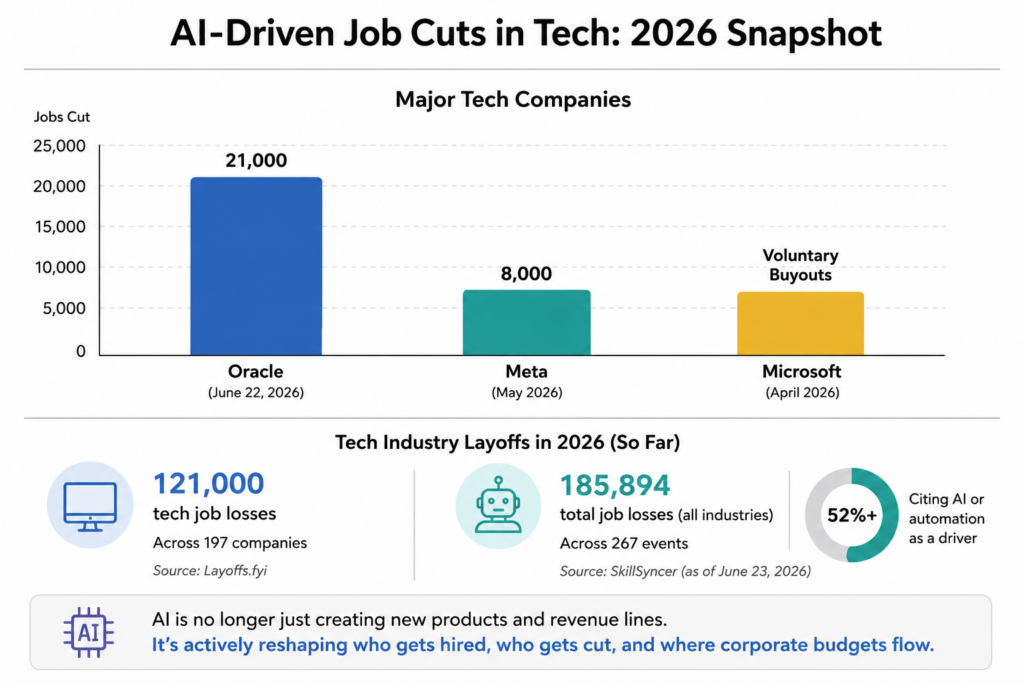
Oracle isn’t operating in isolation. Meta cut about 8,000 jobs, roughly 10% of its workforce, in May. Microsoft began offering voluntary buyouts to part of its US workforce in April.
Across the broader tech sector, tracking site Layoffs.fyi counted more than 121,000 technology job losses across 197 companies so far in 2026, while a separate tracker from SkillSyncer put cross-industry layoffs at 185,894 jobs across 267 events as of June 23, with more than half explicitly citing AI or automation as a driver.
The pattern is consistent: AI is no longer just generating new products and revenue lines for these companies. It’s actively reshaping who gets hired, who gets cut, and where corporate budgets flow.
What This Means for Investors
For investors, Oracle’s filing provides an important glimpse into how the AI investment cycle is unfolding within large corporations. Increasingly, companies are reporting substantial AI-related capital expenditures alongside workforce reductions, highlighting that automation and efficiency initiatives are becoming closely linked.
This trend carries two key implications. First, lower labor costs can support profit margins over time, although those benefits may initially be offset by restructuring expenses and transition costs.
Second, growing regulatory disclosure around AI-driven workforce changes could influence how both investors and regulators assess the broader impact of artificial intelligence on employment. As more companies provide similar transparency, AI’s effect on labor markets is likely to become an increasingly important theme during the second half of 2026.