
Gold (XAU/USD) extends losses into Tuesday, sliding to a near two-week low around $4,115, confirming continued bearish pressure across intraday and swing structures. The move reflects sustained rejection from the $4,300 to $4,320 supply zone, which has repeatedly capped upside attempts. Findtech Group’s experienced brokers examine this topic thoroughly in the following article.
Price action remains characterized by lower highs and lower lows on the H4 chart, which signals a clear downtrend continuation structure. Sellers remain in control as momentum accelerates on USD strength and weakening demand for non-yielding assets.
US Dollar Strength Near Multi-Month Highs
The US Dollar Index (DXY) remains firm near 105 to 106 levels, holding close to its strongest range in months. This reflects persistent rate differential support, strong real yield alignment, and ongoing safe-haven demand for USD liquidity.
Market pricing continues to reflect a higher-for-longer Fed policy path, with rate expectations implying roughly 15 to 25 basis points of additional tightening probability embedded in forward curves.
This environment maintains a structurally negative backdrop for gold because USD strength directly suppresses XAU/USD valuation through inverse correlation channels, while higher yields further reduce demand for non-yielding assets.
Monetary Policy Outlook Keeps USD Bid Intact
The dominant macro driver remains US monetary policy expectations, where inflation remains above target and sticky across core components.
Current estimates place inflation dynamics near 3.0 to 3.5 percent year over year, which is significantly above the 2 percent Fed target, reinforcing expectations that policy will remain restrictive for longer.
Market pricing now reflects a higher probability of at least one additional rate hike cycle within 2025, reduced expectations for near-term easing with cut probability below 20 percent, and sustained elevated policy rates supporting higher US real yields.
Rising real yields increase the opportunity cost of holding gold because it does not generate yield, which reinforces structural headwinds for XAU/USD.
Intermarket Dynamics: Real Yields and USD Correlation Pressure
Gold continues to exhibit strong inverse relationships with both the US Dollar Index (DXY) and US real yields.
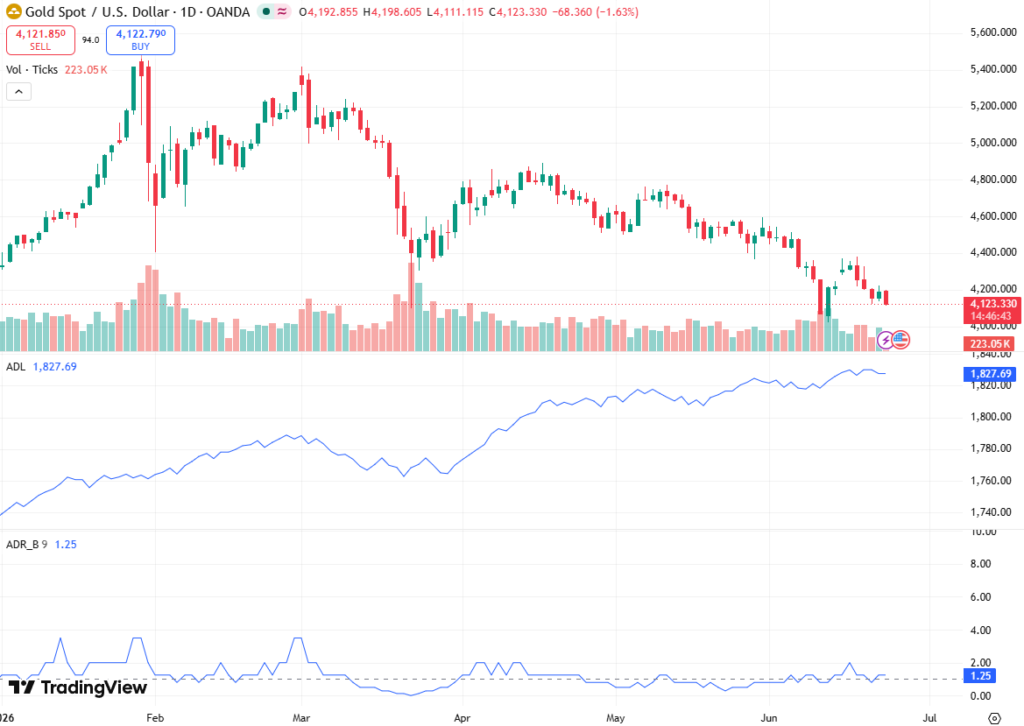
Key correlations remain tightly aligned, with XAU/USD vs DXY near the -0.70 to -0.80 range, and XAU/USD vs US 10-year real yields near the -0.75 to -0.85 range.
With real yields holding near 2.0 to 2.3 percent, gold remains under pressure because valuation models discount non-yielding assets more heavily in high real rate environments, limiting recovery potential.
At the same time, this sensitivity to real yields means that even modest declines in inflation-adjusted rates could act as a meaningful catalyst for price stabilization or rebound. Market positioning and central bank demand also remain important offsetting factors that can occasionally weaken the strength of these statistical relationships.
Short-Term Catalysts: PMIs and PCE Inflation
Market participants are focused on upcoming US flash PMI data, which will provide insight into near-term economic momentum across manufacturing and services sectors.
Readings above the 50 expansion threshold would likely reinforce USD strength and rate hike expectations, while weaker data below 50 could trigger temporary relief in gold.
However, the primary catalyst remains the PCE inflation index, the Fed’s preferred inflation gauge. A stronger monthly print above 0.3 percent core PCE would reinforce hawkish expectations and extend USD upside pressure. Softer readings could support short-term stabilization in gold but are unlikely to shift the broader trend unless sustained.
Technical Structure: Bearish Momentum Below Key Resistance
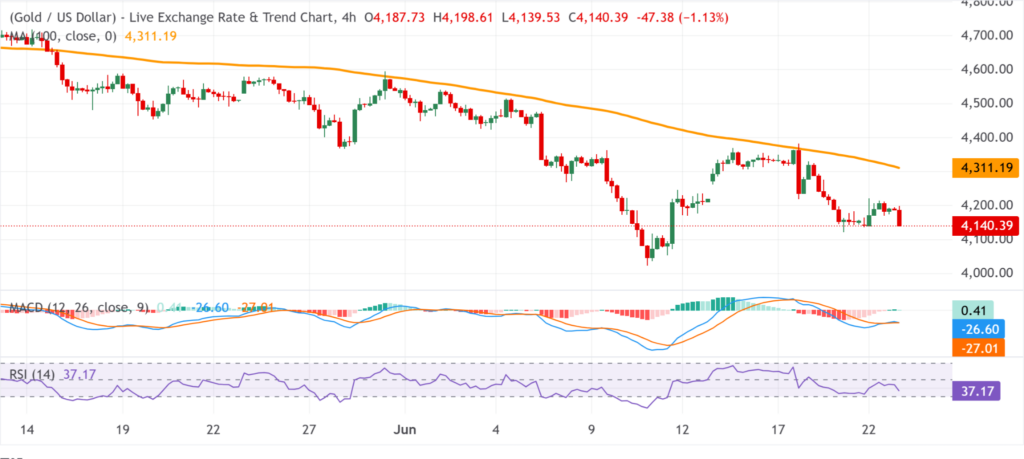
From a technical standpoint, XAU/USD remains firmly bearish on the H4 timeframe, trading below the 100-period Simple Moving Average (SMA) at approximately $4,311.19.
This level continues to act as a strong dynamic resistance zone, aligning with previous rejection points and reinforcing a distribution structure rather than accumulation.
Momentum indicators show mixed but still bearish conditions. The MACD (12, 26, 9) is flattening near the zero line, suggesting early signs of bearish exhaustion but without confirmation of a reversal. The Relative Strength Index (RSI) at 37.17 remains below neutral, confirming that momentum still favors sellers and that any rebounds are likely corrective.
Price structure continues to reflect a descending channel formation, with immediate downside interest concentrated near $4,100, followed by deeper support zones around $4,050 to $4,020.
Outlook: Downside Bias Remains Dominant Below $4,311
Overall conditions continue to favor a bearish regime for gold, driven by a combination of USD strength, elevated real yields, and sustained hawkish Fed expectations.
Unless price action reclaims and holds above the $4,311 resistance level, the broader bias remains tilted toward further downside extension. Short-term rebounds are likely to remain corrective within a broader bearish structure, with macro conditions still favoring USD over gold in the current cycle.