
US stock futures slipped into mixed territory on June 22, 2026, with the S&P 500 slightly lower ahead of a week packed with inflation data and major earnings reports. But one stock cut through the uncertainty entirely.
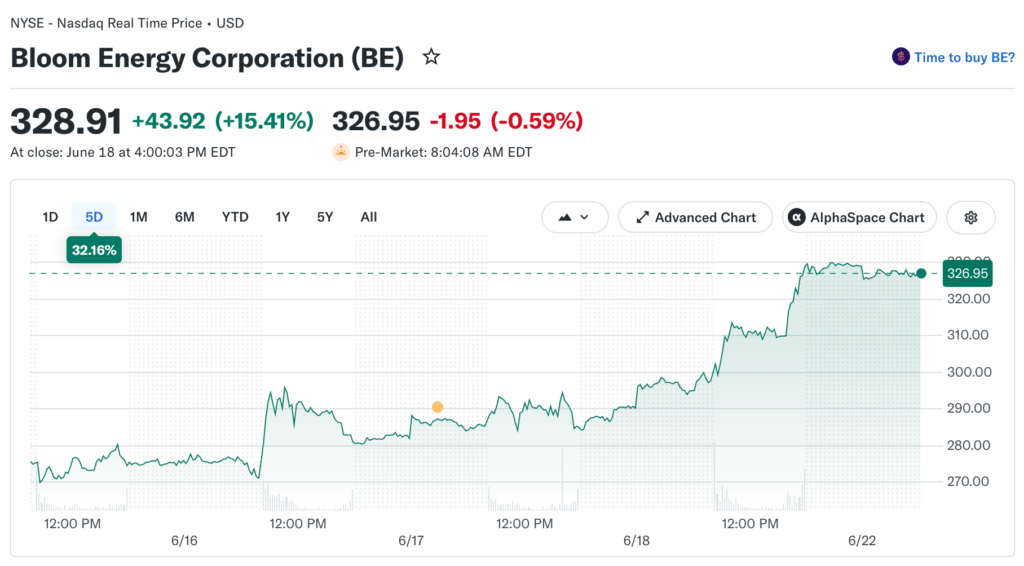
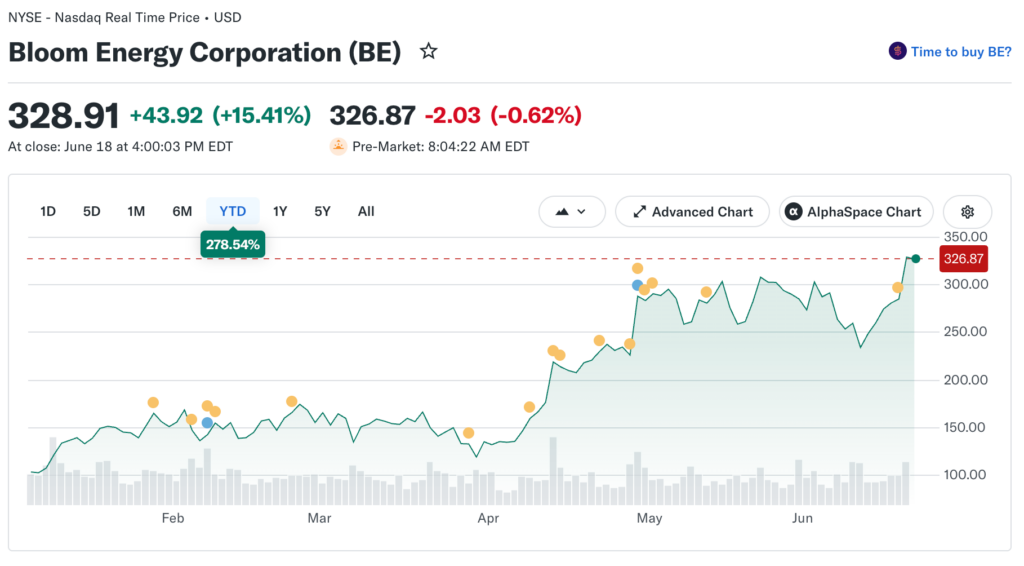
Bloom Energy (BE) surged 15.41% after the Federal Energy Regulatory Commission announced expedited data center power approval timelines, adding another chapter to a run that has already delivered over 1,216% in twelve months. A senior financial analyst at Bankolla says what is happening with BE stock is not simply a rally but a structural repricing of how markets value decentralized power generation in the AI era.
Why FERC’s Announcement Changed the Math for BE
The Federal Energy Regulatory Commission decision to accelerate power approval timelines for data centers removed one of the primary obstacles holding back fuel cell deployments at scale. Data centers need power fast, and traditional grid connection timelines can stretch beyond three years in congested regions.
Bloom Energy’s solid oxide fuel cell systems can be installed on-site in months rather than years, bypassing the grid connection queue entirely.
That regulatory shift is not a small tailwind. It is a fundamental competitive advantage that Bloom’s technology has always had over grid-dependent alternatives, but one that required a regulatory environment willing to reward it. The FERC decision made that advantage monetizable at a speed that analysts had not fully priced into the stock before June 18.
The Partnership Trail Behind the Price
Bloom Energy’s surge did not begin on June 22. It has been building on a foundation of concrete contracts that give the revenue trajectory unusual visibility for a company in the energy technology space.
A $2.65 billion partnership with American Electric Power announced earlier in 2026 provided a long-term contracted revenue anchor. A $2.6 billion partnership with a European AI infrastructure firm announced in May added international scale to what had previously been a predominantly US-focused business.
The company also secured a $5 billion AI infrastructure deal that analysts described as transforming Bloom’s revenue visibility profile entirely. That combination of AEP, the European AI partnership, and the $5 billion AI infrastructure contract means Bloom is no longer a speculative energy technology company.
What a 3.7 Beta Actually Means for Investors
Bloom Energy carries a beta of 3.7, meaning the stock tends to move roughly 3.7 times the magnitude of the broader market in either direction. On a day the S&P 500 gains 1%, BE might gain 3.7%. On a day the index drops 2%, BE could drop 7.4%. That volatility profile is essential context for any investor looking at the stock after a 1,216% twelve-month run.
The 52-week low of $21.41 and the 52-week high of $330.00 capture that range in plain numbers. Shares traded between $293.30 and $330.00 on June 21 alone.
The AI Data Center Demand Equation
Bloom Energy’s position in the AI infrastructure buildout is not accidental. The company’s fuel cell technology produces electricity through a non-combustion electrochemical process, which means lower emissions and quieter operation than diesel generators.
Data centers increasingly face environmental permitting constraints that make Bloom’s technology an attractive alternative to traditional backup and primary power sources.
The four major hyperscalers collectively committed approximately $750 billion in AI capital expenditure plans for 2026 and beyond. That spending has to be powered by something. Grid infrastructure in the US is not expanding fast enough to meet the load growth projections that large AI data center clusters require.
Analyst Caution After a 1,216% Run
Not every analyst is chasing the stock at current levels. The 1,216% twelve-month gain has prompted growing caution from analyst and retail investor communities that tracked the stock through its earlier phases.
UBS described the FERC development as a positive for Bloom in a note on June 18, but multiple firms noted the stock is now pricing in a significant portion of its long-term contract potential at current valuations.
The service business profit streak, which Bloom has maintained across recent quarters, provides some fundamental grounding for the valuation. But at a price near $330, the stock is pricing in continued contract wins, successful project delivery at scale, and a sustained AI data center spending environment without major interruption.
Any one of those assumptions failing to materialize creates downside risk that the 3.7 beta would amplify considerably from current levels.
Watching the Right Numbers Going Forward
Investors tracking Bloom Energy should focus on contracted backlog growth, service revenue margins, and any announcements tied to the AEP deployment timeline. Those metrics provide the clearest read on whether the business is converting its partnership pipeline into recognized revenue at the pace the current stock price implies.
The FERC approval tailwind is real and structural. Whether the stock can hold above $300 into the second half of 2026 depends on Bloom delivering at a pace that matches the contracts already on the books.