
The decentralized finance landscape is witnessing a sustained period of subdued participation within the primary smart-contract blockchain’s derivatives sector. Following a series of significant price corrections, leveraged market participants have largely retreated to the sidelines, creating a environment characterized by low directional conviction.
This structural fatigue is evident in the contraction of capital committed to futures contracts as traders await a decisive macro catalyst.
The total volume of unsettled derivative obligations has experienced a marked decline since the final week of May. Total capital locked in open futures positions for the leading programmable blockchain has dropped by approximately 2 million tokens, reflecting a widespread risk-off posture among leveraged participants.
This decline highlights a broader trend where retail and institutional liquidity providers are opting to preserve capital rather than commit to new directional positions.
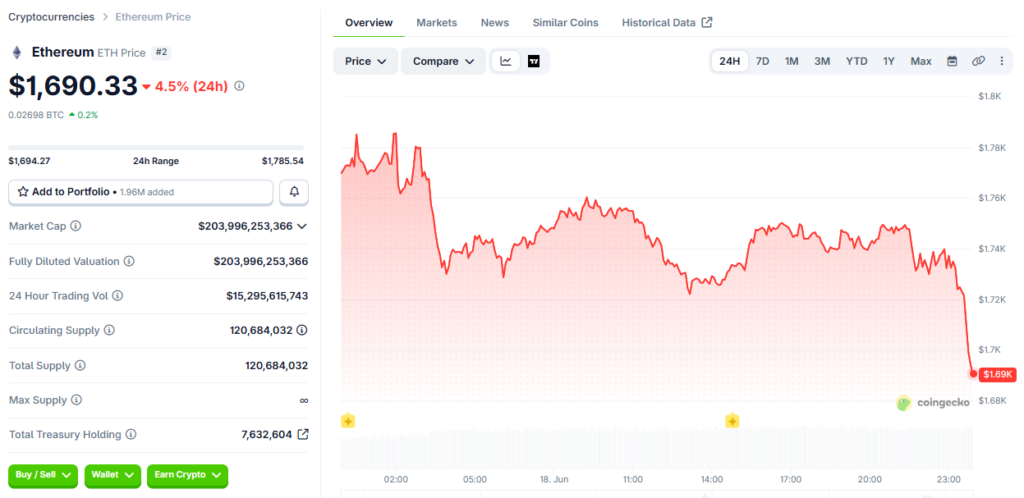
Market sentiment indicators provide further evidence of this inertia, as funding costs for perpetual contracts fluctuate narrowly without establishing a clear trend. Digital currency experts at Bankolla confirm that this lack of decisive positioning leaves the asset trading in a restricted range between $1,741 and $1,806.
Traders are currently struggling to overcome the gravitational pressure exerted by key technical moving averages, which continue to act as firm barriers to upside recovery.
Derivative Sentiment And The Mechanics Of Perpetual Funding
Periodic settlement payments, known as funding rates, are failing to signal a clear preference for either bullish or bearish outcomes. These payments are traditionally used to anchor the price of perpetual derivative instruments to their underlying spot market equivalents.
When these rates oscillate between positive and negative territory for extended periods, it indicates that neither long nor short participants possess the necessary volume to dictate market directionality.
The current sentiment reset follows a period of aggressive liquidations that occurred earlier in the month, forcing many participants to exit positions at a significant loss. Consequently, this cohort remains hesitant to re-enter the market, creating a persistent liquidity vacuum.
The lack of dominant bullish or bearish positioning is exacerbated by the fact that the majority of short-side traders have also migrated to the sidelines to secure realized profits, leaving the market without a clear catalyst.
Spot Market Dynamics And The Influence Of Institutional Capital
While derivative sentiment remains stagnant, spot market reserves have shown only modest fluctuations, offering little insight into future price discovery. Recent data regarding institutional exchange-traded funds revealed a secondary sequence of net capital inflows totaling approximately $9.6 million, yet this activity has failed to trigger a broader recovery.
Such low-conviction flows suggest that institutional allocators are currently prioritizing capital preservation over aggressive accumulation strategies.
This lack of momentum is further validated by the broader absence of retail enthusiasm, which typically acts as a force multiplier during periods of price volatility. The combination of subdued spot exchange reserves and lukewarm institutional fund performance suggests that both investor segments remain largely unconvinced by the current market landscape.
Without a significant shift in external macroeconomic conditions or specific blockchain developments, this state of neutrality is expected to persist.
Technical Analysis And Moving Average Barriers
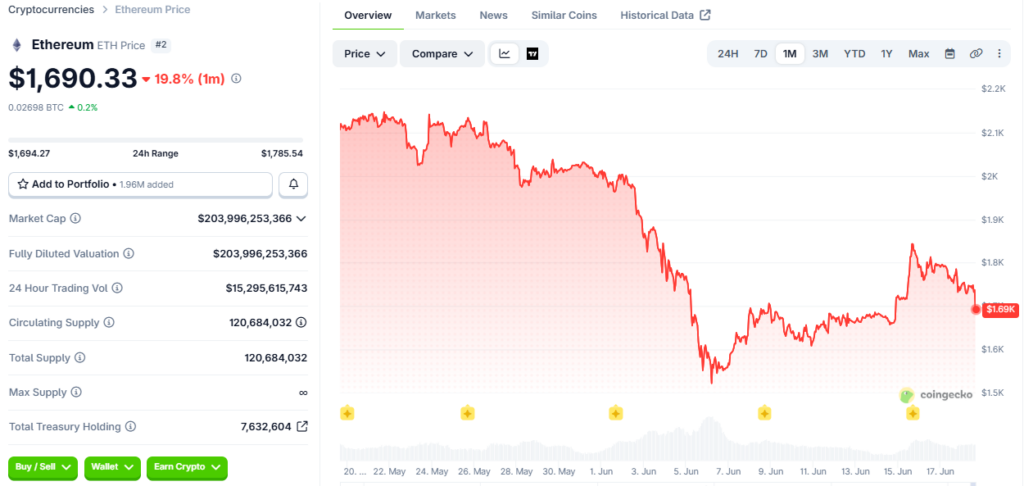
On a daily price chart, the asset continues to display a bearish bias as the price remains capped beneath major short-term and intermediate-term indicators. The 20-day, 50-day, and 100-day Exponential Moving Averages are currently clustered tightly within the $1,794 to $2,109 price band, creating a formidable ceiling for any attempted rallies.
This dense configuration of resistance levels suggests that any near-term upside will face significant overhead supply.
While internal oscillators like the Relative Strength Index (RSI) are showing signs of recovering toward the mid-40s, this shift indicates only a fading of downward momentum rather than a confirmed reversal of the existing trend. The Stochastic Oscillator has entered overbought territory, further signaling that the market is struggling to build sufficient volume to sustain a meaningful break above current resistance.
Traders remain focused on the critical $1,794 pivot point as the primary indicator for a potential shift in momentum.
Risk Management And Support Thresholds
The immediate downside floor is positioned at $1,741, a level that has served as a psychological pivot for recent price action. Should market participants fail to maintain support at this threshold, the next significant zones of liquidity are located at $1,524 and $1,405. A breach of these supports would likely accelerate technical selling, potentially exposing a major historical floor situated near $1,156.
Given the current structural weakness in derivative participation, market participants are advised to maintain a strict risk-management framework.
The combination of capped rallies and significant downside sensitivity suggests that the asset will continue to experience high-frequency, low-conviction price noise until a major catalyst forces a break from the current range. Until the price can successfully stabilize above the 20-day average, tactical allocators are keeping exposure levels low.