
SpaceX priced its IPO at $135 per share on June 12, 2026, raised $75 billion in the largest public offering in American history, and then kept climbing through the following week.
By June 16, shares were trading near $213, pushing the company’s market capitalization above $2.65 trillion and leapfrogging Amazon entirely. Senior brokers at Nummixo share what the SPCX post-IPO surge reveals about market mechanics, forced index buying, and where this rally meets real structural limits.
The Opening Week by the Numbers
The numbers from SpaceX’s first trading week are difficult to process at a normal pace. Shares closed day one at $160.95, a 19% jump from the IPO price, immediately giving the company a market cap near $2.1 trillion. That placed SPCX above Broadcom and several other established technology names before a single quarterly earnings report had been filed as a public company.
Day two brought another 20% advance with no major news catalyst driving the move. By Tuesday June 16, the stock touched an intraday high of $225.64, briefly pushing its implied valuation above $3 trillion and leapfrogging both Amazon and Microsoft simultaneously during after-hours trading.
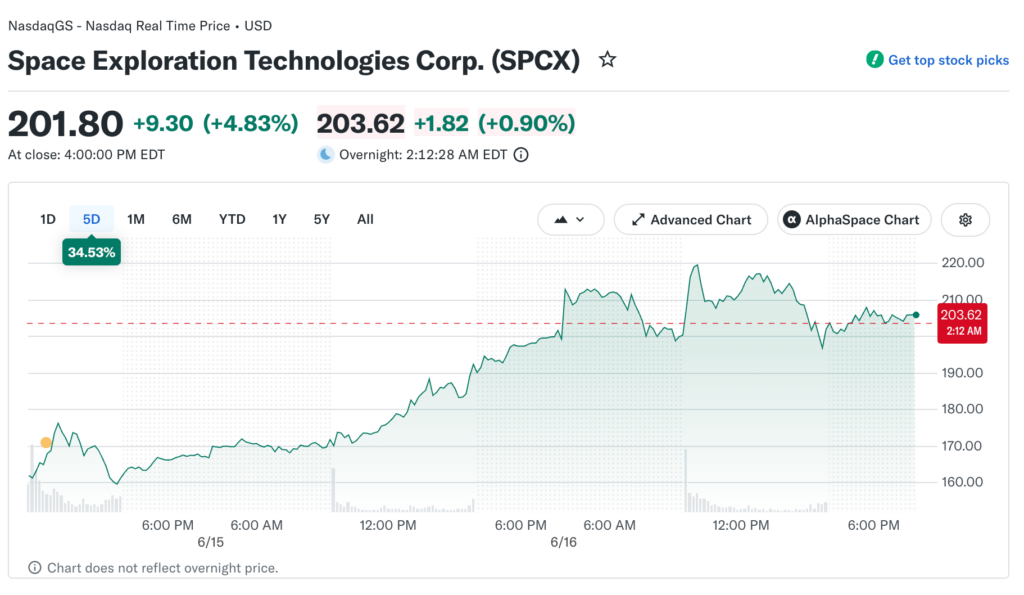
Underwriters exercised the greenshoe overallotment option on June 15, lifting total IPO proceeds to $85.7 billion. That greenshoe signal tells you institutional demand was genuine enough to absorb additional supply without cracking the price floor established at the IPO.
Business Lines Behind the Valuation
SpaceX operates across genuinely distinct and complementary revenue streams that go well beyond the rocket launch business most investors associate with the name.
The reusable rocket operation cuts launch costs in ways no competitor has matched at scale, while Starlink generates recurring subscription revenue from millions of global users across underserved markets.
The AI dimension arrived with the announcement that SpaceX would acquire Anysphere for $60 billion, the parent company of Cursor, a widely used AI-powered coding tool. That acquisition repositions SpaceX at the intersection of space infrastructure and artificial intelligence, two of the most aggressively valued themes in public markets right now.
Over $1.16 billion in SPCX shares exchanged hands in a single morning premarket session on June 16, several times the combined volume of Apple, Microsoft, and Nvidia trading simultaneously. That level of activity reflects liquidity chasing momentum, which creates its own self-reinforcing price feedback loop in early post-IPO trading.
The Options Market Accelerant
Listed options on SPCX began trading on June 16, just two trading days after the IPO itself. When derivative markets open on a newly public stock, market makers who sell call options must buy underlying shares to hedge their exposure, and that mechanical buying adds consistent fuel to an already rising stock.
When retail investors pile into out-of-the-money calls, it forces even more hedging activity higher, pushing the stock price up regardless of any fundamental development on any given day. This structural dynamic explains a meaningful portion of why the rally moved faster than traditional fundamental analysis would predict.
It does not invalidate the long-term business case, but it does mean the pace of the price move is partly a mechanical artifact rather than purely earnings-driven conviction. Investors should hold both truths simultaneously when evaluating the current SPCX price.
Index Inclusion and the Forced Buying Wave
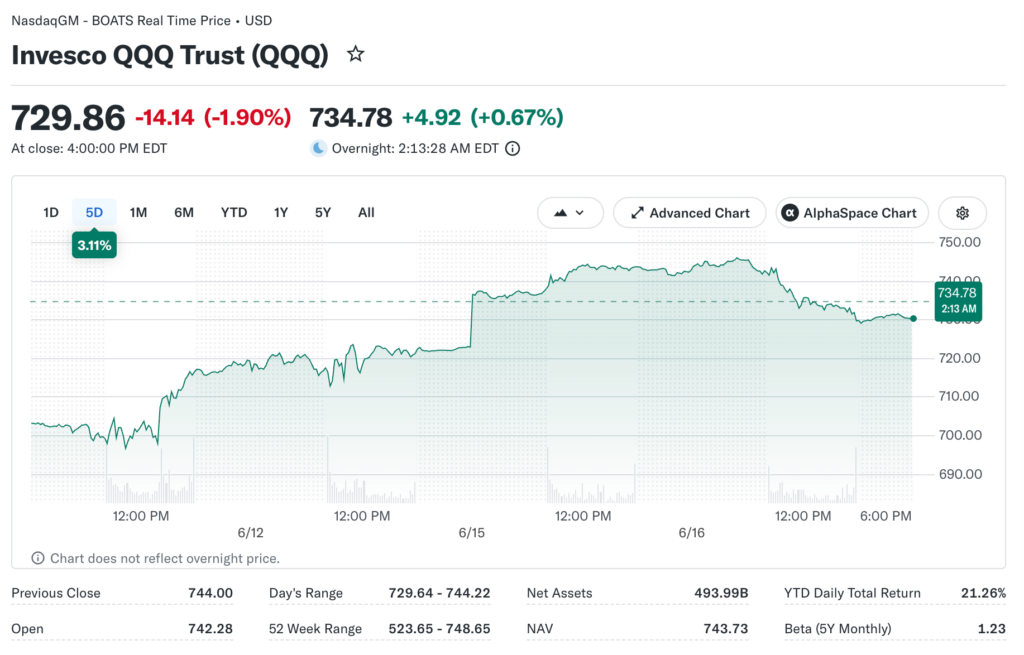
Nasdaq agreed to fast-track SpaceX into the Nasdaq-100, with inclusion expected roughly 15 trading days after IPO, placing the event around early July 2026. That timing forces passive index funds tracking QQQ to sell existing holdings like Apple, Microsoft, and Nvidia to make room for the new entrant.
Bloomberg Intelligence estimated roughly $14 billion in forced passive buying tied to Nasdaq-100 inclusion alone, a wave of mechanical demand that arrives regardless of any investor’s individual view on the company’s valuation or business prospects.
The S&P 500 committee declined to relax its standard eligibility rules, as SpaceX reported a $4.94 billion net loss in 2025 and does not meet the GAAP profitability requirement. S&P 500 inclusion stays off the table until mid-2027 at the earliest, creating a second delayed catalyst that institutional money is already positioning to front-run well before that event arrives.
The Earnings Report Is the Actual Stress Test
Starlink subscriber growth, Cursor integration revenue timelines, and launch frequency without costly failures are the three figures that will determine whether the business grows into its current price over the next 12 to 18 months.
At least one analyst quoted by Reuters was direct about the current valuation: “This makes absolutely no sense today. People are buying SpaceX expecting others will buy too.”
Morningstar flagged the $1.75 trillion IPO valuation as overvalued by roughly half on a discounted cash flow basis, while Wedbush and BlackRock pointed to Starlink’s recurring revenue base and the AI infrastructure buildout as genuinely durable long-term growth drivers. Both sides have real data behind their positions.
The first earnings report after the IPO is the real stress test for a stock that moved 50% in four sessions before filing a single quarterly result as a public company. That report is what separates the momentum trade from the actual long-term investment case.