

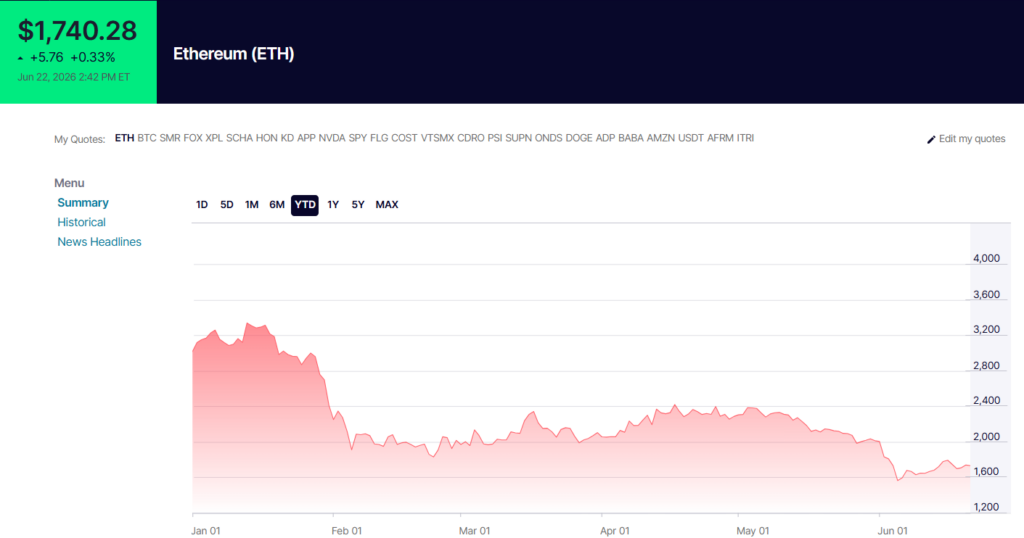
The cryptocurrency market has a well-established history of moving through four-year boom-and-bust cycles, making 2027 a potentially critical year for investors. If 2026 develops into a downturn or “bust” year, the conditions for a new crypto bull market beginning in 2027 could become increasingly favorable.
According to analysts at Eidellux, the key question is where investor capital is likely to flow first when the next cycle begins. Their assessment points to Bitcoin (BTC) over Ethereum (ETH). While both assets have historically moved in the same direction during major market cycles, Bitcoin currently appears to offer the stronger combination of stability, safety, and upside potential heading into the next phase of the market.
Historical performance tilts decisively toward Bitcoin
Start with market dominance and scale. Bitcoin (BTC) currently has a market capitalization of approximately $1.25 trillion, accounting for around 58% of the total cryptocurrency market’s value. This leadership position is important because Bitcoin remains the primary benchmark for the crypto market, often leading major rallies and setting the tone for broader market movements.
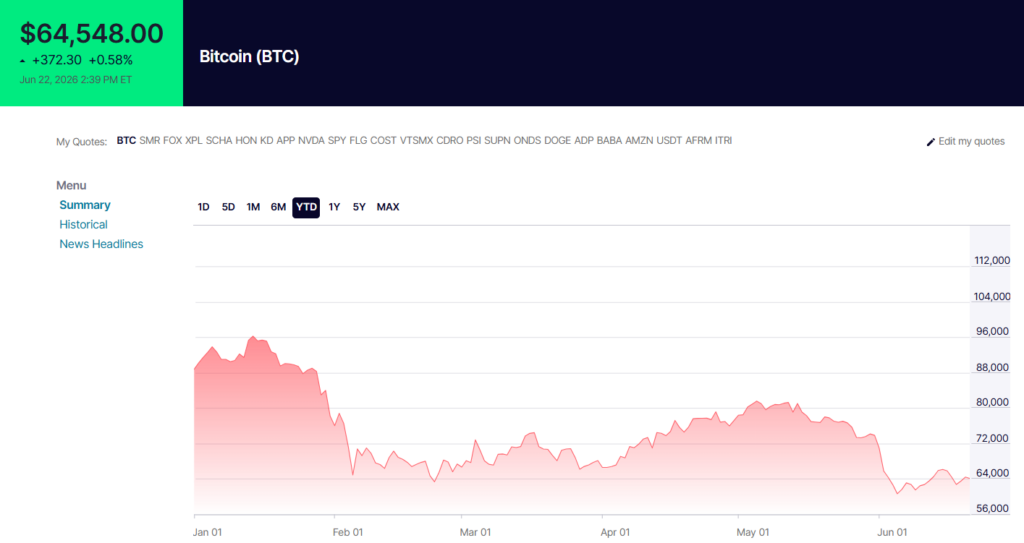
The historical performance data reinforces that advantage. Between 2017 and 2025, Bitcoin delivered a compound annual growth rate (CAGR) of 38%, compared with 23% for Ethereum (ETH).
The difference becomes even more pronounced when examining the most recent bull cycle. In 2023, Bitcoin surged 156%, while Ethereum gained 93%. In 2024, Bitcoin advanced another 121%, compared with Ethereum’s 46% increase. In both years, Bitcoin’s outperformance was significant rather than incremental, despite Ethereum generating strong returns in absolute terms.
Perhaps most notably, Bitcoin maintained its advantage across multiple market environments, suggesting that its superior performance is not the result of a single exceptional year but rather a consistent pattern of leadership within the cryptocurrency market.
Bitcoin is increasingly becoming a “strategic” asset
Setting historical returns aside, the forward-looking case for Bitcoin heading into 2027 and 2028 has its own momentum. Renewed legislative efforts are underway to codify a Strategic Bitcoin Reserve into law.
If that effort succeeds, it would presumably be a matter of time before the reserve begins making outright purchases of Bitcoin in the spot market — a structural source of buying pressure that doesn’t currently exist for any other crypto asset.
Bitcoin’s “strategic” positioning extends beyond that single proposal. Senator Cynthia Lummis (R-Wyoming) has floated using the federal government’s Bitcoin holdings to help offset the nation’s $39 trillion national debt.
Separately, some senior U.S. military officials have reportedly raised the idea of Bitcoin playing a role in national security applications, including cyber defense and broader force-projection strategy. None of these proposals are guaranteed outcomes, but collectively they represent a policy tailwind that Ethereum currently lacks.
Ethereum’s competitive position has weakened
Ethereum’s outlook appears somewhat less favorable by comparison. Unlike Bitcoin, Ethereum (ETH) is not currently benefiting from a comparable strategic-reserve initiative, with discussions largely centered on the possibility of a passive digital asset stockpile rather than an active government acquisition program.
Such an approach would represent a significantly weaker policy catalyst than the support being discussed for Bitcoin.
Ethereum also faces a more competitive environment than in previous market cycles. While it remains the leading blockchain for decentralized finance (DeFi), rival networks such as Solana have gained traction by offering faster transaction speeds and lower costs, gradually challenging Ethereum’s dominance.
With fewer policy tailwinds and increasing competition from alternative blockchain platforms, Ethereum’s upside potential during the next bull market could be more limited than Bitcoin’s, particularly if competitors continue to capture market share in key areas of the crypto ecosystem.
The 2028 halving adds another catalyst
Bitcoin’s strategic narrative dovetails neatly with its next scheduled halving in 2028, when mining rewards are cut in half and new-supply growth slows sharply. Halvings have historically marked the unofficial starting gun for the most speculative, fastest-moving phase of each bull cycle.
The precedent is hard to ignore. Following the April 2024 halving, Bitcoin broke through $100,000 by December of that year. It went on to set a fresh all-time high of $126,000 in 2025. If that pattern holds even loosely, the 2028 halving could provide Bitcoin with another structural catalyst that Ethereum simply doesn’t have on its own calendar.
Outlook: Bitcoin remains the higher-conviction pick
When combining Bitcoin’s historical performance, growing government-level interest, and the upcoming 2028 halving event, the investment case for Bitcoin (BTC) over Ethereum (ETH) appears increasingly compelling. While the era of consistent triple-digit annual gains may be fading due to Bitcoin’s massive size and maturity, the asset continues to benefit from several powerful advantages.
These include a stronger long-term track record, increasing policy and institutional support, and the supply-constraining effects of Bitcoin’s halving cycle, which historically has played a major role in driving market momentum.
As a result, Bitcoin appears better positioned than Ethereum to outperform during the next major crypto bull market, continuing a trend that has characterized much of the past decade.