

West Texas Intermediate (WTI) advances toward the $98.70 region, recovering positive momentum after two sessions of pronounced two-way price action. The following article highlights key aspects of the topic through the insights and expertise of Mynattaro’s professionals.
The US crude oil benchmark remains close to its recent multi-month high, supported by geopolitical risk premiums, resilient buying interest, and a constructive short-term technical structure. The immediate focus is whether buyers can sustain the advance toward the $100.00 psychological resistance level.
The recovery indicates that bullish participants continue to defend the prevailing uptrend despite volatility surrounding geopolitical developments and diplomatic negotiations. WTI’s ability to remain above former resistance near $95.00 suggests that the market is consolidating within a broader bullish structure rather than establishing a bearish reversal.
Geopolitical Risk Premium Supports Crude Oil
Middle East tensions remain a significant fundamental driver of crude oil valuations. Concerns about disruptions to production, export infrastructure, and transportation routes increase the geopolitical risk premium embedded in prices.
Additional uncertainty surrounding potential military escalation involving Iran continues to influence global supply expectations. The possibility of renewed diplomatic engagement, meanwhile, introduces downside risks for crude oil bulls.
The sustainability of the WTI rally depends partly on whether geopolitical developments translate into actual supply disruptions or remain primarily a source of speculative demand. Escalating regional tensions could accelerate buying toward $100.00, while improving diplomatic conditions could weaken upward momentum.
Technical Analysis: $95.00 Breakout Level Remains Critical
The four-hour chart maintains a bullish configuration, with WTI trading comfortably above its 100-period Simple Moving Average (SMA). This positioning indicates that the underlying price trend remains positive and that recent volatility has not invalidated the prevailing bullish structure.
The rebound from the $95.00 support zone is particularly significant. This level previously acted as resistance before the upside breakout, subsequently becoming potential support through the resistance-to-support polarity principle. Its successful defense suggests that buyers remain active during corrective movements.
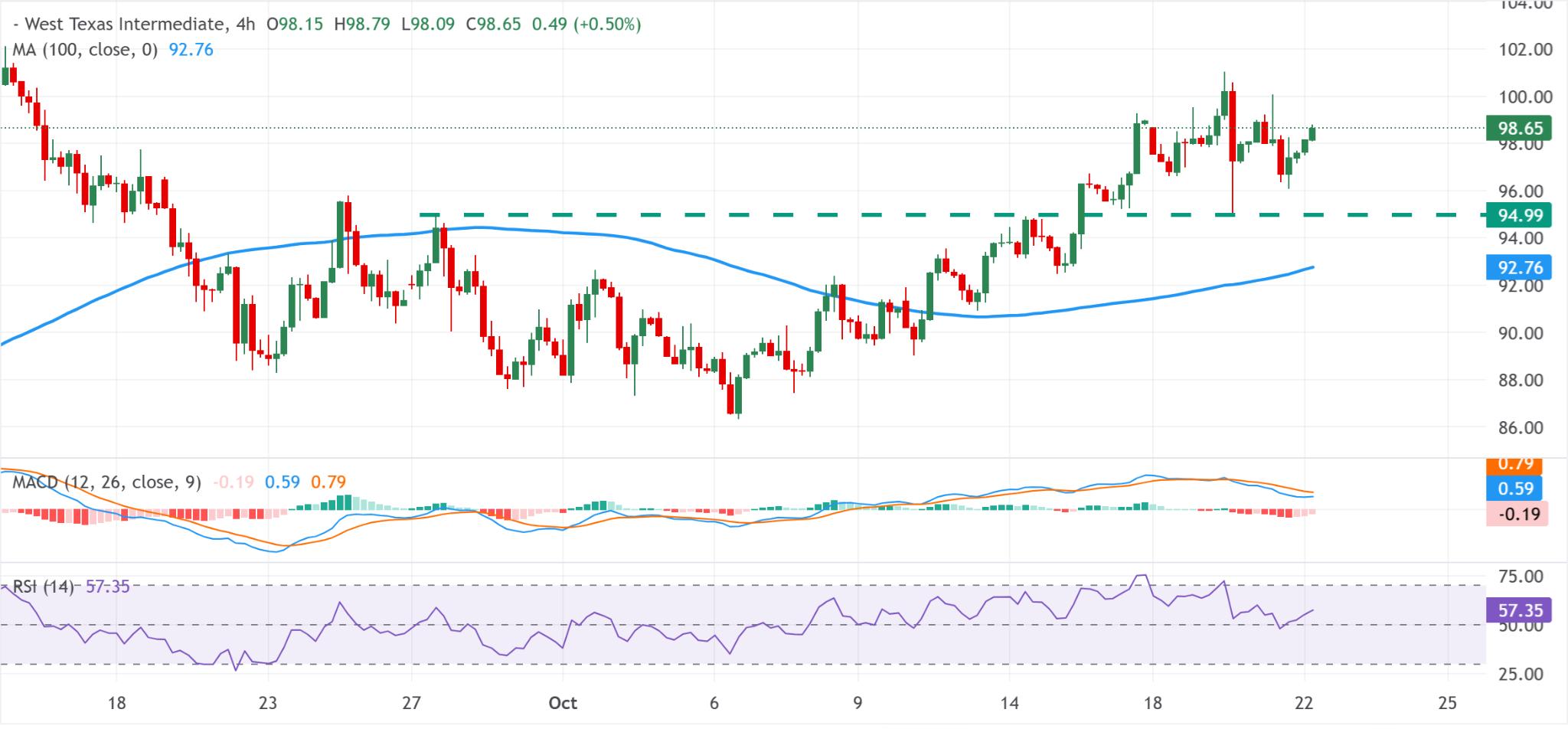
As long as WTI holds above $95.00, the immediate technical bias favors a retest of recent highs, followed by a potential advance toward $100.00. A sustained four-hour close above 98.70-99.00 would strengthen the breakout scenario, indicating that buyers are absorbing selling pressure near the upper boundary of the recent trading range.
A decisive move above $100.00 could attract additional momentum-driven buying and open the way toward higher resistance levels. Sustained price acceptance above this psychological threshold would provide stronger confirmation than a temporary intraday spike.
RSI and MACD Signal Moderate Upside Momentum
The Relative Strength Index (RSI) stands near 57, above the neutral 50 threshold and below the commonly monitored 70 overbought level. This configuration indicates a moderate bullish momentum advantage without suggesting excessive upside extension.
A sustained RSI reading above 50, accompanied by rising prices, would support continuation toward $100.00. An advance toward 60–65 could signal strengthening buying pressure, although the indicator should be evaluated alongside price action rather than used independently.
The Moving Average Convergence Divergence (MACD) remains in negative territory, suggesting that bullish momentum lacks decisive confirmation. This divergence between the constructive price structure and subdued momentum readings indicates that further consolidation could precede a sustained breakout.
A recovery in the MACD toward or above its signal line would improve the technical outlook. If prices advance while the indicator remains negative, traders should monitor potential resistance, momentum exhaustion, and corrective volatility.
WTI Price Targets and Downside Risk Levels
The immediate upside target remains $100.00, with the 98.70-99.00 resistance zone serving as a critical area for assessing breakout strength. Sustained trading above this band would favor another test of the psychological barrier, while a confirmed break above $100.00 could support further price discovery.
On the downside, $95.00 represents the first major support level and the principal threshold for preserving the near-term bullish structure. A controlled pullback toward this region, followed by a bullish reversal, would reinforce the view that sellers are struggling to reverse the prevailing trend.
Deeper structural support lies near $92.76, corresponding to the 100-period moving average on the four-hour chart. A retracement toward this level would represent a more substantial correction and require buyers to demonstrate renewed demand.
A decisive four-hour close below $92.76 would weaken the bullish configuration and increase the risk of an extended downside correction.
Conclusion: Bullish Bias Holds Above $95.00
WTI retains a constructive technical outlook, with prices near $98.70, geopolitical risks supporting the oil premium, and the four-hour chart favoring further gains. The $95.00 support zone remains essential to the bullish thesis, while improving MACD momentum would strengthen the breakout case.
A sustained move through 98.70-99.00 would place $100.00 firmly in focus. A confirmed break above this threshold would favor additional upside, while a decline below $92.76 would undermine the bullish structure and shift attention toward deeper corrective targets.