

The EUR/USD pair remains within a narrow trading range as investors assess escalating political instability in France and Italy, mounting sovereign debt risks, and changing expectations for European Central Bank (ECB) monetary policy.
Through this article, Mynattaro’s team of experts presents a balanced overview supported by professional analysis.
The pair recently advanced to 1.1237, recovering from a low of 1.1112. This represents a rebound of approximately 1.03%, indicating a modest improvement in buying momentum.
The broader fundamental environment remains uncertain. Rising public debt, fiscal consolidation, and intensifying protests threaten investor confidence in the eurozone. Meanwhile, elevated energy prices sustain US inflationary pressures, potentially supporting the US dollar through expectations of restrictive monetary policy.
These competing forces keep EUR/USD price action compressed, with traders monitoring key technical levels for directional confirmation.
France and Italy: Sovereign Debt Risks Pressure the Euro
France faces growing fiscal and political challenges as protests intensify following government spending cuts affecting education and public services. Reports of deadly unrest have prompted authorities to introduce curfews in key cities, highlighting the difficulty of implementing fiscal consolidation while maintaining social stability.
France’s debt-to-GDP ratio of approximately 120% reflects a substantial public debt burden. Spending cuts could improve the fiscal balance over time, but weaker domestic consumption, declining confidence, and slower economic growth remain potential consequences.
These pressures could undermine France’s sovereign credit outlook and increase government bond yields.
Italy faces similar challenges, with a debt-to-GDP ratio near 140%. Authorities have deployed approximately 500 soldiers to Milan amid protests over the rising cost of living. High borrowing requirements, expensive household essentials, and political unrest increase the risk of fiscal instability.
From a foreign-exchange perspective, concerns about sovereign debt sustainability could weaken the euro through widening peripheral sovereign bond spreads, tighter financial conditions, and declining risk appetite.
Higher French and Italian borrowing costs relative to German benchmark yields could increase the eurozone’s risk premium, undermining the euro’s recovery and exposing EUR/USD to renewed selling pressure.
ECB Policy Expectations and Energy-Driven Inflation
Upcoming remarks from Philip Lane, the ECB’s chief economist, and Christine Lagarde, its president, represent important near-term catalysts. Investors will examine their comments for signals regarding inflation projections, economic growth, and interest-rate guidance.
Market expectations indicate that the ECB could leave interest rates unchanged at its next meeting. Policymakers must balance persistent inflation risks against weakening economic momentum and political pressures. Persistent inflation could support restrictive monetary policy, while deteriorating growth could strengthen the case for monetary easing.
Energy prices add further uncertainty. Brent crude oil and West Texas Intermediate (WTI) trade around $109 and $98 per barrel, respectively. Gasoline and diesel prices have reached approximately $4.27 and $6.32, increasing transportation and production costs.
Elevated energy prices transmit inflation through fuel, logistics, manufacturing, and consumer spending. If US inflation remains above the Federal Reserve’s 2% target, interest-rate cuts could be delayed. Higher expected US interest rates relative to eurozone rates would widen the dollar’s yield advantage, potentially limiting EUR/USD gains.
EUR/USD Technical Analysis: 1.1340 Is the Key Resistance
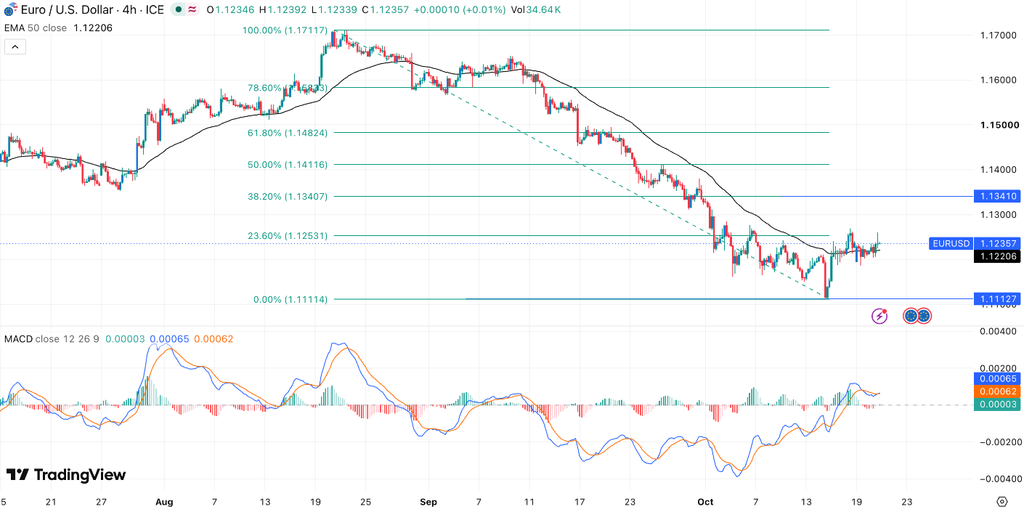
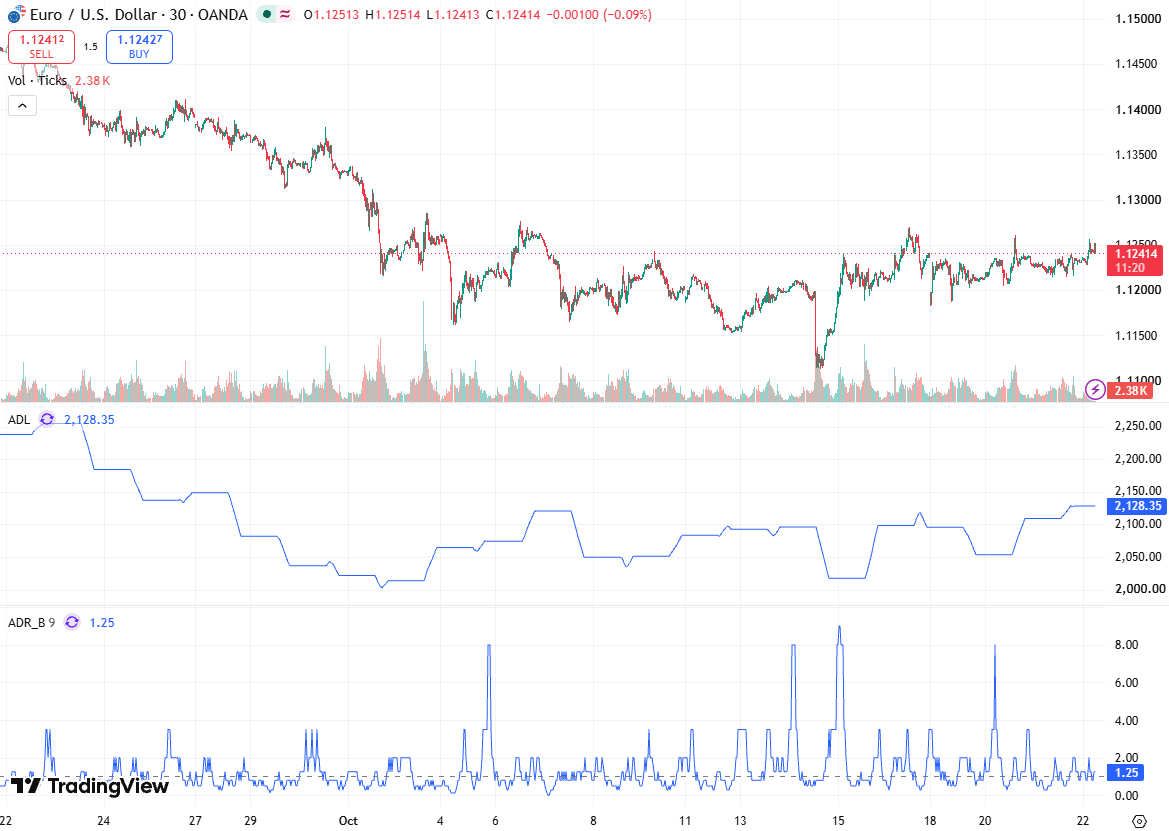
On the four-hour chart, EUR/USD has recovered from 1.1112 to 1.1237, gaining approximately 1.03%. This rebound signals improving short-term momentum, although a confirmed medium-term bullish reversal remains unestablished.
The pair has moved above the 23.6% Fibonacci retracement level, suggesting buyers have recovered part of the preceding decline. The next major target is 1.1340, near the 38.2% Fibonacci retracement level. A sustained breakout above resistance could strengthen the recovery and expose higher price levels.
Momentum indicators support a cautiously bullish outlook. EUR/USD trades above its 50-period Exponential Moving Average (EMA), indicating improving short-term momentum. Meanwhile, the Moving Average Convergence Divergence (MACD) continues rising above its neutral level, signaling positive momentum and increasing buying pressure.
The chart also shows a developing inverted head-and-shoulders pattern, a potential bullish reversal formation. Confirmation requires a decisive break above the pattern’s neckline, preferably accompanied by stronger momentum. Until then, the formation remains provisional.
On the downside, 1.1237 provides a reference level, while 1.1112 remains the critical swing low. A sustained break below 1.1112 would invalidate the immediate recovery structure and increase the risk of another bearish move. A confirmed breakout above 1.1340 would strengthen the bullish outlook.
Conclusion
The EUR/USD pair maintains a cautiously bullish short-term technical bias, supported by its 1.03% recovery, movement above the 50-period EMA, and improving MACD momentum.
The primary upside target remains 1.1340, where Fibonacci resistance could determine the next move. Fundamental risks persist, including French and Italian fiscal instability, elevated energy prices, and interest-rate differentials.
A sustained break above resistance would support further euro appreciation, while a decline below 1.1112 would revive bearish pressure. Until a decisive breakout occurs, range-bound trading and elevated event risk remain the dominant outlook.