

A pattern has emerged at Lululemon Athletica that investors can no longer dismiss as a temporary rough patch. The athletic apparel company has now trimmed its annual revenue target three separate times within a single calendar year.
Each revision followed the same pattern: a quarterly profit figure that exceeded expectations, paired with a top-line result and forward outlook that fell short. When that combination repeats itself consecutively, the market stops treating each revision as an isolated event and starts treating the guidance itself as unreliable.
The brand’s junior broker highlights that Gammance sees the market’s current skepticism toward Lululemon as a rational response to that pattern rather than an overreaction to a single disappointing quarter.
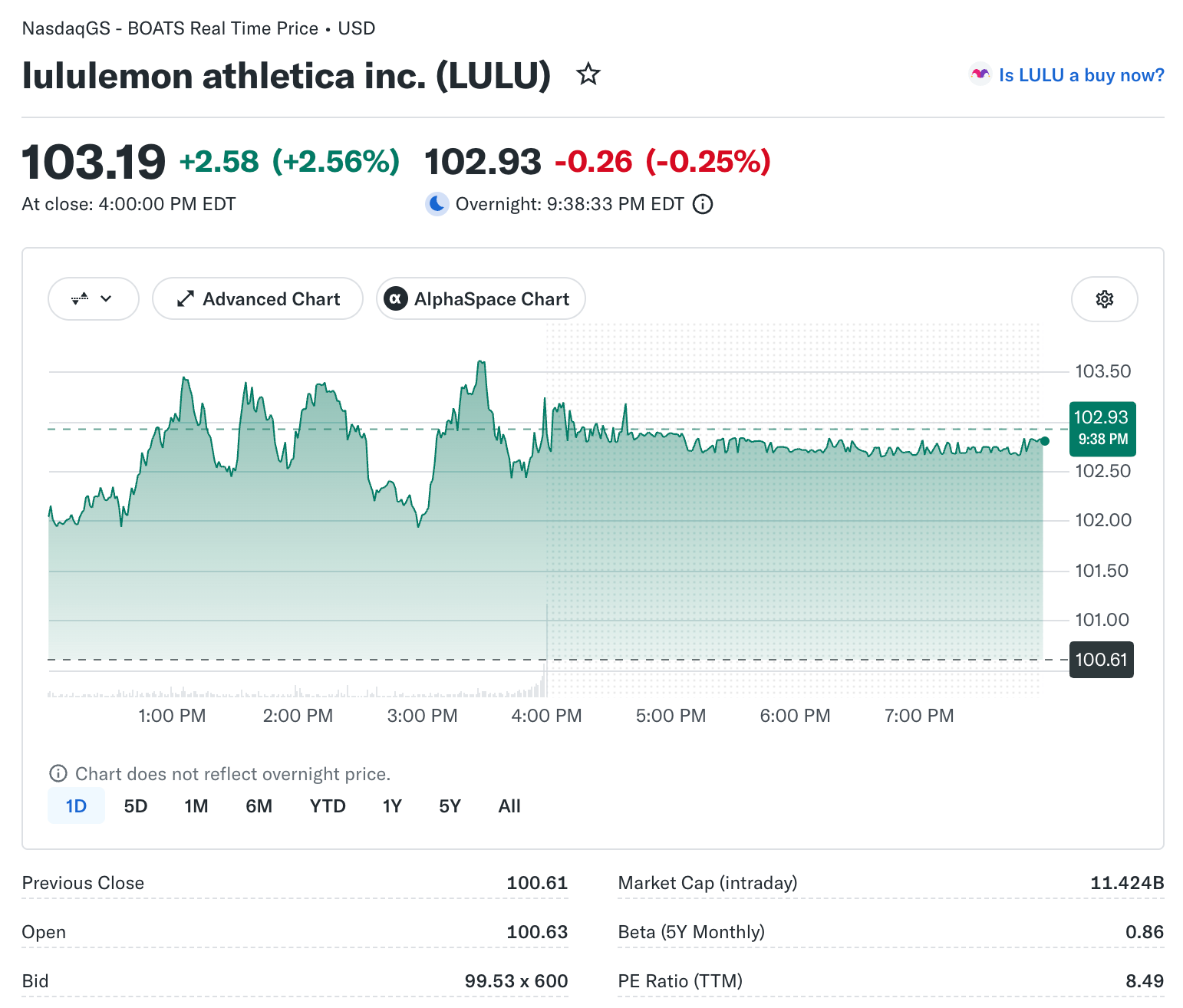
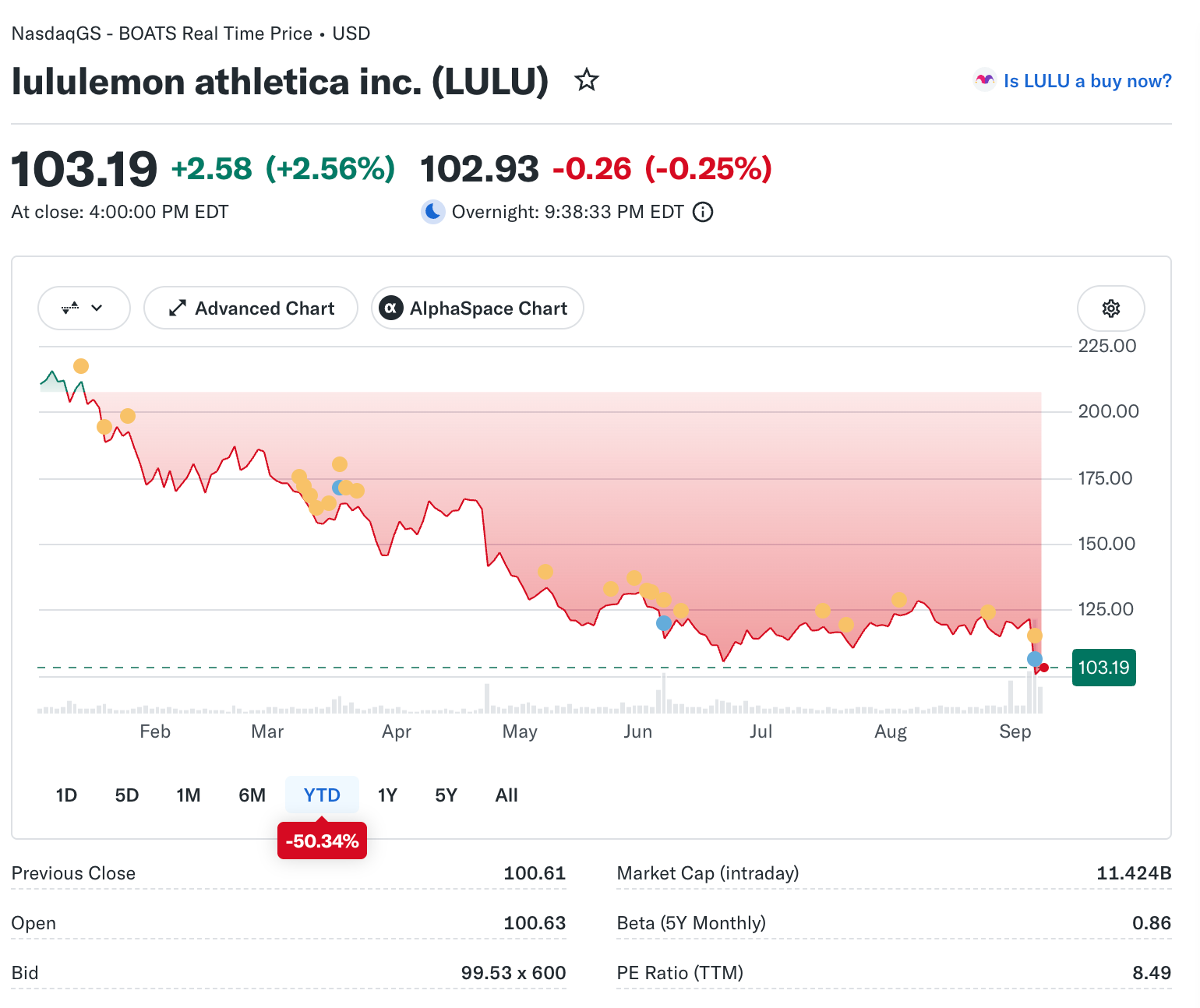
A stock that has lost roughly 17 percent in a single post-earnings session and is trading near lows not seen in close to a decade is reflecting something structural, not seasonal.
The Revenue Trajectory That Concerns Analysts
Net revenue in the most recently reported quarter came in about 4 percent below the prior year’s equivalent figure. That top-line contraction coincided with an inside-the-store traffic measure down nearly 9 percent on a comparable basis across global locations.
The Americas region, which has historically been the engine of the business, recorded the steepest decline, down around 8 percent from the prior-year period. International operations showed some growth in headline revenue, rising in the low single digits year over year.
But comparable sales in those markets also turned negative, suggesting the growth picture outside North America is beginning to soften. When a brand’s home market and its expansion markets both show declining comparable performance, the pricing and demand arguments for sustained recovery become harder to construct.
The full-year revenue target has now been lowered to a range of approximately $10.35 billion to $10.5 billion. That compares with an opening-of-year forecast that was roughly a billion dollars higher. The earnings-per-share outlook for the full year has also been revised downward, and the revised number includes a one-off tariff refund benefit that flatters the adjusted figure.
What Is Actually Driving the Demand Loss
Three forces are converging on Lululemon’s business simultaneously, and none of them resolves quickly. The first is consumer prioritization.
In a high-interest-rate environment, households with mortgages, auto loans, and credit card balances are spending more on those obligations than they were two years ago. The budget line that absorbs the shortfall tends to be aspirational discretionary purchases, which is precisely the category that premium activewear occupies.
Lululemon’s products are not a necessity, and consumers under financial pressure have demonstrated they will defer those purchases without eliminating them permanently. The second force is competitive encroachment. Newer activewear brands have gained meaningful traction with the same customer segment that built Lululemon’s following.
These newer entrants do not carry legacy retail overhead or the margin structures that come with operating at scale. They can move faster on product design and tend to generate stronger organic social engagement, which Lululemon’s management cited as a headwind in its most recent commentary.
The third force is execution inconsistency. Management acknowledged that the response to recent product launches has been uneven, with some new styles connecting and others failing to generate expected volume. For a brand whose premium price positioning depends on consistent product desirability, that inconsistency is a category-defining problem, not a minor setback.
Leadership Change at a Difficult Moment
A new CEO took over around the time the most recent earnings were reported, bringing experience from another major name in the athletic industry. But leadership transitions carry a specific challenge in turnaround situations: they create a gap in strategic momentum while the incoming executive assesses the business before acting.
Without that confidence, the stock reprices toward the multiple that the most pessimistic plausible earnings scenario supports.
The combination of a demand contraction, a third guidance cut within a single year, and a new CEO without a publicly committed operational roadmap creates an environment where investors cannot model the forward earnings trajectory with reasonable confidence.
What the Balance Sheet Offers as Reassurance
One detail worth noting for investors assessing the downside is that the company carries no significant debt. That structural fact does not fix the revenue problem, but it removes a risk category that can turn operational difficulty into an existential crisis.
A debt-free retailer with global brand recognition and a large active customer base has the financial runway to execute a recovery program without debt service obligations compressing management’s options.
The question is not survival, but the pace and credibility of the turnaround. Investors considering the stock at current levels need to form a view on when comparable sales stabilize and what the path back to revenue growth looks like under new leadership.
Until clearer evidence emerges on both questions, the market is likely to remain in a show-me posture toward any bullish case.