
West Texas Intermediate (WTI) crude oil prices remain relatively stable during Friday’s Asian trading session, hovering above the $75.50 mark as traders assess a complex mix of geopolitical developments and technical signals. Rubinax’s brokers explore this topic in depth in the accompanying article.
While escalating uncertainty surrounding US-Iran negotiations continues to provide underlying support to the energy market, easing concerns over supply disruptions have limited the upside potential for the commodity.
WTI, the benchmark for US crude oil, is currently trading around the mid-$75.00 area, posting a modest daily gain of approximately 0.30%. Despite the recovery from recent lows near $72.80, the market lacks strong bullish conviction as investors remain cautious about the next directional move.
Iran Negotiation Uncertainty Supports Oil Prices
One of the key drivers supporting crude oil prices is growing uncertainty around US-Iran diplomatic efforts. Reports that US Vice President JD Vance canceled a planned trip to Switzerland for talks with Iran have increased concerns about the future of negotiations.
The cancellation has fueled speculation that progress toward a broader agreement may be slowing, raising geopolitical risks in energy markets. Because Iran plays a major role in global oil production and regional stability, setbacks in diplomacy often influence oil prices.
Adding to concerns, recent Israeli air strikes in Lebanon have increased Middle East tensions. Investors worry that escalating conflict could disrupt diplomatic initiatives and affect future oil supply.
As a result, traders continue to price in a risk premium, helping crude oil prices remain supported despite broader bearish technical conditions.
Technical Breakdown Keeps Bears in Control
From a technical standpoint, the overall structure of the WTI market continues to favor sellers despite the latest stabilization.
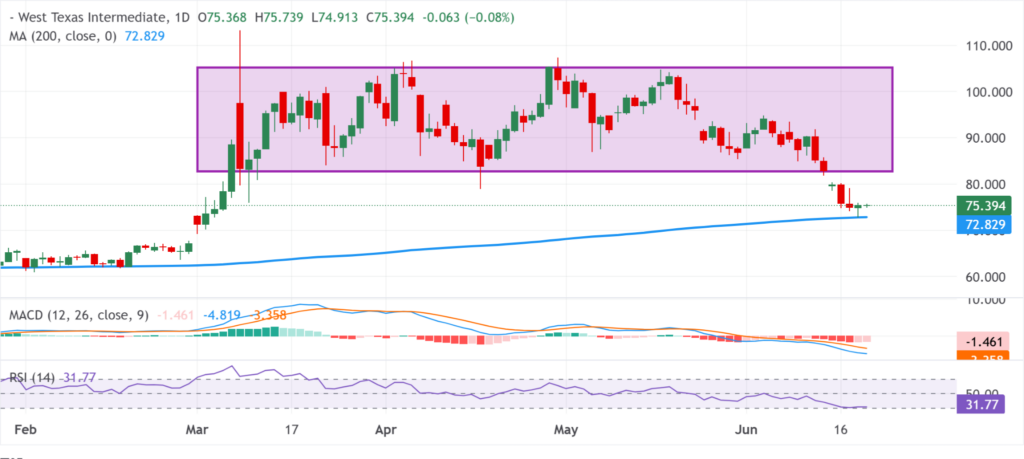
A major bearish development occurred earlier this week when prices made a decisive break below $83.00, which represented the lower boundary of a trading range that had remained intact for approximately three months. This breakdown signaled a shift in market sentiment and encouraged additional selling pressure.
The move below this key support area confirmed a bearish continuation pattern, increasing expectations for further downside risks unless buyers can quickly regain control.
Although prices have managed to recover from recent lows, the broader trend remains vulnerable while trading below former range support.
RSI Signals Selling Pressure Is Becoming Stretched
Momentum indicators show bearish pressure remains dominant, though conditions are nearing levels that could trigger a technical rebound.
The Relative Strength Index (RSI) is currently 31.77, just above oversold territory. Typically, readings below 30 indicate overselling, while readings above 70 signal overbought conditions.
At this level, the RSI suggests sellers still control momentum, but downside pressure is becoming stretched, increasing the chance of short-covering or bargain hunting if no new bearish catalysts appear.
However, since RSI has not yet entered deeply oversold territory, further declines remain possible.
MACD Continues to Reflect Negative Momentum
Additional confirmation of the bearish outlook comes from the MACD (Moving Average Convergence Divergence) indicator.
The MACD line remains below the zero level at around -1.46, signaling persistent negative momentum. A reading below zero suggests that short-term price action remains weaker than the longer-term trend, favoring continued downside pressure.
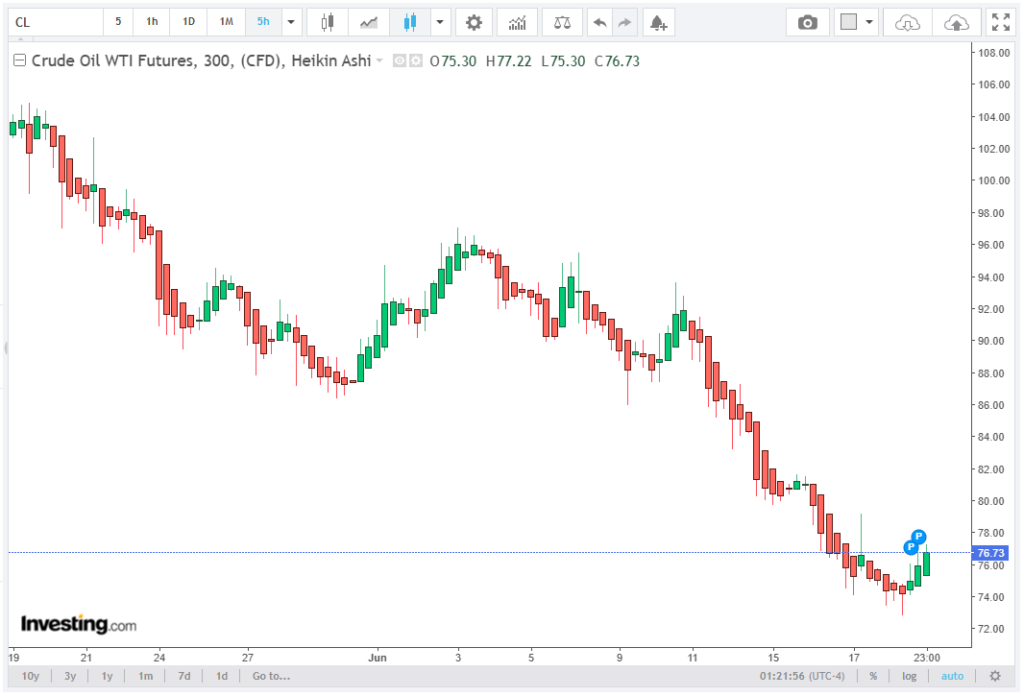
Importantly, no meaningful bullish crossover has emerged. Until such a signal appears, traders are likely to remain cautious about expecting a sustained recovery.
The combination of a weak MACD and an RSI near oversold territory suggests the market remains under pressure but may be approaching a potential turning point.
200-Day SMA Emerges as the Key Battleground
A key technical level for WTI crude oil is the 200-day Simple Moving Average (SMA) near $72.83.
The 200-day SMA is widely viewed as a major trend indicator. Prices above this level typically signal a long-term uptrend, while a sustained break below it may indicate a more bearish trend.
Despite recent weakness, WTI remains above this critical support zone. Holding above the 200-day SMA has limited selling pressure and encouraged some dip-buying.
As long as prices stay above $72.83, buyers may continue to view declines as buying opportunities. However, a decisive break below this level could trigger further technical selling and accelerate losses toward lower support levels.
WTI Price Outlook
Looking ahead, crude oil traders will closely watch Iran-related negotiations, Middle East tensions, and shipping activity through the Strait of Hormuz.
From a technical standpoint, the 200-day SMA remains the key level. Holding above this support could help WTI stabilize and recover toward higher resistance levels. In contrast, a confirmed break below the moving average would strengthen the bearish outlook and increase the risk of further declines.
For now, the market remains in consolidation, with geopolitical uncertainty supporting prices while improving supply conditions and weak technical momentum continue to cap bullish sentiment.