
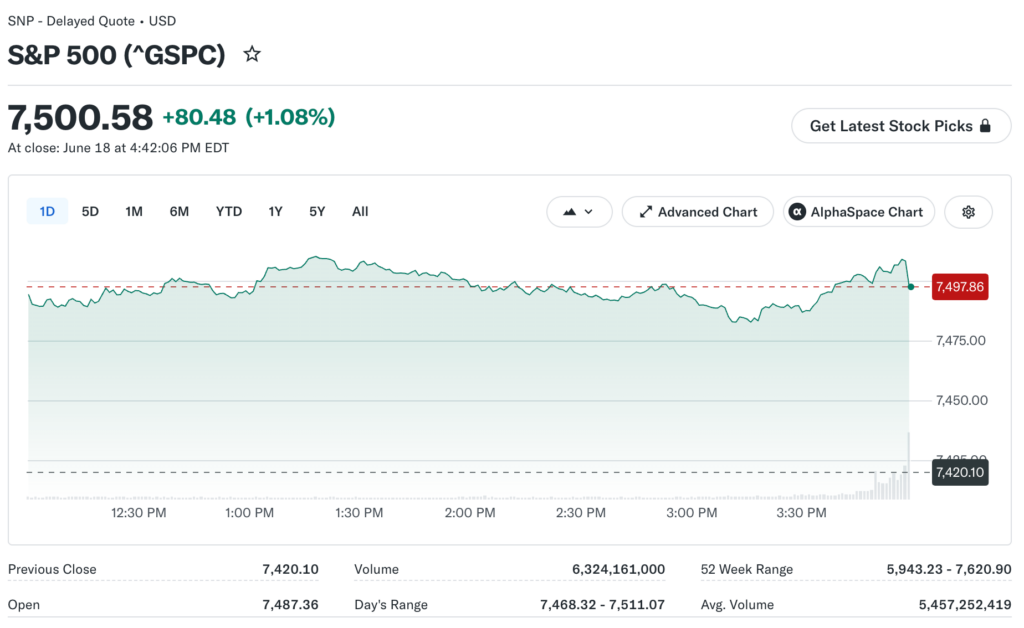
Wall Street spent the back half of last week proving that a single phrase from the Federal Reserve can still move trillions of dollars faster than fundamentals can. On June 17, 2026, the S&P 500 and Nasdaq both fell hard after the Fed’s dot plot showed nine of eighteen policymakers expecting at least one more rate hike before year-end.
A day later, the indexes reversed course, with the Russell 2000 closing the week at 2,979.77 after a 2.12% gain. Brokers at Gammance have been studying the two sessions closely, and their read is simple: the real story isn’t the drop or the bounce on their own, it’s what each one was actually responding to, since the two days were driven by almost entirely separate forces.
A Selloff Built on One Sentence, Not a Trend
The June 17 decline wasn’t a broad repricing of risk. It was a rate-sensitivity trade, and technology stocks absorbed most of the damage because the sector had been carrying stretched valuations relative to where borrowing costs were heading.
When discount rate expectations shift even slightly, growth-heavy names tend to feel it first and worst, since their valuations depend heavily on future earnings that get discounted more aggressively as rates rise.
Semiconductor stocks were hit particularly hard on June 17, then reversed almost immediately. Intel climbed roughly 10% the following day, pushing toward a record high near $135.13, after reports of an Apple foundry agreement began circulating. Marvell Technology rose 12.12%, and SanDisk added 11.1%.
The same names that led the decline led the recovery, a pattern worth noting rather than dismissing as routine volatility, since it suggests company-specific catalysts overrode the macro fear within a single trading day.
The Russell 2000’s Message Mattered More Than the Headline
Of everything that happened in those 48 hours, the small-cap rebound carries the most weight for long-term positioning. Small-cap companies lean far more on domestic credit conditions than large multinationals do, since many carry floating-rate debt and rely on local bank lending rather than global capital markets.
When the Russell 2000 leads a recovery, it’s effectively a vote that the rate fear driving the initial drop is being partially walked back rather than fully accepted.
Part of that shift traces to a modest pullback in Treasury yields on June 18, despite the Fed’s hawkish tone. That move followed an Iran ceasefire memorandum signed in France, which eased near-term energy price expectations and softened the inflation path that had been pushing rate-hike odds higher.
Bond markets found a reason to disagree with the dot plot before equities did, and that disagreement is worth watching for the rest of the quarter.
CarMax’s Earnings Beat Got Buried Under Macro Noise
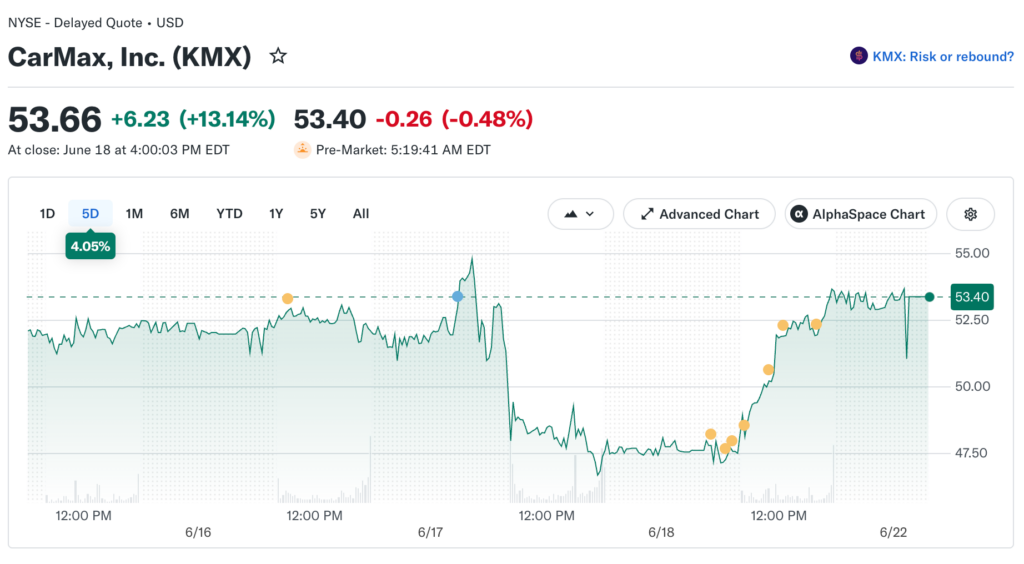
Beneath the index-level drama, CarMax posted fiscal Q1 2027 results that beat expectations, sending shares up 10.37% on June 18. That number deserves closer attention than it received. Used car loan rates have run between 8% and 11% for most of 2026, and a double-digit earnings beat in that environment is a real consumer credit signal, not a footnote.
It partially contradicts NFIB survey data suggesting price pressure building at the small business level, and it hints that buyers in the used vehicle market are still finding ways to transact despite financing costs that would have stalled demand in a weaker economy. That detail matters heading into a Q2 earnings season where consumer discretionary names will carry outsized scrutiny.
Accenture’s Drop Was a Bookings Story, Not a Rate Story
Accenture fell 17.97% on June 18, its worst single-day decline on record, and most coverage filed it under generic AI disruption fears. The more precise driver was a 13% sequential decline in new bookings from a prior record, paired with a Q4 revenue guide that came in 2.3% below consensus. That’s a forward pipeline signal, and it has little to do with what the Fed decides next.
The stock had already fallen more than 50% from its 52-week high of $314.20 before Thursday’s additional drop. For anyone tracking consulting and technology services stocks, the bookings figure is the number to watch, since it confirms AI-driven demand disruption is now showing up in actual revenue, not just analyst speculation. A single quarter of soft bookings can be noise. A second one, if it shows up next quarter, would confirm a trend.
A Bounce Isn’t a Resolution
None of the tensions behind the June 17 selloff disappeared by June 18. Nine FOMC members are still projecting hikes. Inflation sitting at 4.2% year-over-year remains well above target. Technology valuations are still stretched against the current rate backdrop, and none of that gets resolved by one strong trading session.
What the recovery does confirm is that capital rotated within equities rather than fleeing them. One metric worth following in the sessions ahead is the equal-weight S&P 500 against its cap-weighted counterpart. That comparison will show, more cleanly than any single day’s headline, whether this market is genuinely broadening out or simply catching its breath before another volatile stretch into Q3 earnings.