
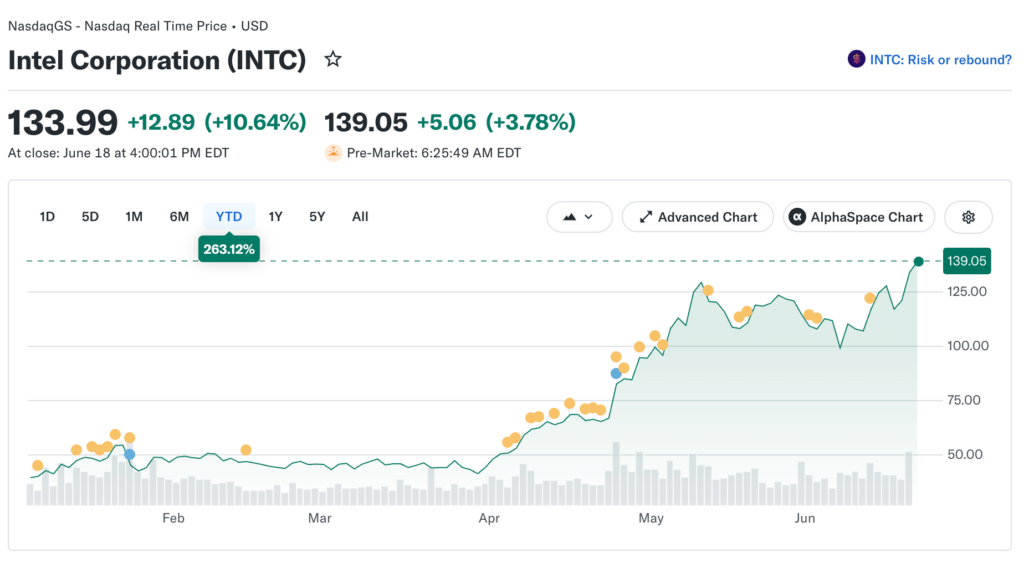
A single social media confirmation pushed Intel toward a record high, but the numbers behind the deal tell a more complicated story than the headline. Intel started 2026 trading near $37 a share. By June 17, 2026, it had climbed above $120, a year-to-date gain exceeding 240% that already made it one of the year’s defining comeback stories.
That evening, the US President confirmed via social media that Apple had agreed to work with Intel on chip design and manufacturing inside the United States. The pre-market reaction pushed Intel toward a record high of $135.13. Brokers at Gammance have been picking apart what that confirmation actually verifies, and what the underlying numbers say about Intel’s foundry business right now.
What the Confirmation Actually Co
 nfirms
Neither Apple nor Intel had issued an official statement as of June 17. The Wall Street Journal had already reported a preliminary agreement back in early May 2026, following more than a year of closed-door talks. The social media post was effectively a restatement of an arrangement that was still unconfirmed by either company, yet the market still moved 9% to 12% depending on the session.
Apple designs every chip that goes into its own devices. The A-series chips inside iPhones and the M-series inside MacBooks all come from Apple’s internal silicon team. What Apple has never done is operate its own factory, choosing instead to outsource its most advanced manufacturing entirely to TSMC in Taiwan.
Any shift toward Intel as a foundry partner represents real supply chain diversification, and a strategic vote of confidence in Intel’s manufacturing capability at the advanced node level.
The Numbers Behind the Partnership Thesis
This was Intel’s sixth quarter in a row of topping its own guidance, and the Q1 2026 print backed that streak up with real growth. Revenue came in at $13.6 billion, climbing 7% from the year before and landing about 9% ahead of what Wall Street had penciled in.
The Data Center and AI unit was the standout, posting 22% growth to reach $5.05 billion. On the manufacturing side, the foundry business trimmed its operating loss to $2.4 billion, a $72 million improvement from the prior quarter as the Intel 4, 3, and 18A processes all saw better yields.
The figure that matters most for the Apple story, though, is smaller and less flattering. Out of $5.42 billion in total foundry revenue, only $174 million came from outside customers, chips built for companies other than Intel itself. The rest, the overwhelming majority, still goes toward Intel’s own product lines.
The Process Node Doing the Heavy Lifting
Intel’s pitch to Apple leans on the 18A-P process, an advancement of its existing 18A node that entered risk production on June 17. Risk production is an early manufacturing stage where Intel runs full wafers to gather defect rate and performance data before scaling to full volume. Intel cited performance gains of up to 9%, power reduction of 18%, and thermal resistance improvements between 20% and 40% compared with base 18A.
CEO Lip-Bu Tan, who took over in 2025, has repeatedly pointed to formal foundry customer commitments arriving in the second half of 2026. The Q2 earnings report on July 23 will be the first real check on whether Apple talks have moved from preliminary discussion into contracted production volume. The external foundry revenue line in that report carries more weight than any other single figure Intel will publish this year.
Where the Valuation Risk Sits
There’s a wide gap between where analysts think Intel belongs and where it’s actually trading. The consensus price target lands somewhere between $82 and $93, putting the current share price 30% to 40% above that range.
Not every analyst sees it the same way, either. Bank of America is still sitting on an Underperform call, while Evercore ISI recently flipped the other direction to Outperform. Mizuho went further still, lifting its target all the way to $135 on the view that Intel’s advanced packaging business could eventually capture 10% to 15% of that market over the long run.
The optimism isn’t limited to outside analysts. Shortly before the Apple news broke, CEO Lip-Bu Tan used a podcast appearance to lay out a goal of returning ten times shareholder value within five to ten years, a target that gives some sense of how aggressively leadership is thinking about the turnaround.
July 23 Will Separate the Story From the Numbers
Intel’s current price is pricing in a foundry turnaround that is directionally credible but still unproven at meaningful scale. That gap between narrative and verified revenue is the central risk for anyone buying at current levels. If the July 23 report shows external foundry revenue above $200 million alongside a formal customer name, the rally has room to continue.
If external revenue stalls near the $174 million mark from Q1 with no new customers confirmed, the distance between the stock price and analyst targets becomes very hard to defend heading into Q3 2026.