
Global investors reassessed inflation trajectories and central bank policy paths, which resulted in significant selling pressure on fixed-income securities and sovereign debt instruments.
Important quantitative information about how rising borrowing costs affect consumer debt markets and broad equity valuations can be obtained by examining benchmark yield curve shifts, producer price inflation metrics, and foreign exchange valuations.
A careful analysis of real interest rates, term premiums, and macroeconomic indicators is necessary to navigate complicated fixed-income allocations. According to a market expert at Achievements AI, long-term inflation expectations and central bank policy positions have a significant impact on capital market stability.
Rising yields provide institutional fixed-income portfolios with appealing real returns, despite the fact that higher borrowing costs pose challenges to corporate debt issuance and mortgage originations.
Benchmark Sovereign Yield Movements Across Maturity Tenors
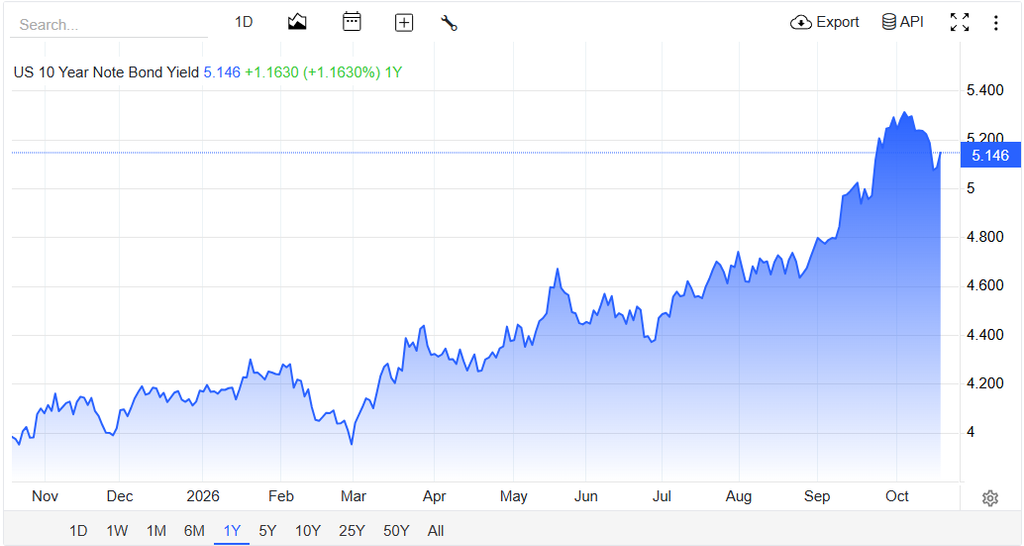
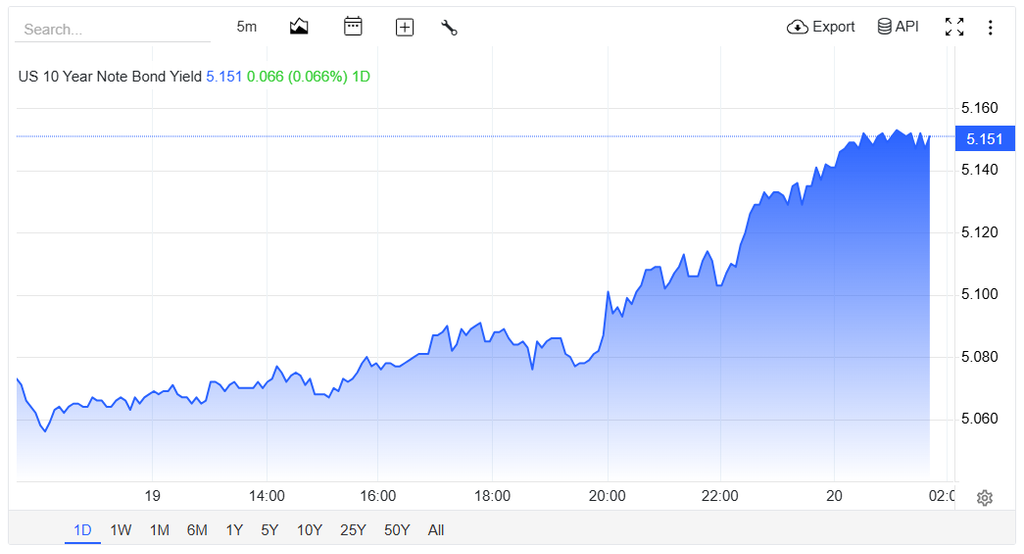
United States sovereign debt yields advanced steadily across the entire maturity spectrum as traders priced in persistent price pressures. Benchmark 10-year Treasury yields rose more than 3 basis points to reach 5.136%, subsequently touching 5.144%, driven by tightening credit conditions affecting mortgages and corporate credit lines.
Longer-dated 30-year Treasury bond yields similarly expanded by more than 3 basis points to 5.471%, eventually settling near 5.477%, reflecting heightened sensitive responses to geopolitical developments and expanding fiscal deficit projections.
Short-Term Rate Trajectories and Money Market Benchmarks
Policy-sensitive 2-year Treasury note yields, which track immediate central bank interest rate expectations closely, climbed 3 basis points to 4.772%, maintaining a level near 4.77%. Shorter money market instruments reflected similar firmness, with 1-year Treasury yields trading around 4.483% and 6-month Treasury bills holding near 4.367%.
Ultra-short liquidity instruments also adjusted, with 3-month Treasury bills hovering at 4.183% while 1-month Treasury bills eased slightly toward 4.015%, highlighting subtle cash allocation shifts among institutional liquidity managers.
Inflation Persistence and Economic Data Indicators
The upward yield pressure follows robust wholesale and consumer inflation figures released by labor statistics authorities. Annual wholesale producer prices expanded by 6.3% in recent reporting periods, marking the largest annual increase recorded since 2022, while headline consumer price index figures climbed 3.7% annually, surprising consensus market forecasts.
If increases in input costs are not passed directly down to retail consumers over the next few quarters, then corporate profit margins may be subject to compression. This is because wholesale costs are increasing at a faster rate.
Energy Market Fluctuations and International Supply Pressures
Energy futures experienced moderate pullbacks despite persistent baseline geopolitical friction in key oil-producing regions. West Texas Intermediate crude futures for near-term delivery fell 0.3% to trade near $101.11 per barrel, while global benchmark Brent crude declined 1.2% to settle near $108.56 per barrel.
Easing energy prices provided temporary relief for transportation metrics, though market participants monitor crude availability closely to evaluate secondary inflationary impacts on core consumer price indexes.
Central Bank Monetary Expectations and Policy Futures
Derivatives trading through interest rate probability tracking tools indicates an above 80% probability that monetary authorities will maintain existing policy rates at their upcoming rate-setting conference. Traders anticipate that central bank officials will opt for a temporary pause to evaluate lagging economic effects from previous rate hikes.
However, elevated producer prices ensure that policymakers maintain a hawkish bias, keeping future interest rate increases on the table if inflation remains above target thresholds.
Real Estate and Consumer Credit Transmission Channels
Rising benchmark sovereign yields transmit rapidly through primary banking channels, pushing mortgage rates, auto loan fees, and revolving credit card interest rates higher. Average thirty-year fixed mortgage rates remaining above multi-year highs continue to dampen national housing starts and new building permit issuances.
Higher costs associated with debt servicing reduce the amount of disposable income available to households, which has the effect of reducing discretionary consumer spending in the retail and hospitality industries.
Institutional Portfolio Adjustments and Yield Curve Realignment
In order to profit from high sovereign yields and minimize capital losses from price declines, institutional asset managers keep modifying fixed-income duration targets. In the face of persistent macroeconomic uncertainty, rebalancing strategies prioritize short-duration Treasury bills and high-grade corporate debt to maximize cash flow yields.
For investors navigating complex fixed-income environments, it is still crucial to keep an eye on upcoming housing data, labor metrics, and central bank communications.
Global Fixed-Income Investors’ Strategic Horizon
It is necessary to strike a balance between short-term rate volatility and long-term real return goals when navigating environments with elevated sovereign yields. Building robust multi-asset portfolios aids in protecting total wealth from broader credit market tightening and fluctuating inflation expectations.
Investors can preserve capital during times of macroeconomic re-adjustment while capturing appealing fixed-income yields by adhering to disciplined capital allocation strategies.