
The S&P 500 continued to advance after lower-than-expected US inflation data strengthened expectations that the Federal Reserve has little reason to adjust interest rates in the immediate future.
Softer producer prices encouraged investors to rotate back into equities, while lower Treasury yields provided additional support for risk assets. Bankolla‘s analysts explore the latest movements in the S&P 500, discussing the technical outlook and the levels that could determine the index’s next directional move.
Softer PPI Boosts Market Confidence
US equities moved higher after June’s Producer Price Index surprised to the downside, offering further evidence that inflationary pressures continue to ease. Headline PPI declined by 0.3% month over month, outperforming expectations of 0.0%, while Core PPI increased by only 0.2%, below the consensus forecast of 0.4%.
The weaker inflation data prompted bond investors to reduce expectations of additional Federal Reserve tightening, pushing Treasury yields lower across the curve. The 2-year Treasury yield retreated toward 4.12%, while the 10-year yield slipped below 4.55%, creating a more supportive environment for equities.
Lower yields generally improve the attractiveness of growth stocks by reducing financing costs and increasing the present value of future earnings. This dynamic helped lift the broader market despite continued geopolitical uncertainty.
Investors nevertheless remain attentive to developments in the Middle East, where ongoing tensions continue influencing commodity markets. Although oil prices eased as traders locked in profits following a strong rally, any renewed increase in crude prices could revive inflation concerns and weigh on equity valuations.
Technical Outlook Remains Constructive
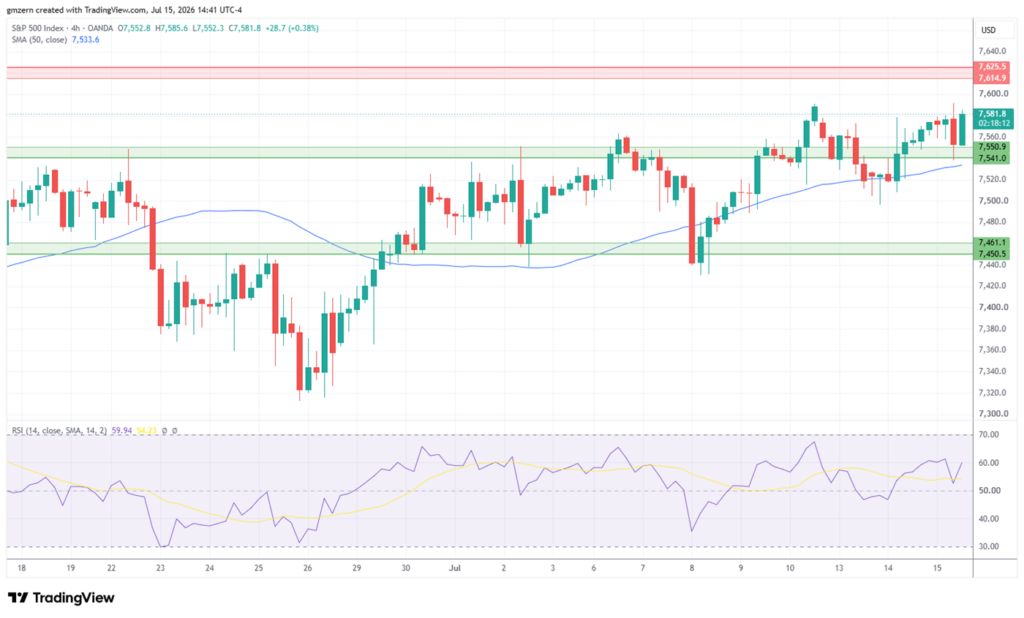
The S&P 500 continues trading above the important support zone between 7,540 and 7,550, reinforcing the prevailing bullish structure despite recent market volatility.
After successfully defending this support area, the index has attempted to establish itself above 7,580, an important short-term resistance that could determine whether buyers regain stronger momentum.
Should the index secure a sustained move above 7,580, attention would likely shift toward the next resistance zone between 7,615 and 7,625. A successful breakout above this range would strengthen the bullish outlook and potentially open the path toward fresh record highs.
Momentum indicators continue supporting a constructive view. The Relative Strength Index (RSI) remains in neutral territory, suggesting the market still has room to strengthen before entering overbought conditions. This balanced momentum profile provides flexibility for additional upside if favorable macroeconomic catalysts continue supporting investor sentiment.
Sector Performance Reflects Selective Buying
Sector rotation played an important role during the latest trading session. Consumer cyclical companies and financial stocks led market gains as investors responded positively to easing inflation pressures and lower Treasury yields.
Energy companies underperformed after oil prices retreated from recent highs, while several technology stocks experienced modest profit-taking despite the broader market’s positive performance.
The mixed sector performance indicates that investors remain selective rather than aggressively increasing overall market exposure. Instead of broad-based buying, capital continues rotating toward sectors expected to benefit most from a stable interest rate environment and resilient economic growth.
This balanced participation often characterizes healthy market advances, where gains are supported by improving fundamentals rather than excessive speculative activity.
What Investors Should Watch Next
Attention now shifts toward upcoming economic releases and additional Federal Reserve communication that could further influence expectations regarding future monetary policy.
Investors will also continue monitoring Treasury yields, as additional declines would likely provide further support for equity valuations. At the same time, developments in energy markets remain important, since a renewed rise in oil prices could increase inflation expectations and limit further gains.
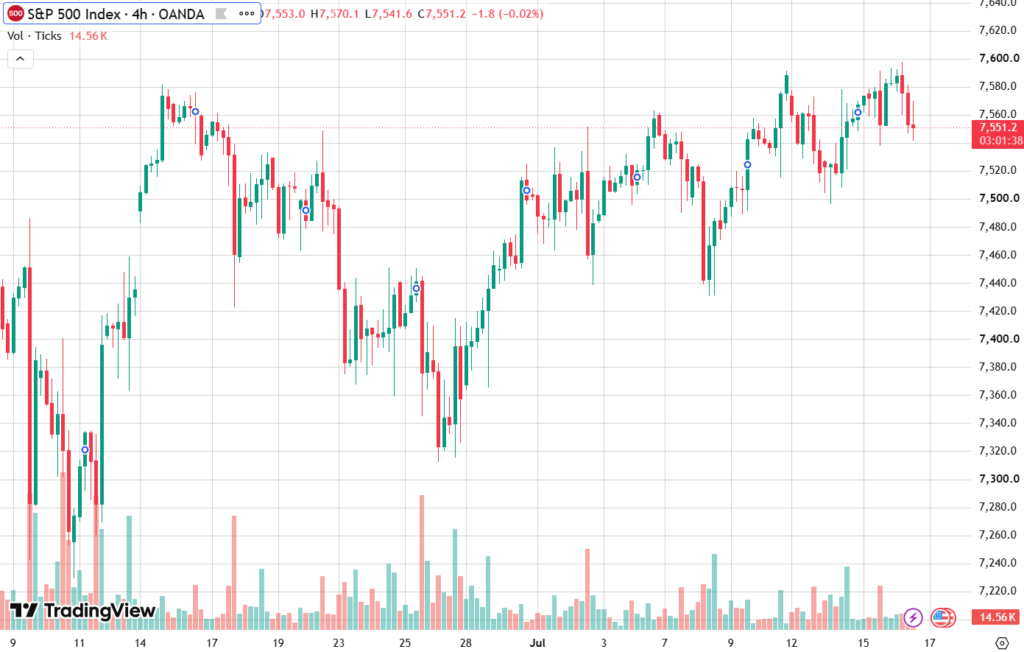
From a technical perspective, traders will closely watch whether the S&P 500 can establish itself above 7,580 before attempting a breakout toward the 7,615-7,625 resistance area. Failure to hold above the 7,540-7,550 support zone would instead increase the probability of a deeper pullback toward 7,450-7,460.
Conclusion
The latest Producer Price Index data has strengthened confidence that inflation pressures continue easing, supporting demand for US equities and helping the S&P 500 maintain its positive short-term outlook. Lower Treasury yields have reinforced this constructive environment, although geopolitical risks and energy market volatility remain important factors to monitor.
As long as the index continues holding above the 7,540-7,550 support area, buyers are likely to retain control of the short-term trend. Investors following this S&P 500 market analysis should continue monitoring inflation data, Treasury yields, and the key technical levels that may determine whether the current rally extends toward the 7,615-7,625 resistance zone and beyond.