
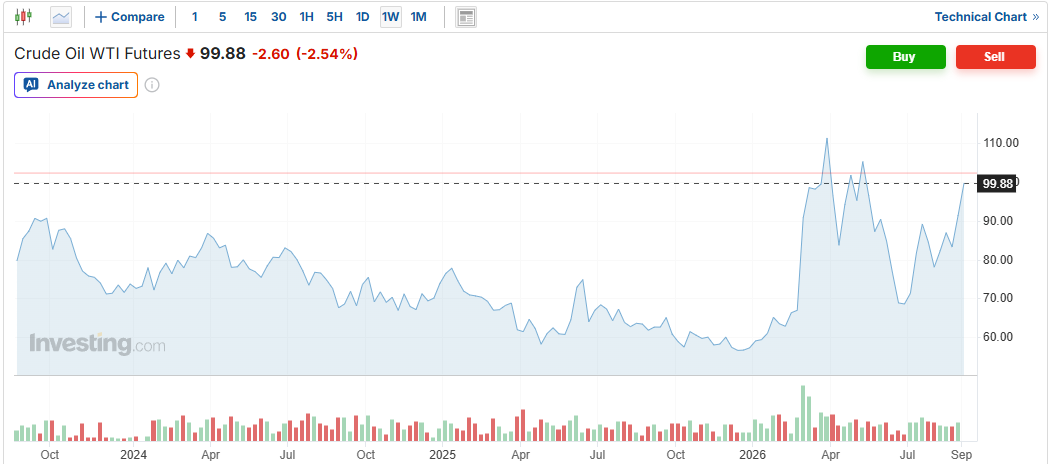
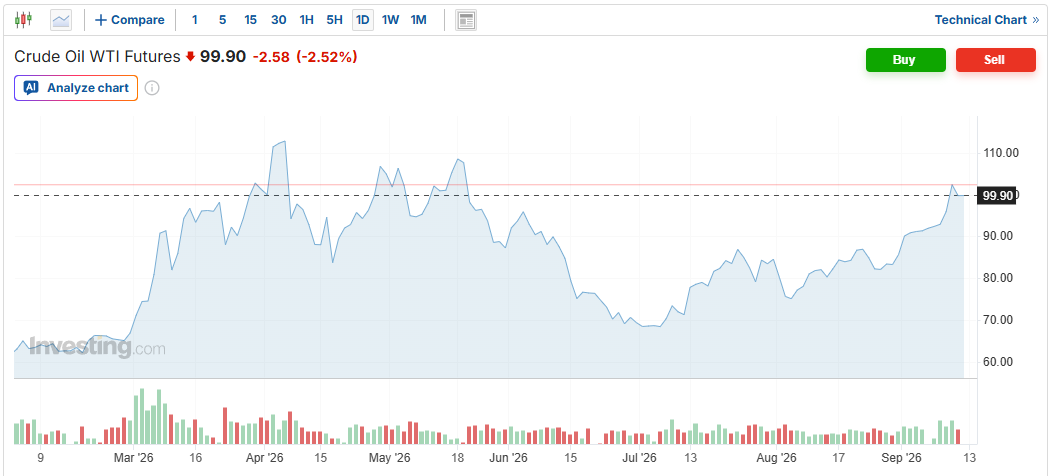
Rising energy expenses are introducing a new operational challenge for private credit borrowers who are already facing high borrowing costs and a difficult path to refinancing. With West Texas Intermediate futures trading near $99.02 a barrel and Brent crude hovering around $103.64, the return of triple-digit oil prices is amplifying input-cost and inflation risks.
This energy shock aligns with increasing market speculation about potential central bank policy tightening, given that inflation continues to remain above its target. Managing volatile credit markets demands disciplined underwriting and a thorough assessment of balance sheets.
A financial analyst at Financial Real Time noted that long-term enterprise value in private debt portfolios relies heavily on maintaining strong interest coverage ratios and effectively managing floating-rate debt exposure.
While direct lending strategies provide attractive yields to institutional investors, surging commodity prices pose a threat to corporate earnings in vulnerable sectors.
Evaluating Floating-Rate Vulnerabilities Amid Energy Shocks
A rise in borrowing costs carries profound implications for private credit markets, where direct loans typically utilize floating-rate debt structures priced at a spread over benchmark rates such as the Secured Overnight Financing Rate.
For corporate borrowers carrying floating-rate obligations, any benchmark rate increase immediately drives up interest expenses as reset dates occur.
Market strategists emphasize that energy-driven inflation represents a severe risk to leveraged borrowers because rising input costs and wages compress operational earnings on one side while floating-rate coupon payments expand on the other.
Analyzing Fitch Ratings And Private Credit Default Metrics
Borrower financial stress is already materializing visibly across private markets, with Fitch Ratings reporting that the U.S. private credit default rate reached a record 6.1%. Additional monetary tightening would compound pressures on highly leveraged enterprises, particularly those attempting to refinance credit facilities originated during the ultra-low-rate borrowing boom.
While market participants anticipate that refinancing hurdles will unfold as a gradual rolling process rather than a single market-wide shock, non-accruals and restructuring activities clearly signal heightened distress.
Deconstructing The Rolling Refinancing Wall Mechanics
Industry experts suggest that the refinancing wall is unlikely to materialize through a single dramatic crisis event. Instead, stronger borrowers are undertaking standard refinancings, whereas stressed credits are addressed through maturity extensions, amendments, equity injections, and formal restructurings.
The most exposed market participants are those entering higher-rate environments with heavy debt loads and thin cash cushions. Borrowers maintaining robust earnings growth and strong interest coverage ratios can absorb restrictive rates that would prove fatal for highly leveraged businesses operating near break-even coverage.
Balancing Portfolio Yields Against Rising Credit Losses
While lenders initially benefit from higher portfolio income as benchmark rates rise, this advantage can be partially offset by increased credit losses if marginal borrowers fail to meet their debt obligations. Small changes in interest rates quickly impact private credit portfolios due to their floating-rate structure.
However, investors caution that the ultimate threat to private credit is not isolated rate movements alone, but rather the broader macroeconomic combination of restrictive policy and sluggish economic growth undermining corporate cash flows.
Assessing Underwriting Standards And Maturity Extensions
Due to the fact that newer loans originated under significantly stricter underwriting standards, a significant portion of the necessary adjustment to higher borrowing costs has already taken place within private credit portfolios. Throughout previous market cycles, a great number of vulnerable companies were able to successfully extend their debt maturities or secure support from lenders.
In light of this, the anticipated payment shock that lies ahead is likely to be less severe than the severe adjustment cycles that private lenders have already successfully navigated. This is assuming that an unexpected economic recession does not occur.
Understanding Treasury Yield Movements And Market Expectations
U.S. Treasury yields have experienced upward pressure, with the benchmark 10-year note yield climbing toward 4.955% as inflation persistence concerns linger. Market participants note that lower-quality credits would require substantial additional basis-point increases before reshaping underwriting outcomes or triggering widespread systemic defaults.
A large number of borrowers and lenders had previously operated under the assumption that base rates would rapidly decline after reaching their peak. This assumption compelled a strategic shift toward the generation of operational cash flow and the reduction of leverage.
Key Takeaways for Private Market Investors Regarding Strategic Portfolios
Private credit borrowers can no longer rely on falling base rates to resolve refinancing equations, as evidenced by the recent convergence of rising oil prices, elevated bond yields, and persistent inflation.
This serves as a stark reminder that private credit borrowers are no longer under the same circumstances. The question of whether or not operating businesses are capable of the generation of sufficient earnings growth to support current all-in debt service costs has become the sole focus of investment attention.
Rigorous credit selection and proactive risk management remain essential for preserving capital across private debt allocations.