
The NZD/USD pair remains under pressure but stable near the 0.5785–0.5788 zone as traders avoid aggressive positioning ahead of the Federal Reserve monetary-policy announcement. Through this article, Vaulltier’s brokers examine the trends, challenges, and opportunities surrounding this topic.
After recovering from recent lows, the New Zealand Dollar (NZD) has struggled to extend gains against the US Dollar (USD), with price action indicating a market trapped between short-term stabilization and ongoing bearish pressure.
The pair is currently trading close to its recent consolidation range, reflecting uncertainty around the next major catalyst. The upcoming Fed decision, combined with updated guidance on interest rates, inflation expectations, and economic growth, is expected to determine whether NZD/USD develops a stronger recovery or resumes its previous decline.
US Dollar Weakness Limited by Pre-Fed Market Caution
The US Dollar Index (DXY) has softened as recent economic data pointed toward slower momentum in the US economy. The Conference Board Consumer Confidence Index declined to 90.8 in July, compared with a revised 92.2 in June, signaling weaker household sentiment.
Recent data suggest that conditions in the labor market are gradually weakening. The NER Pulse report indicated that private-sector companies in the US increased payrolls by just 15,000 jobs per week on average over the four weeks through July 11, representing the fifth straight week of slower hiring activity.
These figures have reduced demand for the Greenback, as traders reassess expectations for future Federal Reserve policy. However, the USD remains supported by safe-haven demand and cautious positioning before the central bank’s announcement.
Fed Decision Becomes the Main Fundamental Catalyst
The Federal Reserve is widely expected to maintain its current interest-rate policy, leaving markets focused on the tone of the accompanying statement and forward guidance.
A hawkish Fed outlook could trigger renewed USD buying, particularly if policymakers emphasize persistent inflation risks or maintain a restrictive policy stance. In this scenario, NZD/USD could face renewed selling pressure toward recent lows.
A more dovish Fed message could weaken the US Dollar and improve the outlook for the New Zealand Dollar, allowing the pair to challenge nearby resistance levels.
NZD Fundamentals Receive Limited Support from Lower Energy Prices
The New Zealand Dollar has gained some support from the sharp decline in crude oil prices, as lower energy costs benefit an economy dependent on imported fuel. Reduced energy expenses can improve domestic conditions by lowering import costs and easing inflation pressures.
Despite this support, the Kiwi Dollar remains vulnerable due to weak momentum and uncertain global risk appetite. The currency has been unable to generate a strong bullish move because investors continue to prioritize the Fed’s policy direction over secondary factors.
Technical Analysis: NZD/USD Tests Key Moving Averages
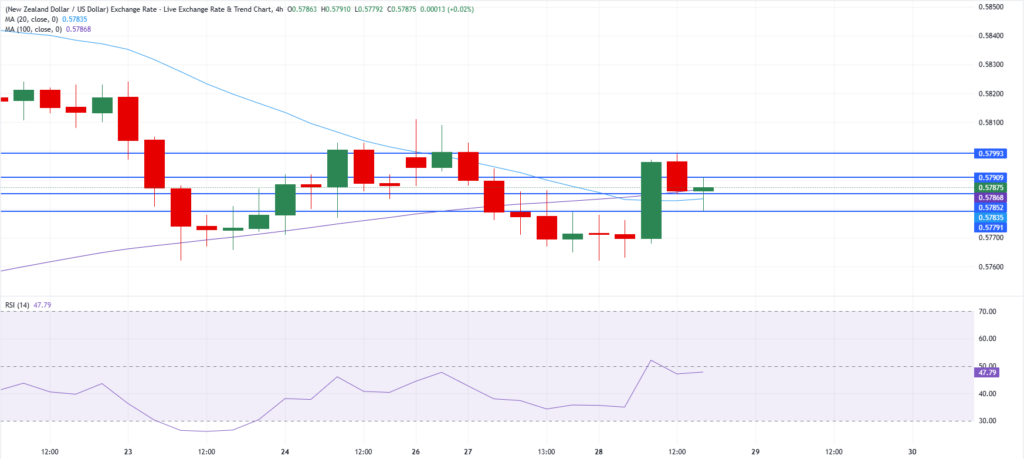
On the 4-hour chart, NZD/USD trades around 0.5788, positioned slightly above the 20-period Simple Moving Average (SMA) at 0.5783 and the 100-period SMA at 0.5787.
The proximity of these moving averages highlights a period of technical compression. The pair is attempting to establish a short-term base, but the lack of separation between price and moving averages indicates limited directional momentum.
The Relative Strength Index (RSI 14) is currently at 47.8, remaining below the neutral 50 threshold. This reading suggests that buying pressure is still insufficient to confirm a bullish reversal, while sellers have also failed to regain full control.
Resistance and Support Levels Define the Short-Term Range
The first upside barrier for NZD/USD is located at 0.5791, followed by stronger resistance near 0.5799. A confirmed break above 0.5799 would improve the short-term technical picture and could expose the pair toward 0.5907, followed by 0.5930 and 0.5965.
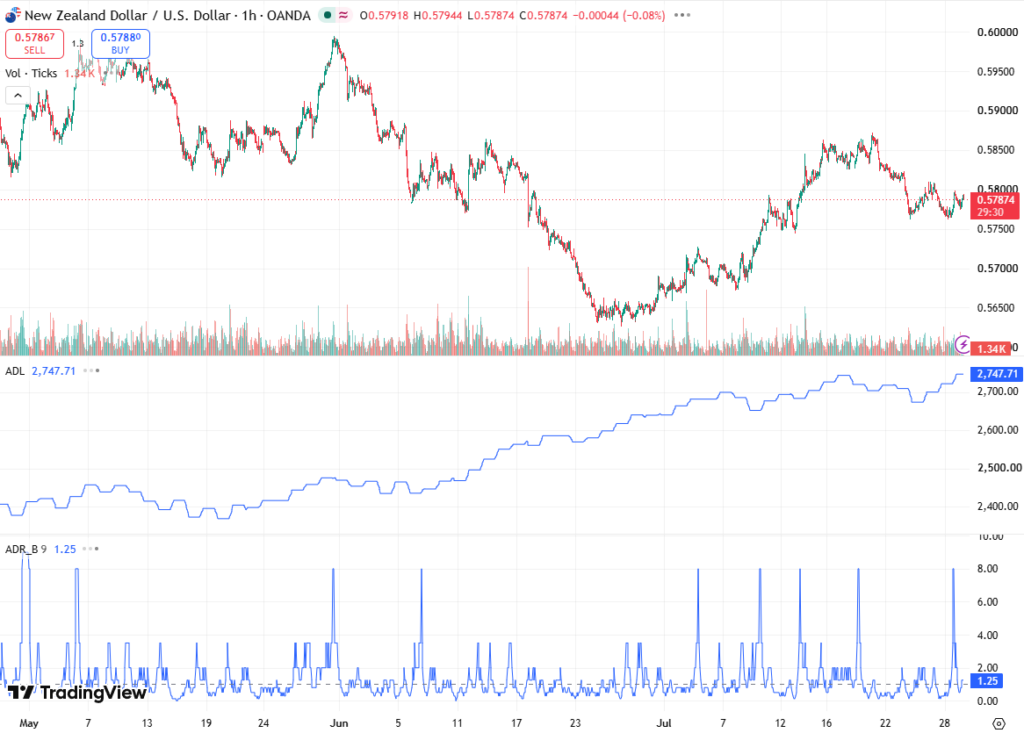
On the downside, immediate support remains concentrated around 0.5787, where the 100-period SMA provides technical protection. Additional support is located at 0.5785, followed by the 20-period SMA at 0.5783 and the lower support zone near 0.5779.
A sustained move below 0.5779 would invalidate the current stabilization attempt and increase the probability of a renewed bearish move. Such a breakdown could signal that sellers are targeting fresh yearly lows.
NZD/USD Forecast: Fed Signals to Determine Next Breakout
The current NZD/USD technical setup reflects a market waiting for confirmation. The pair is holding near 0.5785, but momentum indicators remain weak, and the price structure has yet to establish a clear bullish reversal.
The next directional move will likely depend on the Federal Reserve’s policy guidance. A stronger-than-expected USD reaction could push the pair back toward support levels, while a softer Fed stance may provide the catalyst for a recovery toward higher resistance zones.
Until the Fed decision provides a clearer signal, NZD/USD is expected to remain within a narrow technical range defined by 0.5779 support and 0.5799 resistance.