
Nvidia shares fell 9.26% to close at $181.60 on Wednesday, November 5, marking the chipmaker’s worst single-day decline since January 2025 and wiping approximately $447 billion from its market capitalisation in a single session.
The selloff rippled across the broader AI infrastructure sector, with a basket of 12 leading AI-exposed stocks losing a combined $1.44 trillion in market value, roughly 11.1% of the group’s aggregate capitalization at the previous close.
Analysts at AchievementsAI examine the fundamental and technical factors behind the decline, the question of whether the AI investment thesis remains structurally intact despite the magnitude of the pullback.
Data Centre Scrutiny and Competitive Threats Trigger the Rout
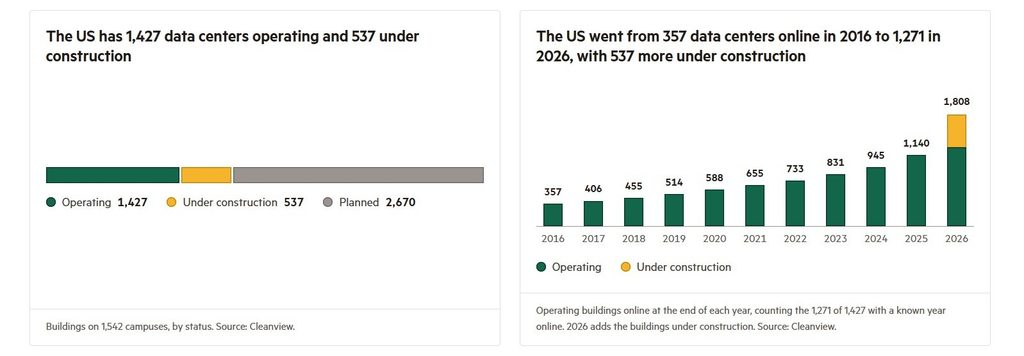
The selloff was driven by a convergence of factors that cast doubt on the pace of AI infrastructure spending. Reports indicated that approximately 50% of proposed US data centre additions could face heightened local scrutiny following the midterm election results.
A Goldman Sachs desk note circulated during the session estimated that roughly 45% of planned US data centre capacity could face the risk of pauses or regulatory delays.
For a company that derived $89.0 billion in Data Centre revenue in Q2 FY2027 alone, representing 117% year-over-year growth, any slowdown in the buildout pipeline directly threatens the revenue trajectory that justifies Nvidia’s premium valuation.
The competitive backdrop also contributed to the negative sentiment. Google’s announcement that its Gemini 3 large language model was trained entirely on proprietary TPU chips raised questions about whether hyperscaler customers could eventually reduce their dependence on Nvidia’s GPU ecosystem.
While Nvidia’s CUDA software moat remains significant, the demonstration that frontier models can be trained without its hardware introduces a long-term competitive variable that had not been priced into the stock.
The broader market context amplified the selling pressure. The Nasdaq Composite fell 5.5% on the session, while the S&P 500 dropped 4.4%.
Technology and semiconductor stocks bore the brunt of the rotation, with investors shifting into defensive sectors, Treasury bonds, and cash equivalents ahead of the October CPI report scheduled for the following week.
Valuation Recalibration After the Pullback
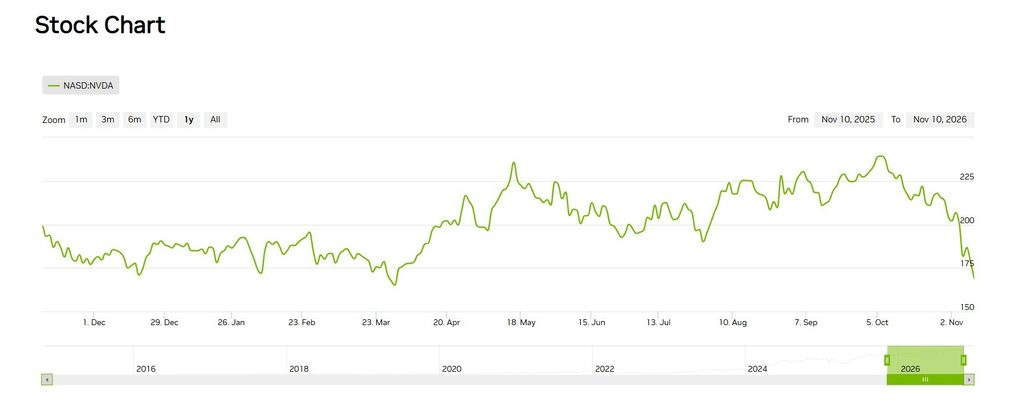
At $181.60, Nvidia traded 24.09% below its October 6 record close of $239.24 and 25.38% below its intraday all-time high of $243.37.
The stock had already declined 16.3% from its peak before the November 5 crash accelerated the drawdown, meaning that the total decline from highs now exceeds a quarter of the stock’s peak value.
On a forward earnings basis, the selloff has compressed Nvidia’s valuation considerably. Based on the FY2027 consensus EPS estimate of $9.31, the forward P/E stands at roughly 19.5x.
Looking further ahead to FY2028 consensus EPS of $15.91, the multiple drops to approximately 11.4x, a level that many growth investors would consider compelling for a company generating quarterly revenues above $96 billion with gross margins near 75%.
The Q3 FY2027 revenue guidance of $108 billion, plus or minus 2%, suggests that management expects the growth trajectory to continue through the current quarter.
Gross margin guidance of 74% points to only a marginal compression from the Q2 level, indicating that pricing power in the AI accelerator market remains robust despite the emerging competitive narrative.
Technical Damage and Key Levels to Watch Into Earnings
The November 5 close sits in the lower third of Nvidia’s 52-week range of $164.27 to $243.37.
The stock broke below its 200-day moving average on the session, a significant technical development that could trigger further mechanical selling from trend-following strategies, systematic momentum funds, and CTAs that use moving average signals as regime indicators.
Immediate support sits near $175, a level that corresponds to the late April consolidation zone and the area where the stock found buyers during the summer correction.
Below that, the $164 area represents the 52-week low and a level where long-term value-oriented buyers are likely to emerge with significant conviction.
On the upside, resistance sits at $195 and then the $200 psychological level, which the stock would need to reclaim to signal a meaningful technical recovery.
The November 9 session saw continued weakness, with shares falling a further 3.87% to $179.42, suggesting that selling pressure has not yet exhausted itself.
The earnings report on November 17 now carries outsized importance for the stock’s trajectory into year-end.
A strong beat accompanied by robust forward guidance could shift the narrative back toward AI infrastructure demand growth and trigger a short-covering rally.
Conversely, any softness in bookings, a reduction in the margin outlook, or cautious commentary about customer spending patterns would validate the selloff and potentially trigger further declines toward the 52-week low.