
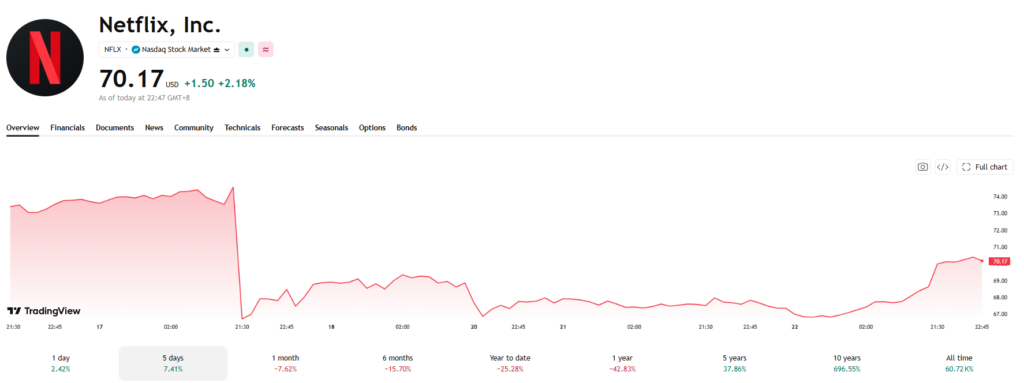
The streaming media landscape is experiencing a profound valuation reset, with Netflix, Inc. (NASDAQ: NFLX) positioned at the center of investor scrutiny. The streaming giant has witnessed a sharp pullback, trading down 44.32% over the past year and hovering near its 52-week low of $65.08.
This dramatic contraction follows a period of aggressive market repricing as Wall Street digests shifting corporate disclosure policies and moderating subscriber growth metrics. Despite these immediate headwinds, a deep divide remains between cautious retail sentiment and bullish institutional price targets.
The company recently reported second-quarter financial figures for 2026, delivering modest earnings per share of $0.80 alongside a minor revenue shortfall against a 13.37% year-over-year gain to $12.559 billion.
Daniel Hansen, a well-respected strategic analysis at Sequoia Edge emphasizes that long-term enterprise value depends on navigating these operational pivots successfully. Concurrently, free cash flow declined 32.73% due to higher cash tax obligations and timing adjustments, prompting market participants to reevaluate the equity’s risk-reward profile across near-term horizons.
Evaluating The Bullish Case For Margin Expansion And Buybacks
Optimistic analysts point to superior profitability metrics as justification for aggressive upside targets, with consensus figures extending up to $161.40 per share.
Netflix boasts an industry-leading operating margin of 33.4%, easily eclipsing legacy media streaming competitors like Disney+ and commanding premium valuation multiples relative to audio streaming peers.
Furthermore, the streaming pioneer is executing its largest capital return program in history, having repurchased $4.7 billion in common stock during the second quarter alone while maintaining $27.1 billion in remaining buyback authorization.
The advertising tier is emerging as a primary growth catalyst for the organization. Management guided full-year 2026 ad revenue to approximately $3.0 billion, effectively doubling the $1.5 billion generated in 2025, while active advertiser counts expanded 70% year-over-year to exceed 4,000 corporate clients.
Founder insider activity also signaled strong internal conviction, with former leadership purchasing 794,250 shares during recent market weakness. Projected full-year revenues between $51.0 billion and $51.4 billion, paired with expected free cash flow near $12.5 billion, underpin the argument for structural undervaluation.
Bearish Pressures And The Transparency Dilemma
Conversely, skeptical market participants highlight decelerating top-line momentum and diminished reporting visibility as significant risk factors. Quarterly revenue growth slowed to 16.19% in the first period and 13.37% in the second, with third-quarter projections cooling further to 12%.
Furthermore, management’s decision to discontinue reporting quarterly paid membership numbers has stripped analysts of their most reliable growth gauge, forcing the market to transition toward traditional media valuation metrics rather than high-growth tech multiples.
Prediction markets and crowd sentiment reflect palpable caution regarding near-term price stability. Engagement metrics have also drawn intense debate, as annualized view-hour growth slowed to just 2% during DMS opening half of the year.
Bears argue that front-loaded content amortization schedules, upcoming debt maturities totaling $1.0 billion, and net insider selling across recent transactions warrant a defensive posture until ad-tier revenues scale into explicit, reportable line items.
Comparative Peer Dynamics Across Entertainment Sectors
Assessing Netflix requires examining its competitive positioning against broader digital entertainment conglomerates. The Walt Disney Company operates with SVOD margins that remain depressed compared to Netflix’s premium profitability tier, validating the multiple expansion historically granted to the market leader.
Meanwhile, audio streaming alternatives trade at demanding forward earnings valuations, illustrating that Netflix shares offer an attractive entry point relative to its massive global scale, 330 million paid households, and unmatched cash generation capacity.
Institutional coverage reflects this bifurcation, characterized by 37 Buy ratings alongside 13 Hold recommendations and zero active Sell ratings. While consensus price targets hover near $97.70, short-term sentiment indicators suggest that trading ranges will remain volatile.
The core debate centers on whether investors are willing to trust internal engagement metrics while pricing shares through a lens of decelerating top-line expansion and tighter liquidity conditions.

Navigating Future Horizons And Core Enterprise Catalysts
As the streaming titan navigates the second half of 2026, market participants are closely monitoring specific financial thresholds to gauge underlying enterprise health. Sustaining an operating margin of 31.5% and defending robust free cash flow targets near $12.5 billion will be paramount for restoring institutional confidence.
Analysts are watching whether management can effectively offset front-loaded content amortization pressures while optimizing capital allocation structures across international markets.
If advertising revenue successfully scales toward reportable materiality, doubling to approximately $3.0 billion, and annualized view-hour growth reaccelerates beyond the recent 2% threshold, the current valuation depression may prove to be a generational buying opportunity.
Institutional buyers are particularly focused on whether the expanded base of over 4,000 corporate advertisers can translate into meaningful top-line acceleration. These milestones represent the primary foundation upon which a durable recovery can be built.