
The Nasdaq Composite remains above the important 26,000 level after softer US inflation data encouraged renewed demand for technology shares. Semiconductor companies also received support from continued optimism surrounding artificial intelligence infrastructure and advanced memory chips.
Brokers from Fondesia.com examine whether the index can extend its recovery toward recent highs or whether high valuations and uneven market participation could lead to consolidation. The Nasdaq recently gained around 0.9%, adding approximately 234 points to close near 26,107.
Technical Outlook Remains Positive
The Nasdaq’s return above 26,000 helps preserve its short-term bullish structure. Round-number levels often act as psychological support or resistance, particularly when markets are reacting to major economic releases.
Holding above 26,000 may encourage buyers to target the recent resistance area around 26,280 to 26,300.
The nine-day Exponential Moving Average may provide the first layer of dynamic support. If the index continues closing above this indicator, near-term momentum could remain constructive.
The 20-day EMA is more important for the wider trend. A sustained move beneath it could suggest that the Nasdaq is entering a broader consolidation phase.

Image 1: Nasdaq Daily Chart With the 9-Day and 20-Day EMAs, 26,000 Support and Resistance Near 26,300
RSI Could Confirm the Recovery
The 14-day Relative Strength Index can help determine whether buying momentum is strengthening.
An RSI reading above 50 would confirm that buyers retain an advantage. A rise toward 60 or 65 could support another test of recent highs without placing the index in clearly overbought territory.
A move above 70 would indicate overbought conditions. Technology-led rallies can remain overbought for several sessions, but elevated readings increase the likelihood of profit-taking.
Traders may also monitor bearish divergence. This would occur if the Nasdaq reaches a higher price level while RSI remains below its previous peak.
Resistance Near 26,300 and 26,500
The first resistance zone is positioned between 26,280 and 26,300, near a recent closing high.
A confirmed break above 26,300 could expose 26,500. This round number may attract additional selling orders and become an important test of the rally’s strength.
Beyond 26,500, the next targets may appear near 26,750 and the psychological 27,000 level.
Reaching these higher levels requires broad participation across the technology sector rather than gains concentrated in only a small number of large companies.
The principal resistance levels are 26,300, 26,500, 26,750, and 27,000.
Support and Pullback Risk
Immediate support is located around 26,000. The reaction near this level may determine whether the recovery remains intact.
Below 26,000, the Nasdaq could test 25,800, which may align with a short-term consolidation area and the rising 20-day EMA.
Further weakness could expose 25,500, followed by approximately 25,250. A decline into these areas would indicate a deeper correction rather than a brief pause.
A moderate retreat followed by renewed buying would support the bullish case. A decisive break below 26,000 on stronger trading volume would carry more bearish implications.
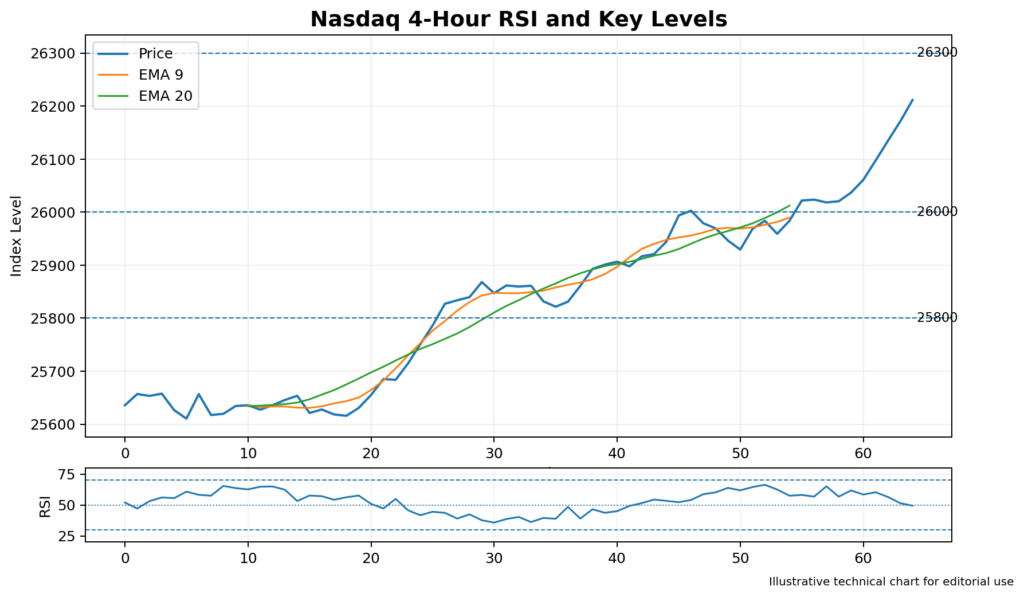
Image 2: Nasdaq Four-Hour Chart With RSI, Support at 26,000 and 25,800, and Resistance at 26,300 and 26,500
Softer Inflation Supports Growth Stocks
Technology shares benefited after US producer prices declined 0.3% in June, marking their largest monthly fall in 14 months. Consumer inflation had also come in softer than expected.
Lower inflation reduces pressure for an immediate interest-rate increase. This can support technology companies because their valuations are particularly sensitive to bond yields and borrowing costs.
Following the inflation data, markets placed an 83.4% probability on interest rates remaining unchanged at the July policy meeting, compared with 58.3% one day earlier.
However, renewed increases in oil prices could complicate the outlook by adding to future inflation pressure.
Semiconductor Demand Adds Momentum
Semiconductor shares have also benefited from optimism about demand for artificial intelligence systems, cloud computing, and advanced memory products.
A major Asian memory chip producer recently gained almost 13%, while other semiconductor companies recorded strong gains. Analysts pointed to demand continuing to exceed available supply, particularly for high-performance memory used in artificial intelligence applications.
This supports the wider technology sector, although rapid gains can also leave individual shares vulnerable to profit-taking.
Trading Implications
The Nasdaq retains a cautiously bullish bias while it remains above 26,000 and its short-term moving averages.
A confirmed move through 26,300 could expose 26,500 and 26,750, while 27,000 remains the larger target.
A break below 26,000 would weaken the recovery and shift attention toward 25,800 and 25,500.
Conclusion
The Nasdaq remains technically constructive above 26,000, supported by cooling inflation and strong semiconductor demand.
Resistance is positioned at 26,300, 26,500, 26,750, and 27,000. Support can be found near 26,000, 25,800, 25,500, and 25,250.
A breakout above 26,300, supported by stronger RSI and broader market participation, could lead to further gains. A sustained move below 26,000 would suggest that the recovery is losing momentum.