
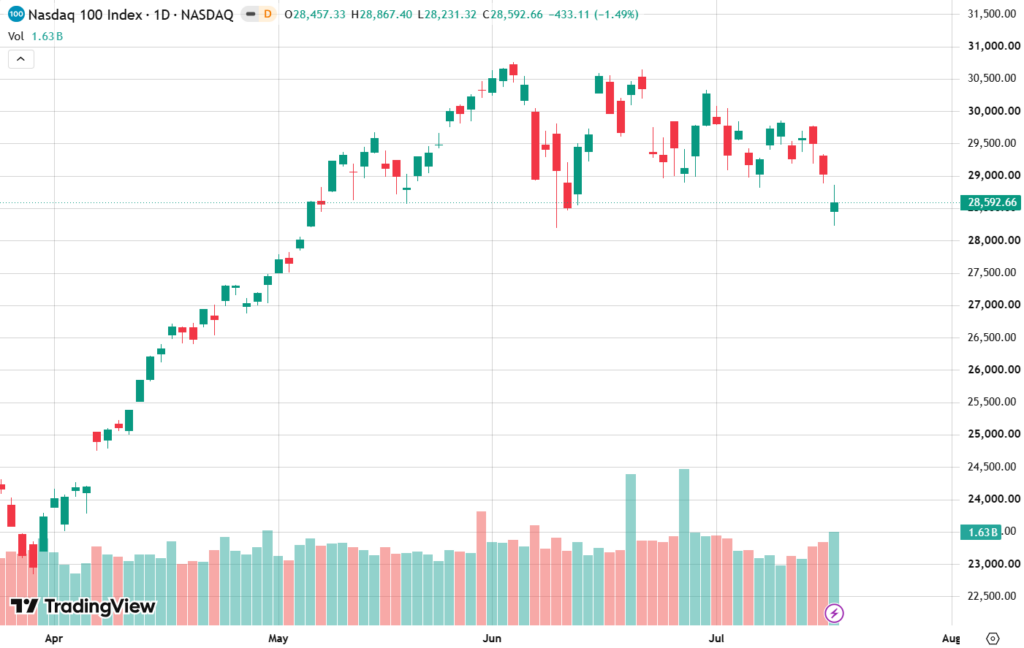
The Nasdaq 100 came under renewed pressure as another wave of selling hit major technology and semiconductor stocks. Despite broadly solid earnings, investors are becoming increasingly cautious about elevated AI valuations, prompting fresh profit-taking.
In its latest market analysis, Gammance brokers give a technical outlook for the Nasdaq 100, highlighting the key support and resistance levels while exploring the macroeconomic and sector-specific developments currently influencing market sentiment.
Technology Stocks Lead the Pullback
US equity futures pointed lower ahead of Friday’s opening session, with technology shares once again leading the decline. Nasdaq 100 futures fell around 1.6%, significantly underperforming both the Dow Jones and the S&P 500, as weakness across global semiconductor stocks continued to spread.
The selling pressure extended well beyond the United States. Taiwan’s benchmark index dropped 6.5%, while Japan’s Nikkei declined 4.4%, reflecting growing concerns surrounding the sustainability of recent gains within the semiconductor industry.
Several major technology companies also traded lower in pre-market activity. Shares of SanDisk, Applied Materials, and Dell Technologies remained under pressure, while AI leaders such as NVIDIA, Alphabet, Amazon, and Meta continued extending recent losses. Investors increasingly question whether current AI valuations already reflect future earnings.
Despite the recent weakness, corporate earnings have generally remained resilient. Large US banks reported solid quarterly results, while TSMC also delivered stronger-than-expected revenue and profit. However, markets continue to question whether the massive capital expenditures required to support AI infrastructure can justify current stock prices.
Technical Breakdown Signals Caution
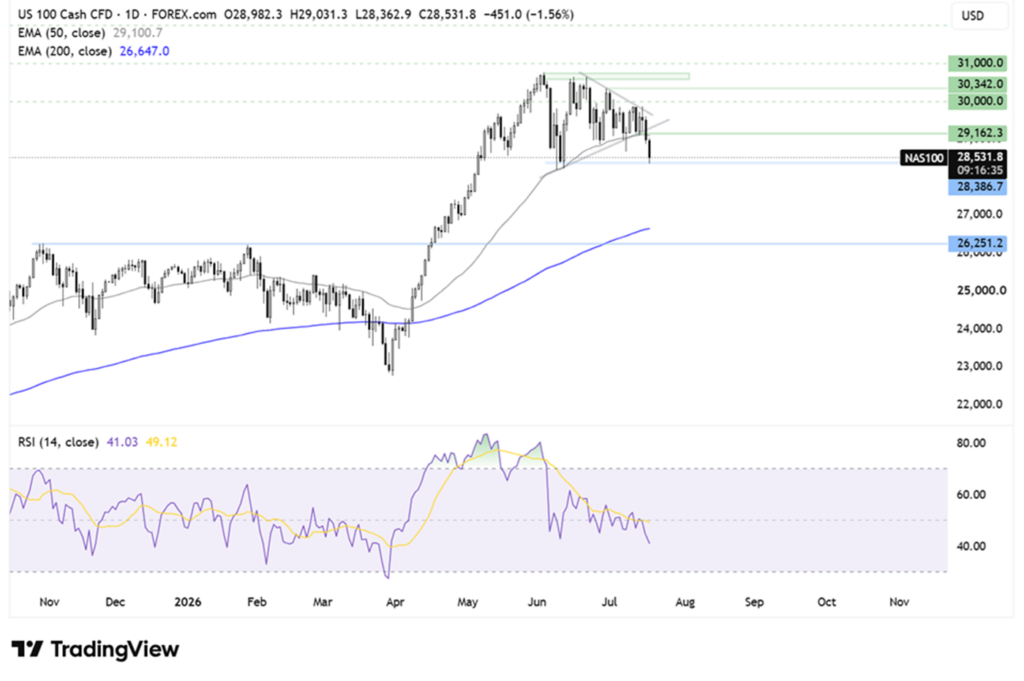
The technical picture has weakened noticeably over recent sessions.
The Nasdaq 100 has broken below a symmetrical triangle formation, a pattern that had previously suggested growing uncertainty between buyers and sellers. The breakout suggests bearish momentum could continue if key support levels fail.
Adding to the cautious outlook, the index is now trading below its 50-day Exponential Moving Average, while the Relative Strength Index has slipped below the neutral 50 level. Together, these indicators suggest that selling pressure currently outweighs buying momentum, even if short-term rebounds remain possible.
The first important support zone sits between 28,300 and 28,400. A decisive break beneath this region could expose the psychological 27,000 level before attention shifts toward the 200-day Exponential Moving Average, currently located near 26,650.
On the upside, buyers would first need to recover the 29,100 area, where the former triangle support and the 50-day EMA now converge as resistance. Beyond that, the market could begin targeting the 30,000 psychological level followed by the recent July high near 30,300.
AI Valuations Remain the Main Concern
While artificial intelligence continues to dominate long-term investment narratives, recent market behavior suggests investors are becoming more selective.
TSMC recently increased its 2026 capital expenditure guidance, reinforcing confidence in long-term AI demand. However, instead of fueling another rally, the announcement raised fresh questions regarding the enormous investment required throughout the semiconductor supply chain.
This shift in sentiment has encouraged many investors to lock in profits after an exceptionally strong rally across AI-related companies during recent months.
As a result, even fundamentally strong companies have experienced renewed selling pressure as portfolio managers rebalance positions following an extended period of outperformance.
Macro Factors Continue To Influence Market Sentiment
Beyond company-specific developments, broader macroeconomic conditions remain an important driver for equity markets.
Earlier in the week, softer-than-expected US inflation data initially improved expectations that the Federal Reserve may adopt a less aggressive monetary stance. However, renewed geopolitical tensions between the United States and Iran have complicated that narrative by pushing oil prices higher and reviving concerns over future inflationary pressures.
Higher energy prices could influence central bank policy if inflation remains persistent. Investors will also monitor upcoming US consumer confidence data for additional clues regarding domestic demand and the overall health of the economy.
Bond yields, inflation expectations, and developments across commodity markets are therefore likely to remain closely connected with technology sector performance over the coming weeks.
Key Levels to Watch
Several technical levels remain particularly important for traders monitoring the Nasdaq 100.
Immediate support is located between 28,300 and 28,400, followed by the psychological 27,000 level and the 200-day EMA near 26,650. On the upside, the first recovery objective remains 29,100, with stronger resistance located around 30,000 and the recent swing high near 30,300.
These levels will help determine whether the pullback deepens or stabilizes.
Conclusion
The Nasdaq 100 has entered a more cautious technical phase after breaking below its recent symmetrical triangle pattern and falling beneath the 50-day EMA. Although corporate earnings remain broadly supportive and the long-term AI narrative is still intact, investors have become increasingly sensitive to elevated valuations following months of exceptional gains.
Traders now remain focused on macroeconomic developments and key technical levels. A sustained recovery above 29,100 would improve the short-term outlook, while a confirmed break below 28,300 could accelerate selling pressure toward lower support zones.