
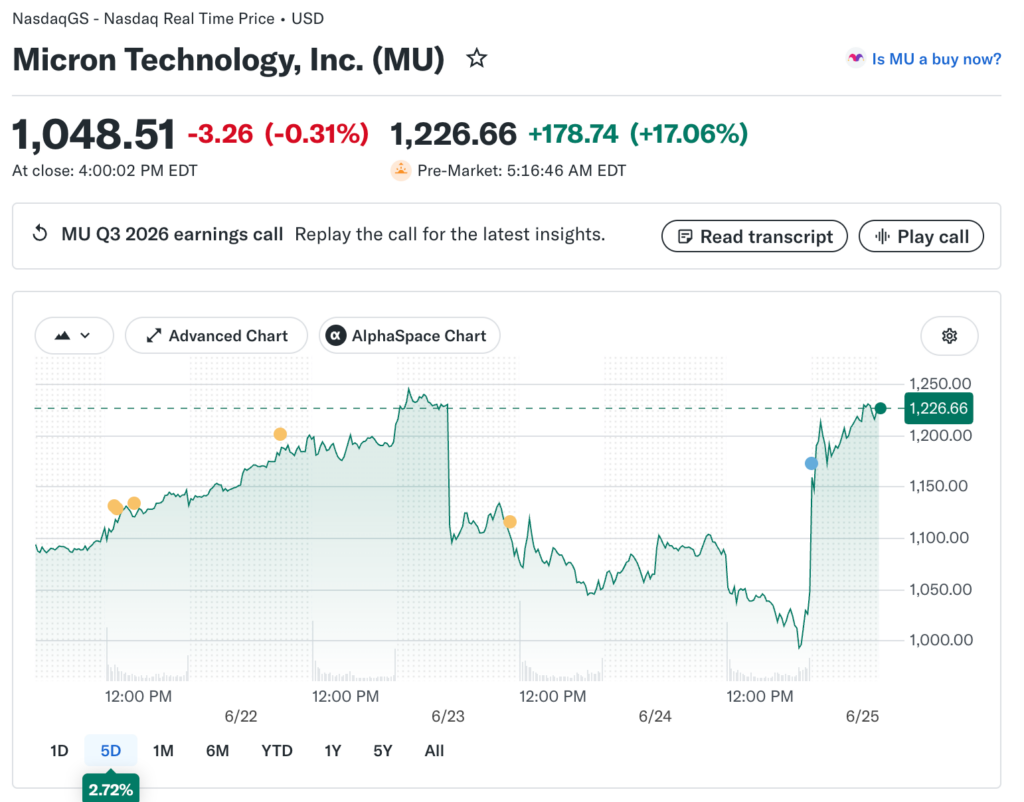
Micron Technology delivered what analysts immediately described as the strongest quarter in the company’s history after the close on June 24, 2026, sending shares surging roughly 12.6% in after-hours trading. The numbers made the pre-earnings selloff look like an overreaction in real time.
EPS came in at $25.11 against a consensus of $20.20, a 24.31% beat, while revenue reached $41.46 billion against expectations closer to $35 billion. A senior financial analyst at Winseterra says the report did not just beat estimates. It rewrote the forward revenue model for the entire AI memory sector heading into June 25.
The Numbers That Changed the Conversation
Micron’s Q3 fiscal 2026 result represented a dramatic jump from the $1.91 EPS the company posted in the same quarter one year earlier. That year-over-year comparison captures the pace of the AI high-bandwidth memory supercycle better than any analyst note could describe.
The company simultaneously raised its Q4 guidance to $49 billion to $51 billion in revenue, a projection that exceeded even the most optimistic pre-earnings analyst targets and forced immediate revisions across Wall Street research desks.
Capital expenditure came in at $7.1 billion for the quarter, reflecting the scale of manufacturing investment Micron is committing to sustain HBM supply to hyperscaler customers. The company also declared a $0.15 dividend, a signal that management is confident enough in cash generation to return capital while simultaneously funding one of the most aggressive capacity expansion programs in semiconductor history.
Why Q4 Guidance Matters More Than the Q3 Beat
A Q4 revenue guidance range of $49 billion to $51 billion deserves more analytical attention than the Q3 beat, substantial as that was. Guidance at that level would represent a sequential revenue increase of roughly 20% from an already record-breaking quarter.
That trajectory implies the supply constraint driving Micron’s pricing power is not easing but intensifying as hyperscaler AI infrastructure buildout accelerates into the second half of 2026.
TD Cowen had raised its price target to $1,500 before the earnings release. Goldman Sachs maintained a neutral rating with a $900 target, noting investor positioning was extremely bullish given the dramatic share price run-up.
The Q4 guidance landing well above the most optimistic pre-earnings scenarios effectively validated the TD Cowen thesis and created significant pressure on more cautious analyst positions to revise upward heading into June 25.
The DRAM ETF and Sector Implications
The DRAM ETF had hit all-time highs even on June 23 when Micron’s individual stock was falling more than 11%. That divergence between sector conviction and company-specific fear resolved exactly as the ETF’s behavior suggested it would.
When Micron’s numbers confirmed that AI memory demand is generating revenue at a scale exceeding even elevated expectations, the sector thesis was validated not just for Micron but for the entire memory supply chain.
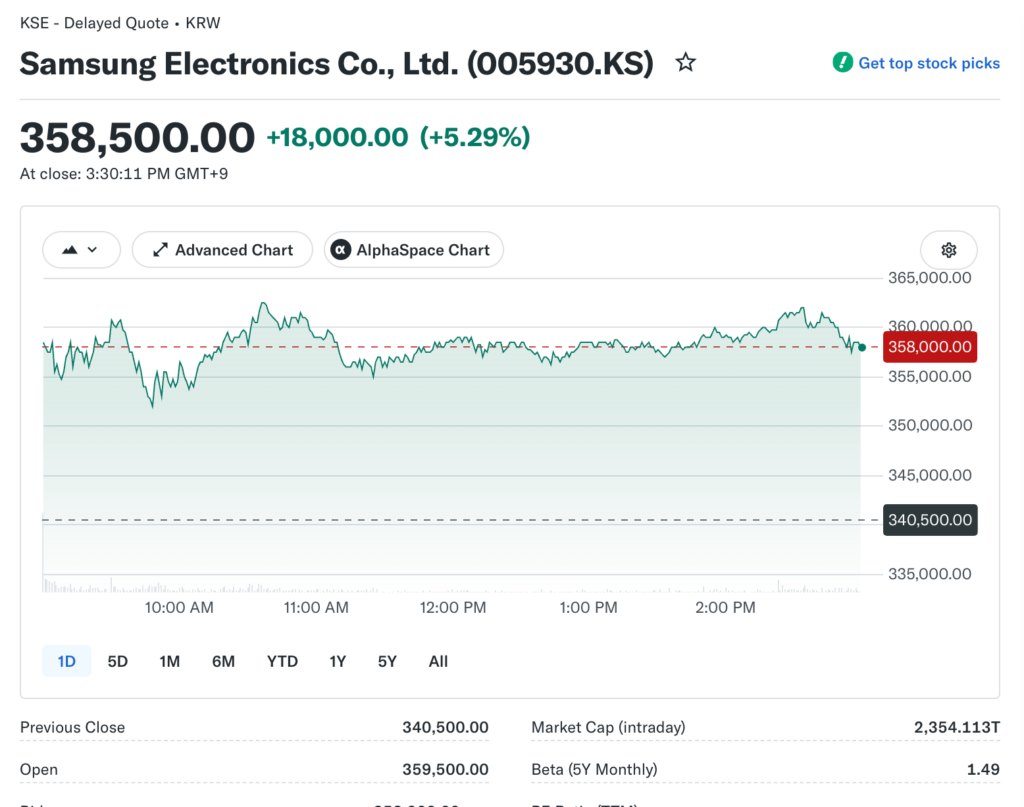
SK Hynix, Samsung, and the broader memory infrastructure ecosystem all benefit when Micron confirms that HBM demand is outrunning supply by a margin large enough to generate a 24% EPS beat. That read-through is the reason the DRAM ETF’s all-time high on June 23 was a better forward signal than Micron’s individual stock decline on that same session, and the June 24 earnings result confirmed exactly what the ETF was pricing.
What Micron’s Result Says About the Fed’s Rate Path
The Micron beat arrives one day before May PCE inflation data on June 25. The combination of record Micron earnings and an oil price that has fallen to $73.74 per barrel for Brent, its lowest level since before the Iran conflict began, creates a market environment heading into June 25 that is constructively positioned for a softer PCE reading.
Lower energy costs feeding into PCE, combined with a tech sector earnings beat that validates AI infrastructure spending, removes two of the three headwinds compressing technology valuations since June 17.
The third headwind, the Fed’s hawkish rate posture, remains. But PCE data on June 25 carries the most direct power to address it. A reading that shows energy-driven inflation relief flowing through the index would reduce rate-hike probability and give the Micron-driven after-hours enthusiasm durable legs into regular trading.
KB Home and the Consumer Signal Investors Missed
While Micron dominated the June 24 narrative, KB Home quietly added 3% after reporting fiscal Q2 revenue of $1.11 billion, narrowly beating analyst estimates of $1.10 billion. Homebuilder results are a direct read on housing demand and mortgage rate sensitivity, given that the thirty-year fixed mortgage rate has been running near 6.47% throughout 2026.
KB Home beating revenue estimates even marginally in that rate environment signals that housing demand is more resilient than the macro picture implies. That result, combined with Micron’s blowout earnings and Brent crude falling to $73.74, gives the equity market a constructive three-part foundation heading into PCE data on June 25.
Whether the index-level performance reflects all three positives or focuses narrowly on the inflation number is the session’s central question.