
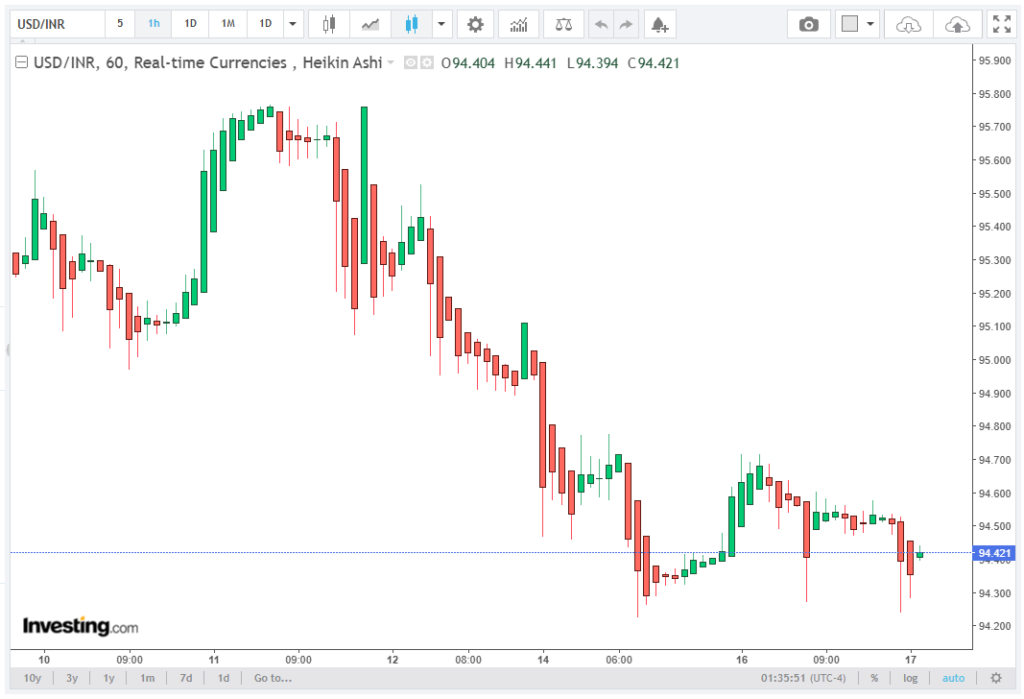
The Indian Rupee (INR) remains largely flat on Wednesday, consolidating after gaining for two consecutive sessions against the US Dollar (USD). The USD/INR pair is trading near 94.40–94.50, reflecting a low-volatility equilibrium zone where neither directional bias has achieved dominance. In this article, Nummixo brokers provide a clear and accessible breakdown of the topic.
Price action indicates a compressed range structure, with intraday movement constrained within approximately 0.15–0.25%, suggesting declining realized volatility across the spot market.
The current stabilization is primarily driven by three synchronized macro variables: declining crude oil prices, balanced equity flows, and a broadly risk-on global sentiment environment that has weakened USD demand at the margin.
Crude Oil Correction Strengthens INR Macro Support
A key structural support for the INR comes from sustained weakness in global crude benchmarks. WTI crude oil is trading near $75.20 per barrel, marking a multi-session decline and extending losses for the fifth consecutive trading day.
This downward trajectory reflects increasing market probability of expanded global supply, with expectations of a potential US–Iran interim agreement facilitating the return of Iranian exports. Market pricing currently reflects an estimated 3–5 million barrels per day of latent supply risk normalization, which would materially shift the global oil balance.
For India, every $1 decline in crude oil typically improves the current account balance by approximately 0.04% of GDP, making recent oil weakness a statistically meaningful tailwind for the currency.
The result is a reduced import bill pressure, improving the INR’s structural stability and lowering downside risk even in the presence of external financial tightening.
External Balance Dynamics and RBI Positioning
Recent macro revisions following policy normalization by the Reserve Bank of India (RBI) indicate a notable shift in India’s external account trajectory. Economists have adjusted forecasts from a projected –1.2% of GDP deficit toward a marginal surplus, ranging between +0.1% and +0.3% of GDP.
This improvement is driven by a combination of moderating import costs, stable remittance inflows, and resilient services export growth exceeding 7–8% year-on-year.
From a reserve management perspective, the RBI is estimated to hold a foreign exchange buffer exceeding $640 billion, alongside a large forward short-dollar book near $100–105 billion, reflecting prior intervention cycles.
Market participants increasingly expect the central bank to utilize periods of INR strength to optimize forward exposure, potentially reducing synthetic dollar liabilities while maintaining spot market stability within a controlled corridor.
This introduces a structural ceiling on excessive INR appreciation, reinforcing a managed float regime with asymmetric intervention tolerance.
Global Monetary Policy Expectations and USD Volatility Drivers
Market attention is concentrated on the upcoming policy decision by the Federal Reserve, with expectations firmly anchored in a hold decision, maintaining policy rates within the 3.50%–3.75% corridor.
However, forward guidance remains the key driver of FX volatility. Market-implied probability models suggest a 60–70% likelihood of persistent restrictive bias messaging, which could temporarily support USD strength.
The USD index has recently exhibited a downward skew in momentum indicators, but remains sensitive to communication-driven repricing.
The INR, as a high beta emerging market currency, typically exhibits a 0.4–0.6 correlation coefficient with USD index movements, implying that any hawkish repricing could reintroduce short-term depreciation pressure.
Technical Structure: USD/INR Inside Descending Triangle Compression
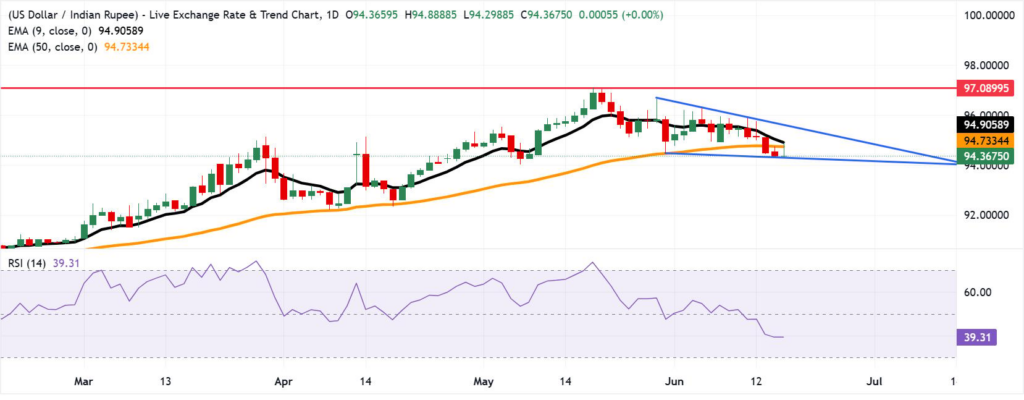
From a technical standpoint, USD/INR remains in a clearly defined descending triangle formation, with horizontal support anchored near 94.30 and a declining resistance trendline compressing price action.
The pair is currently trading at 94.40, slightly above the lower boundary, indicating a critical liquidity test zone where market participants assess whether structural buyers remain active.
The 9-day and 50-day Exponential Moving Averages (EMAs) are positioned at approximately 94.90 and 94.73, both above spot, confirming a persistent bearish alignment structure.
This EMA configuration indicates negative momentum clustering, where short- and medium-term trend signals remain aligned in a downward bias.
The 14-day Relative Strength Index (RSI) is hovering near 40, indicating weak momentum without oversold exhaustion, which typically implies continuation probability rather than immediate reversal.
Volatility compression within the triangle suggests an impending directional breakout, with statistical bias slightly favoring downside continuation if 94.30 support is breached on a closing basis.
Outlook: Controlled Range with Downside Skew
The USD/INR pair is expected to remain in a tight consolidation band, driven by offsetting macro forces.
Supportive elements include declining crude oil prices, improving external balance dynamics, and stable domestic equity participation. Counterbalancing pressures include potential hawkish global monetary signals, intermittent risk-off geopolitical shocks, and structurally capped appreciation due to central bank balance sheet management behavior.
Overall, the bias remains mildly bearish within a controlled volatility regime, with increasing probability of a directional breakout as the 94.30 support threshold approaches a decisive technical test.