
The USD/IDR exchange rate advanced for a second consecutive session, trading near 17,980 during Asian hours as the Indonesian Rupiah (IDR) remained under depreciation pressure despite intervention by Bank Indonesia (BI). Discover what Rubinax’s experts have to say about this topic in this detailed analysis.
The currency pair’s appreciation reflects persistent demand for the US Dollar (USD), shifting Federal Reserve interest-rate expectations, and sensitivity to global capital flows. The inability of intervention measures to generate a sustained Rupiah recovery highlights the influence of external monetary conditions on Indonesia’s foreign exchange market.
Bank Indonesia has reiterated its commitment to exchange-rate stabilization through direct transactions in the spot market and onshore and offshore non-deliverable forward (NDF) markets.
Spot intervention involves buying Rupiah and selling foreign currency when necessary to counter excessive depreciation, while NDF operations can influence forward pricing and currency-hedging costs. These measures seek to moderate volatility, improve market liquidity, and discourage disorderly speculative positioning.
Indonesia’s Growth Forecast Improves to 5.1%
The International Monetary Fund (IMF) raised Indonesia’s 2026 GDP growth forecast to 5.1%, from 5.0% previously, reflecting stronger expected household consumption and an anticipated acceleration in government expenditure.
The 0.1-percentage-point upward revision indicates improved expectations for domestic economic activity, potentially supporting corporate earnings, fiscal revenues, and medium-term investor confidence.
Stronger consumption can sustain economic growth by supporting retail sales, services, and employment. However, the implications for the Rupiah depend on whether domestic demand strengthens exports and investment sufficiently to offset higher imports.
Robust GDP growth alone does not guarantee currency appreciation, particularly when international yield differentials favor foreign assets.
US Inflation Strengthens Hawkish Fed Expectations
The latest US Consumer Price Index (CPI) report has intensified uncertainty surrounding the Federal Reserve’s monetary-policy trajectory.
Headline CPI increased 0.6% month-over-month, while annual inflation reached 3.7%, exceeding the 3.6% consensus forecast. Core CPI, excluding food and energy, advanced 0.3% monthly and 2.6% annually, compared with market expectations of 0.2% and 2.5%, respectively.
The monthly headline increase matched forecasts, but the elevated annual rate and stronger-than-expected core inflation reinforced concerns that underlying price pressures remain persistent. Consequently, investors reassessed the likelihood of additional monetary tightening at the upcoming Federal Open Market Committee (FOMC) meeting.
According to CME Group’s FedWatch tool, futures markets priced in approximately a 31.6% probability of a rate hike at the late-October meeting. Although this probability does not establish that an increase will occur, it reflects a meaningful repricing of policy risk.
A more hawkish Fed could support the USD through higher expected Treasury yields and tighter global dollar liquidity. Wider US–Indonesia interest-rate differentials may reduce the relative attractiveness of Rupiah-denominated assets, particularly when investors demand additional compensation for emerging-market currency risk.
This dynamic could sustain USD/IDR upside pressure despite BI intervention.
USD/IDR Technical Outlook: 17,980 Remains Bullish Territory
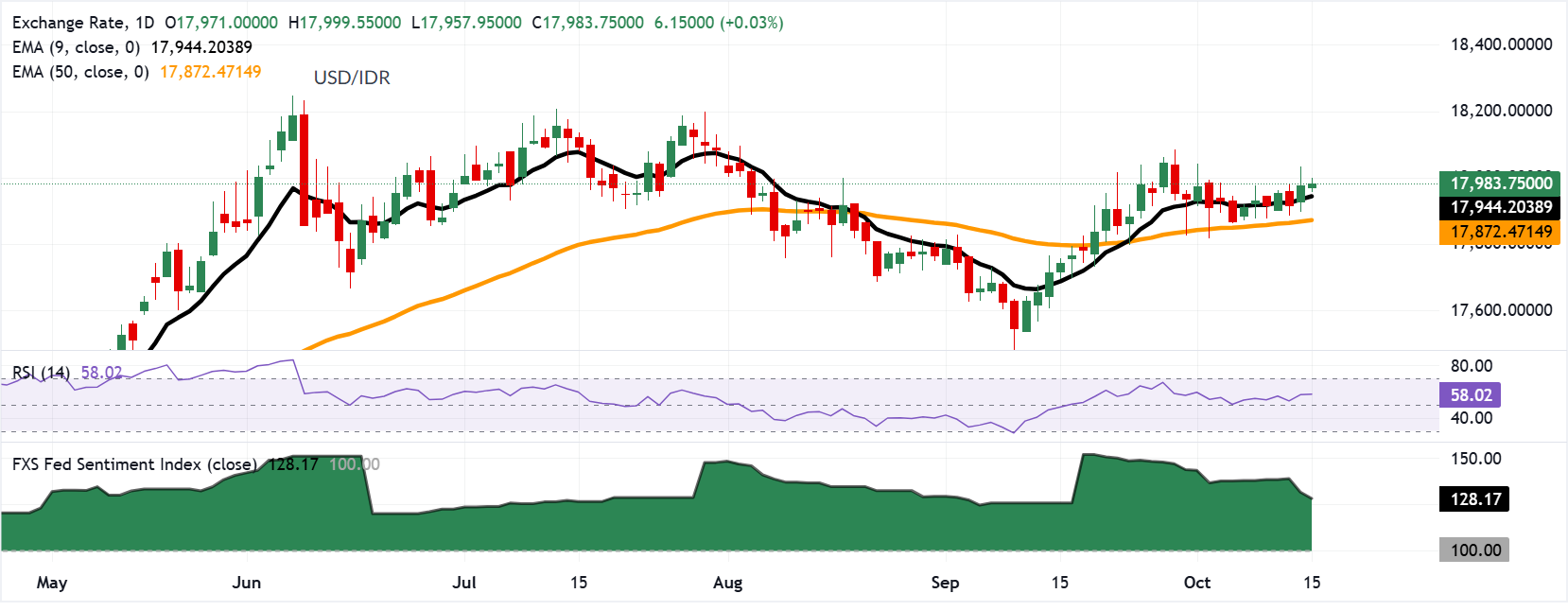
The daily chart indicates that USD/IDR retains a bullish near-term structure, with the exchange rate trading around 17,980, above both the nine-day EMA at 17,944.20 and the 50-day EMA at 17,872.47. This positioning suggests that short-term price momentum remains positive and that recent buying interest has not yet been invalidated.
The nine-day EMA provides immediate support approximately 35.80 points below the prevailing exchange rate. A sustained hold above this level would reinforce the current upward bias. The 50-day EMA, approximately 107.53 points below spot, represents a deeper support zone where additional buying interest could emerge during a corrective move.
The 14-day Relative Strength Index (RSI) near 58 remains above the neutral threshold of 50 but below the conventional 70 overbought level. This indicates positive momentum without an established overbought signal. Nevertheless, a failure to establish fresh highs could produce momentum divergence or consolidation, particularly if dollar demand weakens.
A sustained move above 17,980 would keep the bullish structure intact, although a confirmed breakout would require follow-through buying. A daily close below 17,944.20 would weaken immediate momentum, while a break beneath 17,872.47 would indicate a more substantial deterioration in the technical setup.
Conclusion
The Indonesian Rupiah remains vulnerable despite Bank Indonesia’s spot and NDF interventions, as stronger US inflation and a 31.6% implied probability of a Federal Reserve rate hike support dollar demand.
Indonesia’s upgraded 5.1% growth forecast offers a positive domestic fundamental backdrop, but energy-import exposure and international yield differentials remain significant risks. Technically, USD/IDR near 17,980 retains a bullish bias above the 17,944.20 nine-day EMA and 17,872.47 50-day EMA, while the RSI at 58 signals positive but not overextended momentum.
The next directional move will depend on the interaction between BI intervention, US monetary-policy expectations, capital flows, and key technical support levels.