
Gold (XAU/USD) trades with a modest bullish bias below $4,150, supported by declining US Treasury yields and a corrective pullback in the US Dollar (USD) from an 18-month high. The recovery follows a three-session losing streak, although the precious metal has yet to establish a decisive bullish reversal.
Persistent inflationary pressures, elevated interest-rate expectations, and geopolitical uncertainty continue to constrain upside momentum. Find valuable insights and expert perspectives on this topic in Rubinax’s latest article.
The decline in US bond yields has reduced the opportunity cost of holding non-yielding gold, providing near-term support for bullion. Additionally, USD profit-taking has improved the metal’s relative attractiveness to international investors. However, repeated failures to sustain gains above $4,200 indicate that selling pressure remains significant at higher levels.
Market participants are balancing the effects of a weaker dollar against the possibility of additional Federal Reserve (Fed) monetary tightening. This divergence in fundamental drivers has kept XAU/USD within a technically vulnerable recovery structure, with traders awaiting fresh macroeconomic catalysts.
Elevated CPI Reinforces Hawkish Federal Reserve Expectations
The latest US inflation data have strengthened concerns about persistent price pressures. Headline Consumer Price Index (CPI) inflation accelerated from 3.4% to 3.7% year over year, exceeding consensus expectations. Meanwhile, core CPI increased to 2.6% from 2.4%, indicating that underlying inflation remains elevated despite previous monetary tightening.
These readings complicate the Fed’s efforts to bring inflation toward its 2% target. Persistent inflation increases the probability of higher interest rates or an extended period of restrictive monetary policy, both of which can weigh on gold through higher real yields and stronger demand for dollar-denominated assets.
San Francisco Fed President Mary Daly indicated that additional rate increases may be necessary, but that immediate action is not required. This stance reflects a cautiously hawkish, data-dependent policy framework rather than an immediate commitment to further tightening.
Markets continue to price in an over 85% probability of another rate increase by the end of the year. The US Dollar remains vulnerable to short-term corrections but retains underlying support from expectations of higher borrowing costs. For gold, a sustained decline in US real Treasury yields would be a more convincing bullish signal than nominal yield weakness alone.
Energy Inflation and Geopolitical Risks Limit Bullish Momentum
Energy-price volatility represents a significant upside risk to inflation. Higher crude oil prices can increase transportation, manufacturing, and distribution costs, potentially slowing disinflation and forcing the Fed to maintain restrictive financial conditions for longer.
At the same time, escalating geopolitical tensions across the Middle East and Eastern Europe are increasing uncertainty surrounding energy supply chains and maritime security. Disruptions around strategic shipping routes could elevate oil prices, reinforce inflation expectations, and strengthen demand for safe-haven assets.
However, geopolitical uncertainty can support both gold and the US Dollar, creating competing safe-haven flows. The greenback’s liquidity and relative defensive appeal may limit bullion’s gains, particularly if energy-related inflation increases expectations of further monetary tightening.
This interaction between inflation expectations, real yields, and safe-haven demand remains central to the near-term gold outlook. A decline in the dollar alone may not sustain a rally unless accompanied by improving technical momentum and a reduction in rate-hike expectations.
Technical Analysis: XAU/USD Support and Resistance Levels
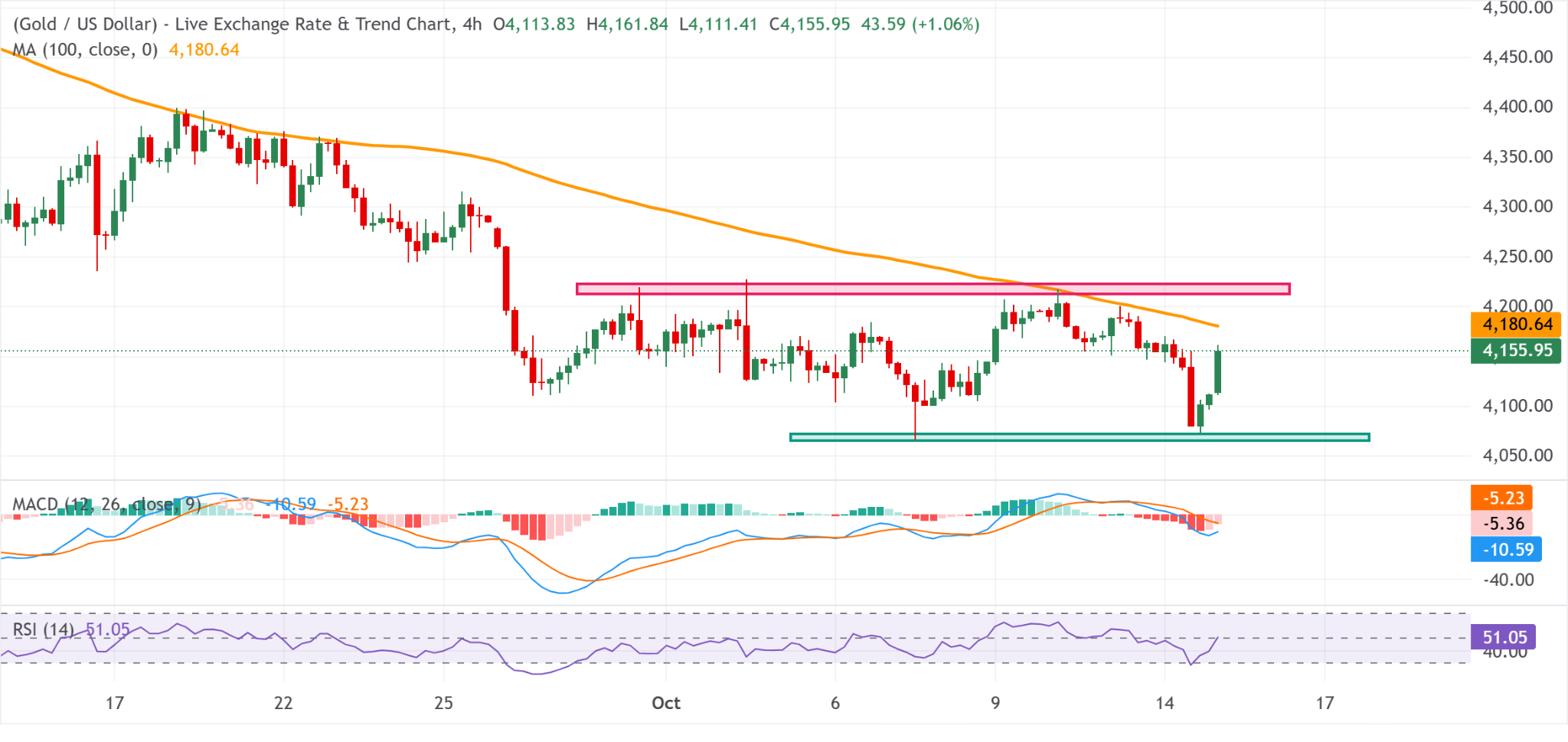
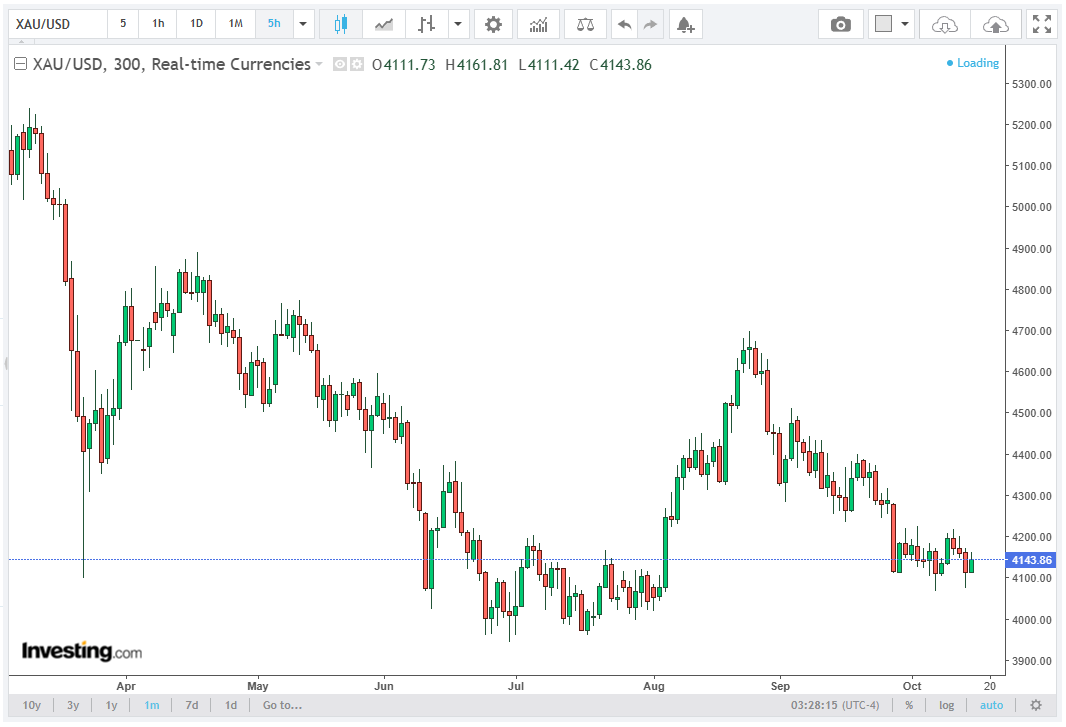
Technically, gold maintains a bearish-to-neutral short-term structure, trading below the 100-period Simple Moving Average (SMA) on the four-hour chart. This positioning suggests that the recovery has not yet invalidated the prevailing downside bias.
The Moving Average Convergence Divergence (MACD) remains below its signal line and in negative territory, although its contracting histogram indicates fading bearish momentum. Meanwhile, the Relative Strength Index (RSI) is stabilizing near 50, reflecting neutral momentum rather than a confirmed bullish breakout.
Initial resistance stands near $4,180, corresponding to the 100-period SMA. Above this level, the 4,215-4,220 resistance zone represents the principal technical barrier. A sustained four-hour close above this range could confirm improving momentum and expose higher resistance levels.
On the downside, $4,100 represents immediate support, followed by the 4,075-4,065 demand zone. A decisive breakdown below this region would strengthen the bearish structure and increase the probability of further downside continuation.
Conclusion
Gold remains supported by USD weakness and declining Treasury yields, but bullish conviction is limited by persistent inflation and elevated Fed rate-hike expectations. The 4,180-4,220 resistance structure must be overcome to establish a more constructive technical outlook, while $4,100 and 4,075-4,065 remain critical downside levels.
The US PPI report, real-yield movements, and changes in monetary-policy expectations will determine whether the current consolidation develops into a sustainable recovery or resumes its broader bearish trajectory.
Until a decisive breakout occurs, XAU/USD remains vulnerable to two-way volatility and event-driven repricing.