
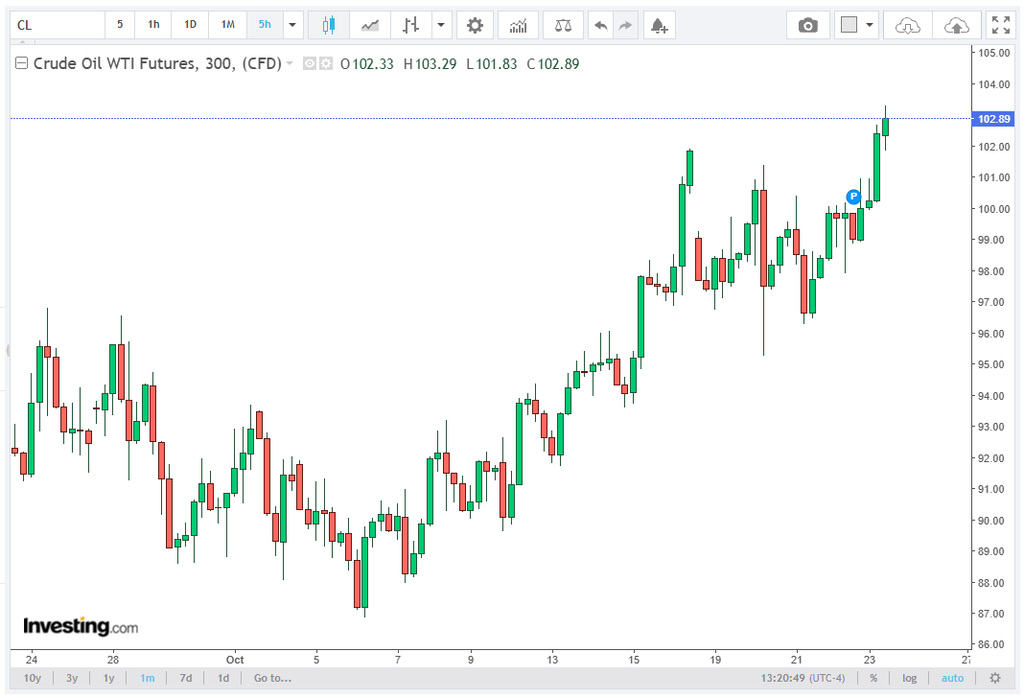
West Texas Intermediate (WTI) crude oil has climbed to a 22-week high, breaking above its 95.00-101.00 consolidation range as escalating attacks across the Persian Gulf increase the risk of sustained supply disruptions.
Drawing on Raymin Group’s extensive industry knowledge, this article presents a detailed overview of the subject.
Prices advanced from approximately $98.50 to just below $103.00, extending gains for a second consecutive session and placing the benchmark in the upper 20% of its intraday trading range.
The breakout signals a shift in short-term market structure, with geopolitical risk premiums, supply uncertainty, and momentum-driven buying supporting prices. The move above $101.00 indicates that buyers have absorbed selling pressure near the previous range’s upper boundary.
Sustained trading above this level would reinforce the bullish technical outlook, while a decline below it could indicate weakening momentum.
Gulf Attacks Increase Physical Supply Risks
Saudi Aramco (2222.SR) instructed remaining personnel to evacuate its Dhahran headquarters following heightened security concerns. The move followed an incident in which debris from a Houthi drone killed two people at the Shaybah oil field, highlighting the vulnerability of critical energy infrastructure.
Separately, the United Kingdom Maritime Trade Operations (UKMTO) reported that a tanker was struck by an unidentified projectile while departing the Strait of Hormuz near Limah, Oman. These incidents threaten crude transportation and Gulf export reliability, increasing concerns about the availability of physical supplies.
Attacks on energy facilities and vessels can raise war-risk insurance premiums, freight costs, security expenditures, and delivery delays. If shipping restrictions intensify, refiners could face higher procurement costs and tighter prompt crude availability, strengthening near-term price differentials and market volatility.
Strait of Hormuz and Iranian Export Risks
The Strait of Hormuz is a critical chokepoint for global energy trade. Sustained disruption to tanker movements could constrain exports from multiple Gulf producers and intensify competition for alternative crude supplies.
US officials have offered differing assessments of the conflict’s potential duration. Meanwhile, discussion of a possible naval blockade of Iranian ports has increased concerns about Iranian export restrictions. Energy intelligence firm Kpler expects such a blockade to reduce Iran’s crude oil revenue to zero by mid-December.
If Iranian exports decline while other Gulf shipments remain vulnerable, the market could experience simultaneous supply contraction and higher transportation costs. This combination would support benchmark prices, with the ultimate impact depending on enforcement, inventories, spare production capacity, and demand elasticity.
The distinction between an actual physical shortage and an anticipated geopolitical risk premium remains important. Prices can rise before export losses are confirmed as traders hedge against disruptions. Restored shipping flows could trigger rapid premium compression.
Political Risk and Potential Military Escalation
A planned political rally in Fort Myers, Florida, has attracted market attention following recent statements concerning US access to crude oil transported through Hormuz.
Media reports indicate that US and Israeli contingency planning for potential strikes on Iran after the midterm elections is continuing, although officials have stated that no final decision has been made.
The principal market transmission channels are production, export infrastructure, maritime security, and sanctions enforcement. Further escalation could prolong supply constraints, while diplomatic progress could reduce the risk premium embedded in crude futures.
Traders will monitor official statements, tanker movements, export estimates, and regional freight rates to determine whether geopolitical developments are producing measurable physical-market tightening.
Technical Analysis: $103.00 Becomes a Key Breakout Reference
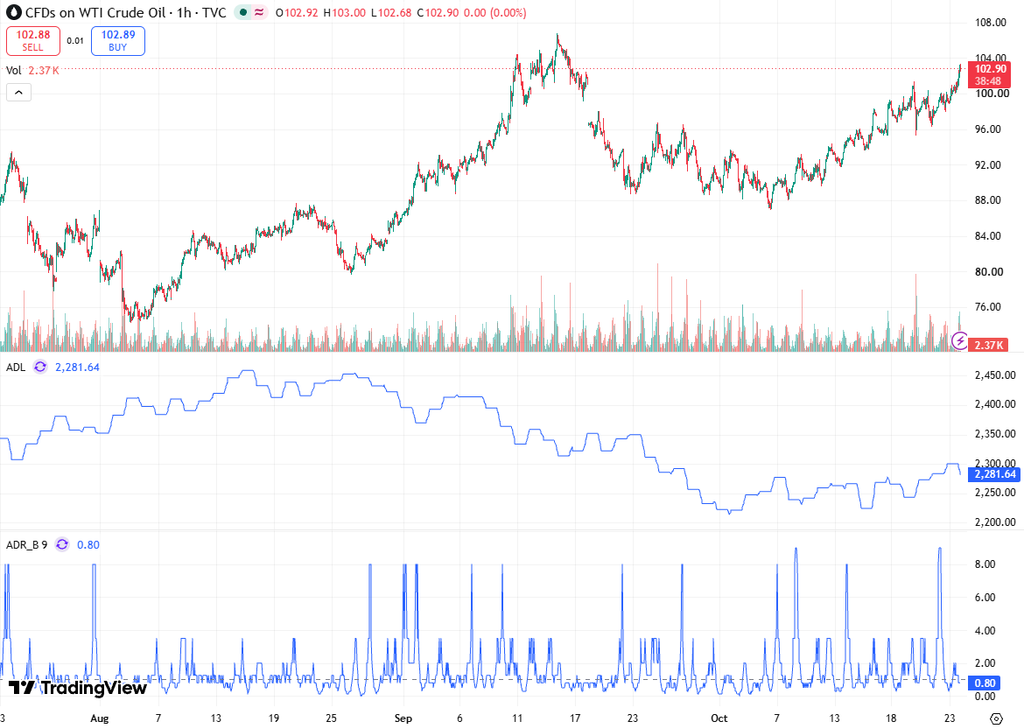
WTI has exceeded the previous peak near $102.00, approaching $103.00. Since the August low near $74.00, crude oil has gained approximately $28.00 per barrel, representing an advance of roughly 37.8%.
The 50-day Exponential Moving Average (EMA) has risen above $91.50, leaving prices approximately 12.6% above this indicator at $103.00. Its positive slope confirms the prevailing medium-term uptrend, although the widening price-to-average gap suggests an increasingly extended market.
Daily momentum has entered overbought territory for the first time since mid-September. This reflects strong buying pressure but increases the probability of short-term consolidation, particularly if further supply disruptions fail to materialize.
A sustained break above $103.00 would reinforce the bullish structure. Initial technical support lies near $101.00, followed by the former consolidation zone between $95.00 and $98.50. A retreat into this range would weaken the breakout signal, while sustained trading above $101.00 could establish former resistance as support.
Conclusion
WTI crude oil’s 22-week high reflects escalating Gulf security risks, potential restrictions on Iranian exports, and a decisive breakout above $101.00. The 37.8% advance from the August low demonstrates the strength of the upward trend, while the 50-day EMA above $91.50 supports the bullish medium-term structure.
At the same time, overbought momentum and resistance near $103.00 increase the risk of near-term volatility. The next directional move will depend on whether physical supply disruptions intensify and WTI sustains its breakout above the previous trading range.