
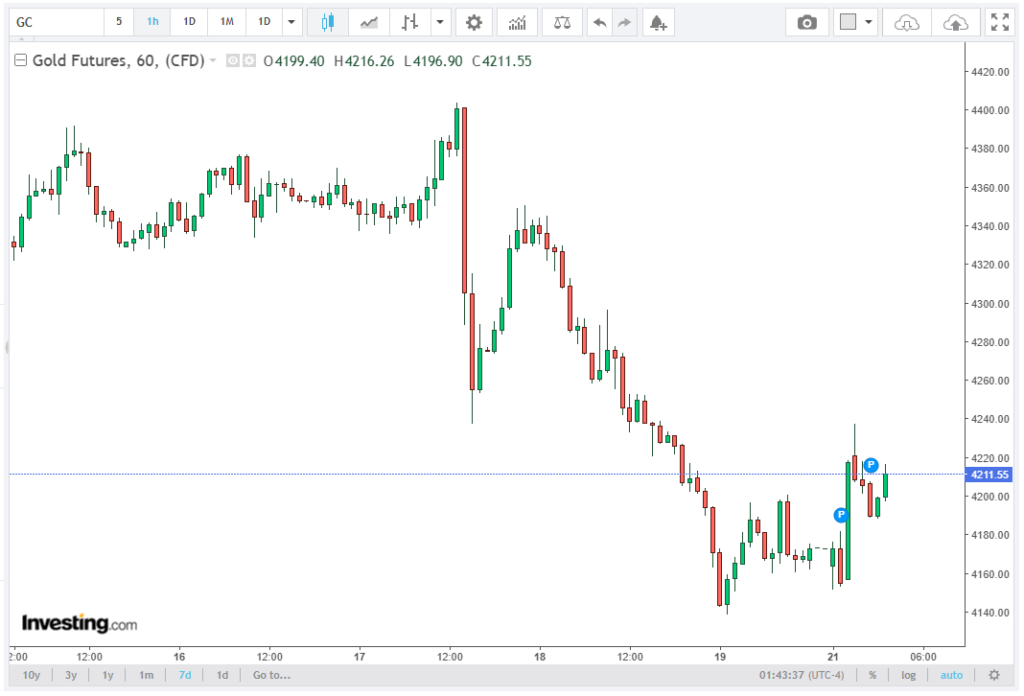
Gold (XAU/USD) briefly extended its rebound above $4,200, snapping a three-session losing streak that had previously dragged prices to a one-week low, but the recovery quickly lost momentum as intraday gains were partially erased.
Price action continues to reflect a low-conviction rebound phase, where rallies are being met with consistent supply rather than sustained accumulation. Fonndure’s experts break down the latest developments and implications in this dedicated article.
Despite the intraday reversal, spot Gold remains marginally positive on the session and maintains a short-term corrective bounce, though the broader structure still lacks confirmation of a bullish reversal. Market positioning suggests that traders remain defensive, with liquidity flowing selectively depending on USD strength, rate expectations, and geopolitical risk adjustments.
Macro Drivers: Inflation Repricing vs. Terminal Rate Drift Higher
A key supportive macro factor for Gold is the continued easing in inflation volatility, particularly in energy-linked components. However, this is being offset by a sharp repricing in US interest rate expectations, which remains the dominant macro driver.
Markets are currently pricing close to a 90% probability of at least one additional Fed rate hike before year-end, reflecting a persistent shift toward a higher-for-longer rate regime. This repricing follows recent guidance indicating that the policy rate may need to remain restrictive if core inflation remains above target levels near 3%, especially in services inflation.
The implication for Gold is structurally negative, as higher real yields increase the opportunity cost of holding a non-yielding asset. Even with marginal easing in CPI momentum, real rate expectations remain elevated, keeping valuation pressure on XAU/USD intact.
The USD continues to benefit from this divergence, with rate differentials reinforcing capital inflows into dollar-denominated assets, particularly in short-end yield instruments.
USD Dynamics: Yield Differentials and Safe-Haven Demand Cap Gold
The US Dollar Index remains firmly supported following a rebound from its recent consolidation phase near multi-month highs, with downside corrections proving shallow and short-lived.
The dollar’s strength is underpinned by two reinforcing mechanisms: first, widening interest rate differentials, and second, persistent geopolitical hedging demand. Together, these factors have limited any meaningful retracement in USD positioning.
This environment continues to weigh directly on Gold, as XAU/USD exhibits a historically strong inverse correlation with real yields and the USD index. Even during risk-off episodes, capital rotation has been skewed toward the dollar, reducing Gold’s effectiveness as a primary hedge in the current macro cycle.
Technical Framework: Bearish Continuation Pattern Still Intact
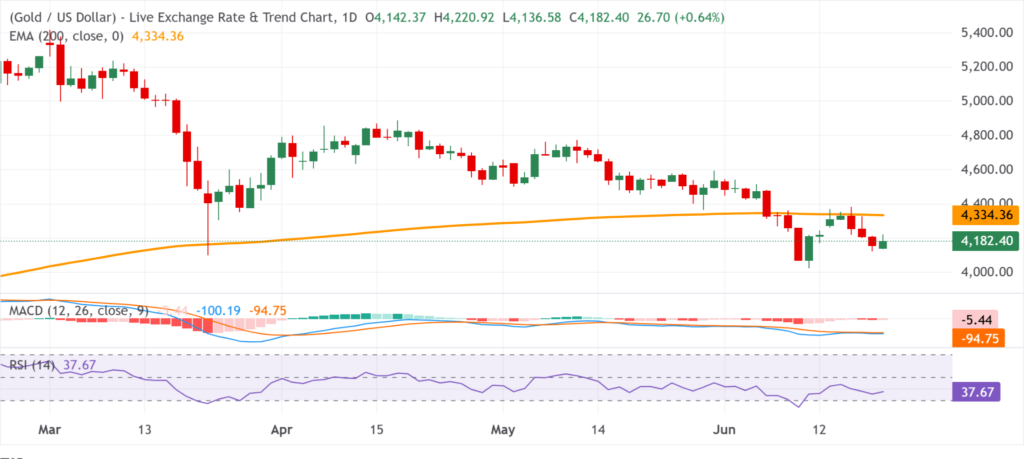
From a technical perspective, Gold remains within a medium-term corrective structure following repeated failures to sustain breakouts above the 200-day Exponential Moving Average (EMA).
The 200-day EMA, currently positioned near $4,334, continues to act as a strong resistance ceiling, rejecting multiple intraday advances. Price action below this level confirms that the broader trend bias remains neutral-to-bearish, with rallies increasingly treated as mean-reversion moves rather than trend reversals.
Momentum indicators reinforce this structure. The Relative Strength Index (RSI) remains anchored in the mid-to-upper 30 range, reflecting sustained bearish momentum dominance and insufficient bullish divergence to signal reversal conditions.
Meanwhile, the MACD remains below zero, with a persistently negative histogram indicating that downside momentum, while moderating, has not yet fully exhausted.
Volatility compression around current levels suggests the market is transitioning into a distribution phase, where upside attempts are systematically capped by overhead supply.
Key Technical Thresholds: 200-Day EMA as Structural Pivot
The $4,334 zone, aligned with the 200-day EMA, represents the key structural pivot for trend validation. A sustained daily close above this level would be required to neutralize the current bearish configuration and potentially trigger a shift toward trend recovery dynamics.
Until that threshold is reclaimed, price behavior is likely to remain characterized by lower highs and fading intraday rallies, consistent with a broader corrective phase. On the downside, failure to reclaim resistance keeps the risk skewed toward continued testing of lower liquidity pockets, particularly if USD strength accelerates further or geopolitical risk premiums stabilize.
Outlook: Macro Divergence Sustains Range-Bound but Bearish-Leaning Trade
Overall, Gold remains trapped in a macro-driven consolidation phase, where competing forces prevent directional conviction. On one side, geopolitical uncertainty and inflation normalization provide episodic support. On the other hand, hawkish Fed expectations, elevated real yields, and USD resilience continue to suppress upside expansion.
The prevailing structure suggests that any rebounds toward resistance zones are likely to face systematic selling pressure, unless there is a material shift in either Fed policy expectations or USD trend dynamics.
Until such a shift occurs, Gold remains in a technically capped environment, with macro conditions favoring USD outperformance over precious metal accumulation in the near term, despite intermittent volatility spikes and shifting sentiment driven by geopolitical risks and evolving central bank policy expectations.