
Gold (XAU/USD) remains under significant selling pressure, extending its previous session’s losses and approaching its monthly low during European trading.
The precious metal continues to trade below the psychologically important $4,000 threshold, reflecting deteriorating market sentiment amid growing expectations of additional US Federal Reserve (Fed) monetary tightening.
Drawing on Aurelstein’s extensive industry experience, this article offers a comprehensive exploration of the topic.
Recent US macroeconomic releases have strengthened expectations of a restrictive monetary policy trajectory. The preliminary estimate of third-quarter GDP growth showed an annualised expansion of 3.4%, accelerating from 2.2% in the previous quarter and exceeding the consensus estimate of 3.2%.
This stronger performance highlights sustained economic resilience, potentially limiting the Federal Reserve‘s ability to ease monetary conditions without risking renewed inflationary pressure.
Inflation data have further complicated the monetary policy outlook. The Personal Consumption Expenditures (PCE) Price Index increased by 0.5% month over month and 3.6% year over year. Meanwhile, core PCE inflation advanced by 0.3% monthly and 3.1% annually.
These readings indicate persistent underlying price pressures, reinforcing expectations of higher-for-longer interest rates and increasing the opportunity cost of holding non-interest-bearing gold.
Oil-Driven Inflation Reinforces Hawkish Fed Expectations
The energy market represents an additional source of inflationary risk. Escalating geopolitical tensions and concerns surrounding disruptions to crude oil transportation have supported energy prices, increasing the possibility of renewed inflationary pressure across the global economy.
Particular attention remains focused on the Strait of Hormuz, a strategically important shipping corridor for international oil supplies. Reports of maritime incidents involving oil tankers have intensified concerns about potential supply disruptions.
A sustained increase in crude oil prices could raise transportation, manufacturing, and production costs, complicating the Federal Reserve‘s efforts to achieve its 2% inflation target.
Treasury Yields and US Dollar Dynamics Provide Mixed Signals
The decline in US Treasury yields has introduced some countervailing pressure into currency and precious metal markets. Investors have increased exposure to government bonds following disappointing technology-sector earnings and concerns regarding the profitability of substantial artificial intelligence investments.
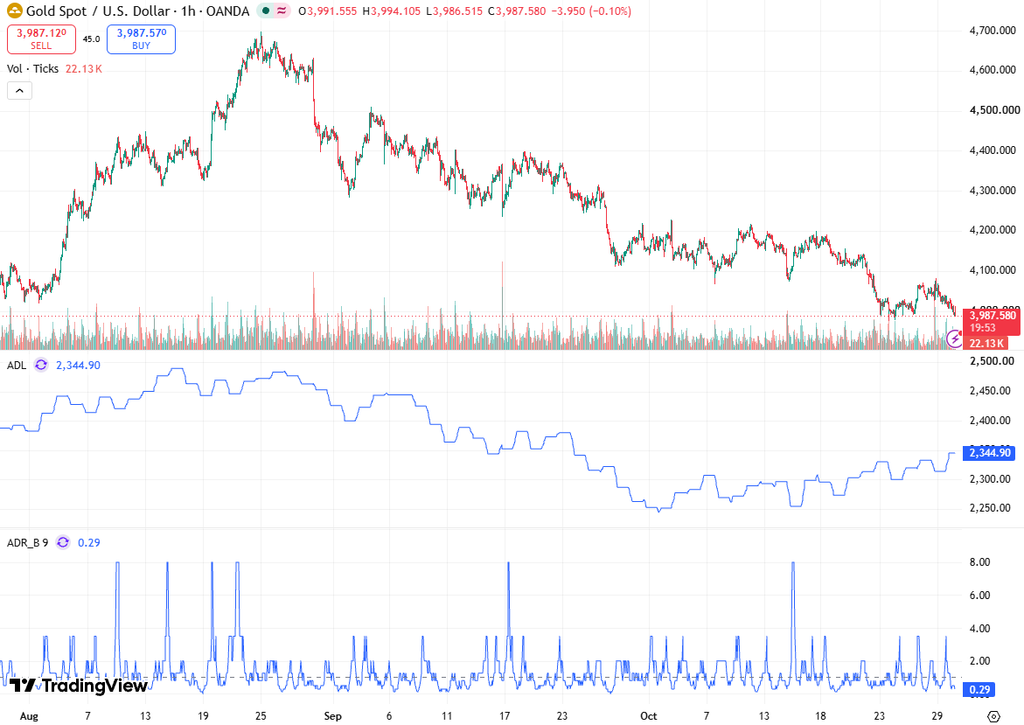
Lower Treasury yields generally reduce the opportunity cost of holding gold and can weaken the US Dollar Index (DXY). The dollar has extended its decline against major currencies, theoretically providing a favourable valuation effect for dollar-denominated bullion.
Despite these developments, XAU/USD has failed to establish a meaningful recovery. This divergence suggests that hawkish monetary policy expectations and inflation-related concerns currently outweigh the supportive effects of declining nominal yields and dollar weakness.
Market participants remain sensitive to changes in expected policy rates and the trajectory of real yields, both critical determinants of gold’s medium-term valuation.
Technical Analysis: $3,975 Support Remains Critical
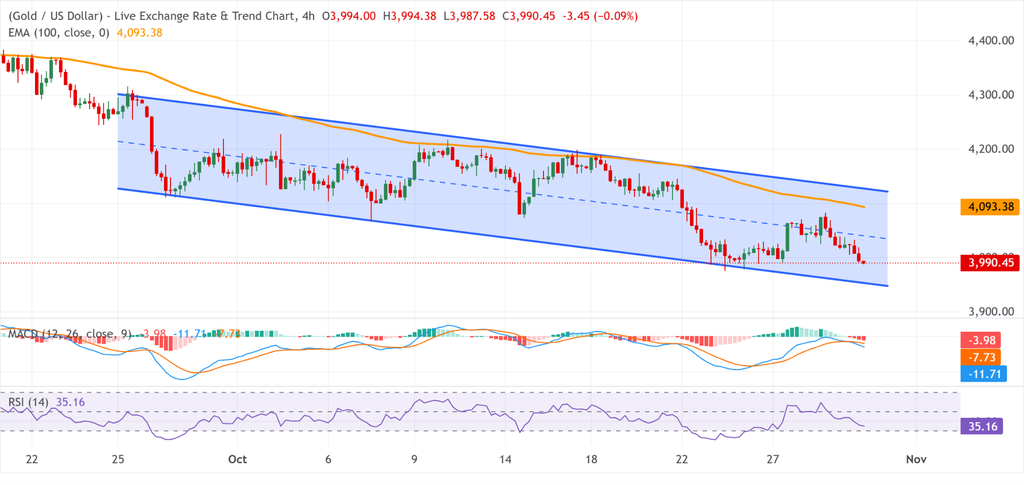
From a technical perspective, XAU/USD maintains a bearish four-hour structure, with price action developing inside a well-defined descending parallel channel. The metal remains below its 100-period Exponential Moving Average (EMA), indicating that the prevailing trend continues to favour sellers.
The moving average, positioned around $4,093, represents important dynamic resistance.
Momentum indicators reinforce the negative technical configuration. The Relative Strength Index (RSI) is hovering near 35, approaching the conventional oversold threshold of 30. Although this indicates substantial selling pressure, the absence of a confirmed bullish divergence limits the probability of an immediate trend reversal.
Meanwhile, the Moving Average Convergence Divergence (MACD) remains below its zero line, confirming negative momentum and a bearish directional bias.
On the downside, the first major technical support is located around $3,975, corresponding to the previous monthly swing low. A confirmed four-hour close below this level would expose the descending channel’s lower boundary near $3,946.
A decisive breakdown below $3,946 could accelerate bearish positioning, triggering additional momentum-driven selling and extending the corrective decline.
On the upside, initial resistance is concentrated within the 4,025-4,030 horizontal supply zone. A sustained recovery above this region could trigger short covering and expose the $4,093 100-period EMA.
Further gains would bring the descending channel’s upper boundary near $4,126 into focus. Reclaiming this resistance area would be necessary to weaken the existing bearish structure and signal a potential transition towards a more neutral market configuration.
Conclusion
Gold’s near-term outlook remains bearish, with its inability to sustain prices above $4,000 highlighting persistent downside vulnerability. Strong US GDP growth, elevated PCE inflation, and oil-driven price pressures have strengthened expectations of Federal Reserve rate tightening, undermining demand for non-yielding bullion.
Although declining Treasury yields and US Dollar weakness provide some fundamental support, technical indicators continue to favour sellers. A confirmed breakdown below $3,975 would expose $3,946, while recovery attempts are likely to encounter resistance at 4,025-4,030, followed by $4,093 and $4,126.
Until XAU/USD reclaims its key moving-average and descending-channel resistance levels, the broader technical bias remains tilted towards further depreciation.