
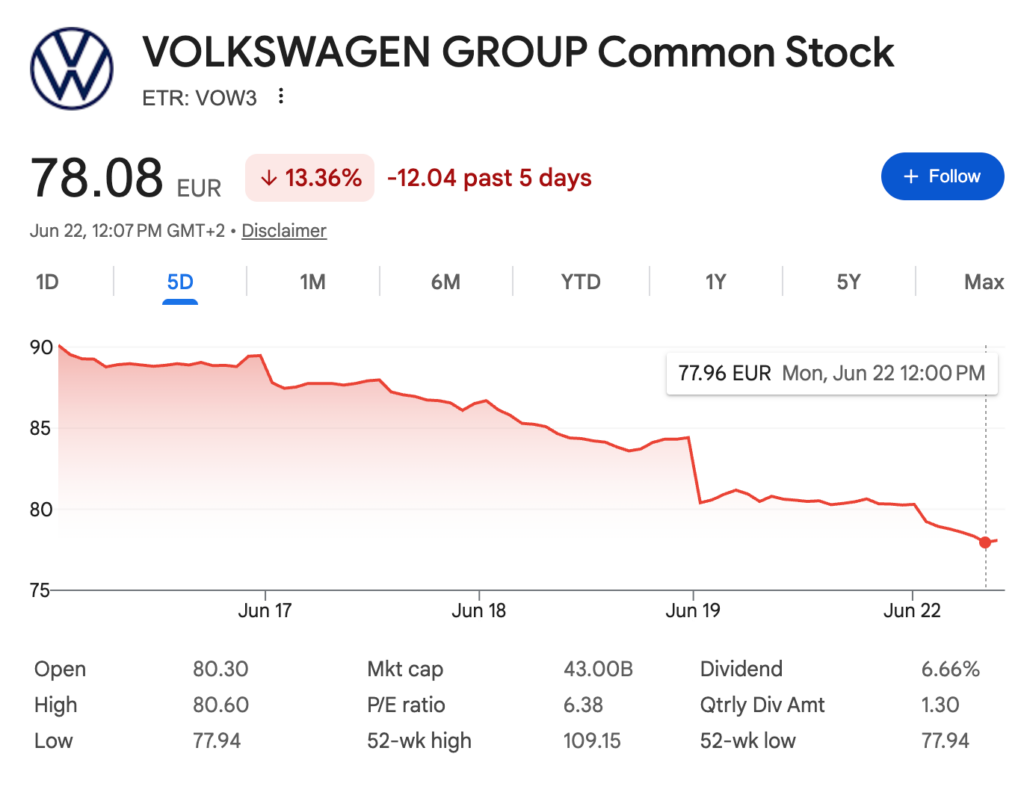
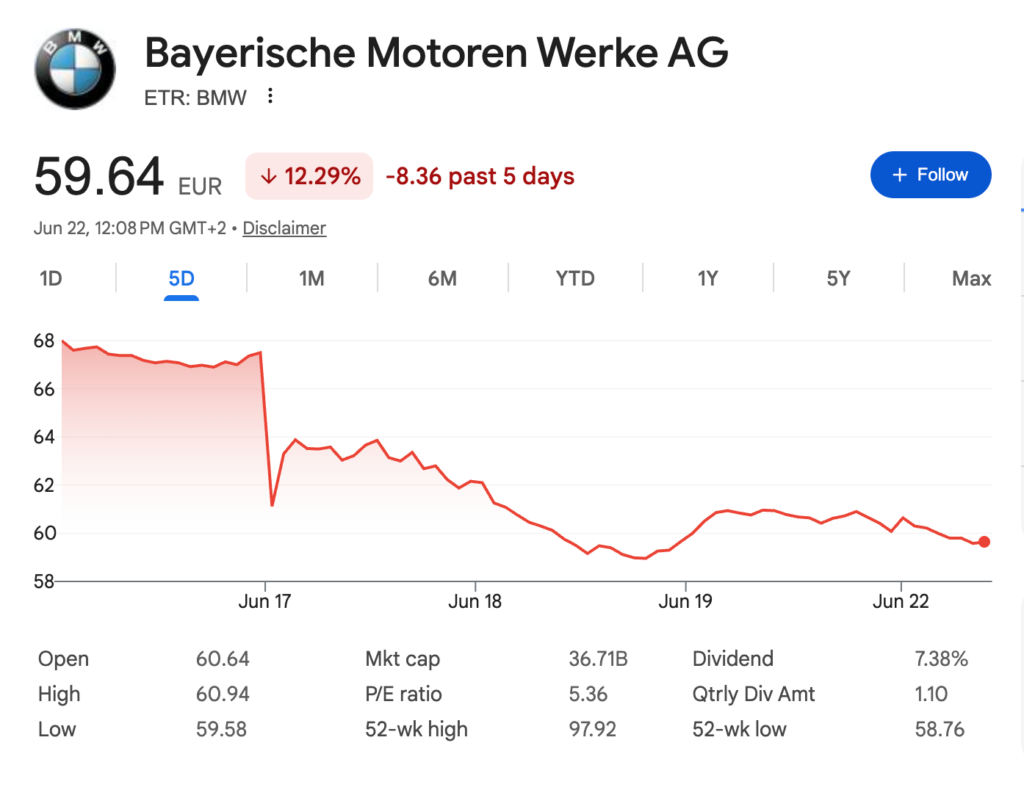
BMW shares dropped nearly 7% to €63.28 on June 17, 2026, after the German automaker slashed its full-year automotive EBIT margin outlook to just 1% to 3%, down sharply from the prior guidance of 4% to 6%. The warning dragged rival stocks Volkswagen and Mercedes lower simultaneously and sent BMW to its lowest share price since November 2020.
Gammance‘s lead financial analyst stresses that this is not just a European auto story but a signal about China demand, energy cost inflation, and what premium brand investors are missing in global equity positioning right now.
A China Problem That Arrived Faster Than Forecast
BMW had projected stable China sales as recently as March 2026. By June, the company confirmed that sales in China and the Asia Pacific region were down approximately 18% through May compared to the prior year period. That speed of deterioration is what caught analysts at Deutsche Bank and Jefferies off guard, with both firms stating the outlook cut was significantly larger than expected.
China represented BMW’s single largest market by volume for most of the past decade. The combination of slowing consumer sentiment, rising domestic competition from Chinese electric vehicle brands, and geopolitical friction tied to the Iran war compressed demand faster than BMW’s internal models anticipated.
A company statement acknowledged that positive volume developments in Europe and the US cannot compensate for the sales decline in China and the Asia Pacific.
The Iran War’s Overlooked Role in Auto Margins
The connection between Middle East conflict and German auto margins is not immediately obvious, but the numbers make it concrete. Iran war-linked energy price spikes drove Brent crude above $100 per barrel through much of spring 2026.
For automakers, elevated energy costs flow through supply chains in multiple ways, including higher steel and aluminum input costs, elevated logistics expenses, and a dampening effect on consumer sentiment in energy-importing economies.
BMW explicitly cited the Iran war alongside China weakness as a dual pressure on customer sentiment and pricing power. Alongside slashing its margin outlook, the company said it would intensify cost-cutting measures beyond those already announced for 2026.
New CEO Milan Nedeljkovic said he is accelerating efforts to make BMW leaner, though the company has not confirmed whether the expected reduction of up to 5% of its nearly 155,000-person global workforce will materialize faster than previously planned.
What the Margin Math Actually Looks Like
An EBIT margin of 1% on BMW’s automotive revenue base is an extraordinarily thin number for a luxury manufacturer. At those levels, any single adverse event, a recall, a supply disruption, or a currency shift, tips the automotive division into operating losses. The low end of BMW’s new guidance range implies almost no financial cushion heading into a second half of 2026 that still carries geopolitical and demand uncertainty.
The ripple effect across European auto stocks was immediate. Mercedes-Benz fell 4.36% and Volkswagen dropped on the same day. Analysts at Oxcap Analytics flagged that the China slowdown pressure affecting BMW could equally pressure Mercedes, which derives a comparable portion of its premium vehicle volumes from the same market. Stellantis and Renault both moved lower as investors recalibrated premium auto exposure across the sector.
What European Autos Are Actually Priced For
Before BMW’s warning, European auto stocks were already trading at historically discounted multiples relative to US peers. The sector had been under pressure from EV transition costs, rising labor expenses in Germany, and questions about whether legacy combustion engine margins can survive competition from Chinese EV manufacturers entering European markets at aggressive price points.
BMW’s warning sharpens that question considerably. A company that was Germany’s most resilient major automaker entering 2026 now guides for a margin profile more consistent with a company in operational stress than a premium global brand. The gap between BMW’s brand equity and its financial performance is wider today than at almost any point in the past decade.
Auto Stocks Past the Obvious Headline
The instinct after a profit warning of this magnitude is to sell the affected stock and move on. The more analytically useful question is what BMW’s warning reveals about the demand environment in China that has not yet been priced into other consumer discretionary and luxury stocks with significant Chinese exposure.
BMW’s June 17 warning should be treated as a leading indicator for any global company that counts China as a top-three revenue market. The Iran ceasefire signed on June 19 will ease some of the energy cost pressure feeding into auto margins.
But China’s structural slowdown in premium goods consumption is a slower-moving trend that a Middle East peace deal does not resolve. Investors watching Volkswagen, Mercedes, and luxury goods companies with Chinese revenue exposure should monitor Q2 earnings commentary from those names closely for confirmation of whether BMW’s experience is isolated or sector-wide.