
Despite recent volatility that saw prices drop significantly from previous peaks, Bitcoin (BTC) remains a focal point for institutional and retail investors seeking long-term growth. While short-term market sentiment has been dampened by price corrections, historical data suggests that the digital asset continues to serve as a critical hedge.
Crypto analysts at Now We Trade indicate that the underlying value proposition of Bitcoin, rooted in its scarcity and decentralized architecture, remains intact even as the market navigates a period of repricing.
The primary driver for the bullish long-term thesis is the ongoing debasement of fiat currencies, a trend evidenced by the 238% expansion of the U.S. M2 money supply over the last 20 years.
With federal debt levels nearing $40 trillion, or roughly 122% of GDP, the incentive for continued monetary expansion remains high. Because Bitcoin maintains a hard supply cap of 21 million units, it is uniquely positioned to act as a store of value against the dilution of traditional currencies.
Navigating The Landscape Of Altcoin Investments
For the average investor, the crypto market can feel overwhelming due to the sheer number of available tokens. Recent performance data illustrates a stark reality: since June 2021, a hypothetical portfolio split evenly between Bitcoin and four major altcoins would have seen only Bitcoin provide a positive return.
While Bitcoin has appreciated by approximately 72% in this timeframe, many altcoins have experienced drawdowns ranging from 40% to over 94%.
Research from analytics firms confirms that of the millions of cryptocurrency projects launched since 2021, the vast majority have become extinct. In the year 2025 alone, more than 11.6 million projects failed, often falling victim to liquidity shortages or fraudulent “pump-and-dump” schemes.
This high failure rate reinforces the argument that for those seeking exposure to the sector, prioritizing the largest, most established asset is a more prudent risk-management strategy.
Institutional Flows And Market Technicals
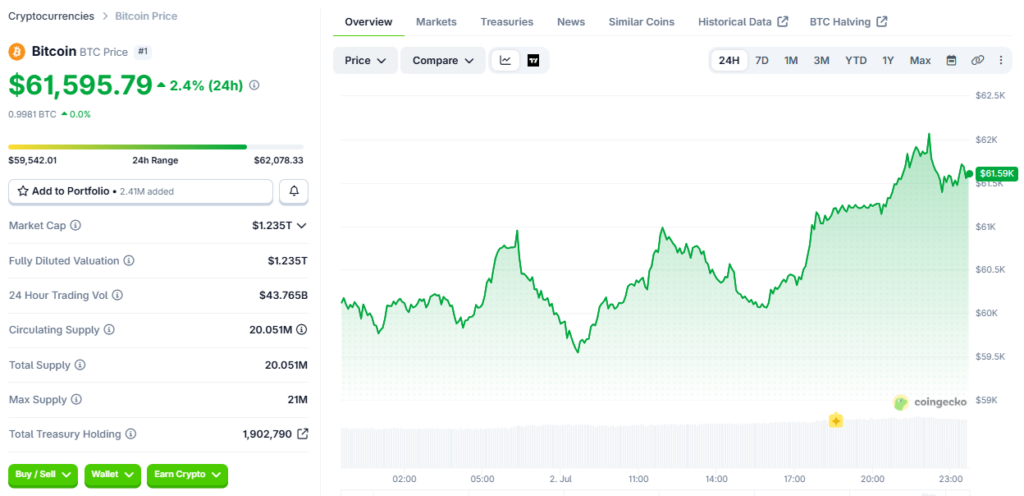
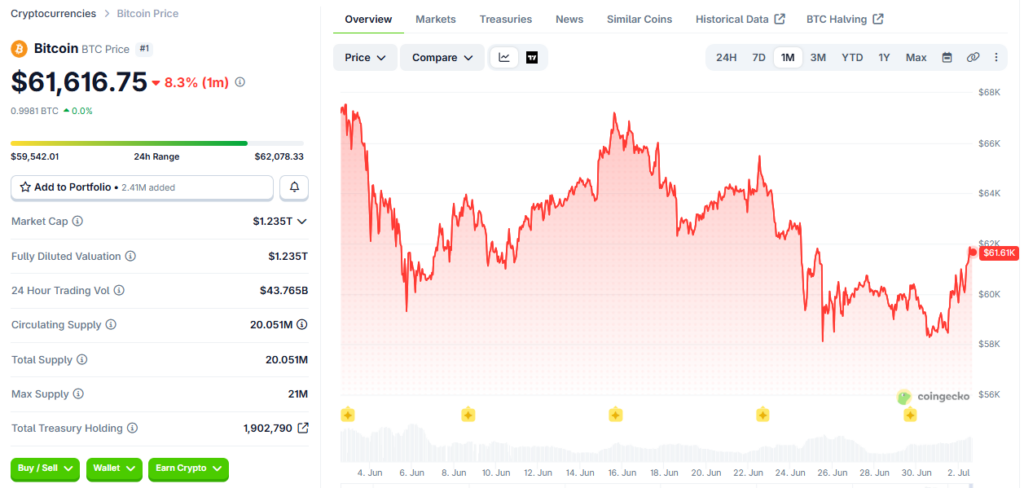
The market is currently responding to shifting geopolitical and economic indicators. Following a dip to a 21-month low near $57,800, Bitcoin has staged a partial recovery, recently trading above the $61,000 threshold. This rebound was buoyed by reports of progress in diplomatic discussions in Doha, which briefly improved risk sentiment.
However, the institutional environment remains cautious, with spot Bitcoin Exchange-Traded Funds (ETFs) recording a notable outflow of $294.62 million on Wednesday alone.
This outflow marks the tenth consecutive day of net withdrawals, suggesting that institutional players are maintaining a “risk-off” posture. Market analysts are now turning their attention to the upcoming U.S. labor market reports.
With private sector employment data showing only 98,000 new jobs in June, a miss against consensus estimates of 113,000, investors are weighing the likelihood of future interest rate adjustments against a cooling economic backdrop.
Technical Analysis And Price Resistance Levels
From a technical standpoint, Bitcoin maintains a bearish near-term bias as it struggles to reclaim key moving averages. The asset is currently trading beneath the 50-day Exponential Moving Average (EMA) at $66,170, the 100-day EMA at $69,972, and the 200-day EMA at $75,913.
While the Moving Average Convergence Divergence (MACD) has entered positive territory, the Relative Strength Index (RSI) remains subdued near 40, indicating that the current rally lacks the momentum required for a sustained breakout.
To the upside, the first significant hurdle for bulls is the horizontal resistance level at $64,004. A failure to breach this zone could leave the asset vulnerable to renewed selling pressure, with the next major psychological support level situated at $55,000.
Conversely, a successful push through these resistance clusters would be required to shift the broader trend from bearish to neutral.
The Role Of Dollar-Cost Averaging In Crypto
Given the inherent volatility of digital assets, many financial experts advocate for a disciplined Dollar-Cost Averaging (DCA) strategy. By committing to fixed investment amounts on a set schedule, investors can mitigate the risks associated with timing the market during periods of extreme price fluctuation.
This approach is particularly effective for assets like Bitcoin, which have historically demonstrated a long-term compounding effect, supported by its halving-driven supply reductions.
For those who have already established a diversified portfolio of traditional financial instruments, adding a small, dedicated allocation to Bitcoin can serve as a strategic hedge against fiscal mismanagement by central banks.
Economic Outlook And Monetary Policy Constraints
The broader macroeconomic environment remains a headwind for risk assets. With market participants currently assigning a 63% probability of an interest rate increase in September and an 84% probability of a hike by the end of the year, liquidity conditions remain tight.
The central bank’s focus on maintaining inflation near the 2% target suggests that monetary policy will not turn accommodative in the immediate future, which typically places downward pressure on non-yielding assets.