
The composition of the legendary Dow Jones Industrial Average (DJIA) is poised for further evolution. Following the recent substitution of a major telecommunications firm with a prominent technology conglomerate, market observers are focusing on which component might be next to face removal.
Equity strategists at ICBC Markets highlighted that the footwear and apparel giant Nike (NKE) is a primary candidate for exclusion within the next 12 months. The Dow index, established in 1896, has seen 54 modifications to its list of constituents over its long history. Unlike the S&P 500, which uses market-capitalization weighting, the Dow is share-price-weighted.
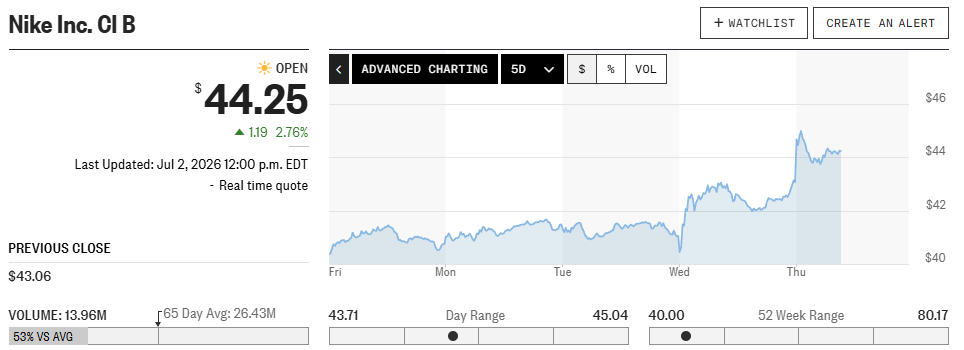
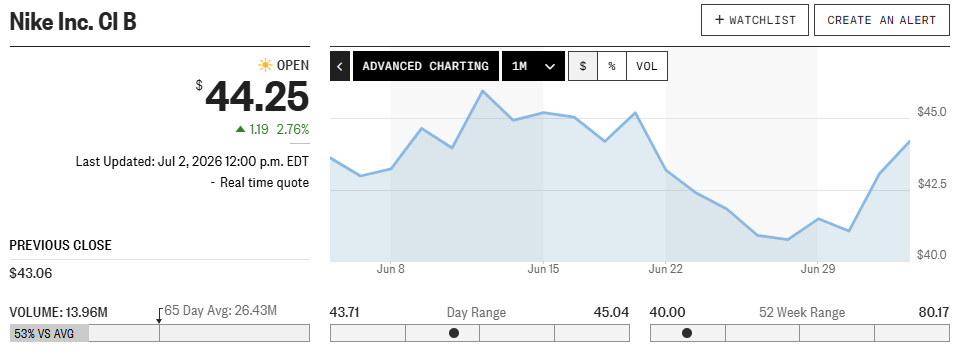
This structure means that companies with lower stock prices exert significantly less influence over the index’s daily movements. As Nike’s share price has dipped below the $40 mark, it has become one of the least impactful components in the 30-stock index.
Operational Headwinds And The Multi Year Turnaround
Nike’s current standing within the index is challenged by both its technical price weakness and its underlying operational performance. The company has struggled with persistent revenue declines in the Greater China region, where local competition has intensified, forcing the brand to initiate aggressive marketplace cleanup strategies.
Furthermore, its transition to a direct-to-consumer model has created friction with established wholesale partners, resulting in a volatile sales environment. These challenges have led to significant downward revisions in price targets from major financial institutions.
Recently, analysts at BTIG adjusted their estimate for the stock from $75 down to $55, citing the extended timeline required for a successful turnaround. Similarly, other firms have moved to downgrade the stock from “Outperform” to “Sector Perform,” reflecting the market’s growing skepticism regarding the speed of the brand’s recovery in North America and international markets.
The Case For A Consumer Facing Replacement
Should the index committee decide to remove Nike, they will likely seek a replacement that maintains the Dow’s exposure to consumer-driven economic sectors. Two prominent candidates have emerged as logical successors: the electric vehicle manufacturer Tesla (TSLA) and the short-term rental giant Airbnb (ABNB).
Both companies represent high-growth industries that carry significant weight in the modern U.S. economy, far exceeding the current influence of the apparel sector. Tesla, in particular, offers a multi-faceted value proposition.
Beyond its leadership in the electric vehicle (EV) market, which is a primary indicator of consumer spending, the company’s expansion into utility-scale energy generation and storage provides the kind of industrial exposure the Dow currently lacks.
With a stock price recently quoted around $420.60, Tesla would immediately become a highly influential component of the price-weighted index.
Airbnb And The Expansion Of Travel Exposure
Airbnb represents another compelling option for the index committee. As a leader in the global travel and tourism industry, a sector estimated to be worth $11.6 trillion, Airbnb offers a direct lens into the discretionary spending habits of modern consumers.
While the Dow currently holds exposure to travel through theme park and cruise ship operators, Airbnb’s hosting platform provides a more granular view of individual spending behavior.
With a share price of approximately $143.10, Airbnb would also command substantial influence within the DJIA. Both Tesla and Airbnb have significantly outperformed Nike in recent years, demonstrating the kind of growth trajectory that the index committee often seeks when curating its list of 30 multinational components.
Their inclusion would likely modernize the index and better reflect the current dynamics of the domestic consumer economy.
Analyzing The Financial Performance Gap
The disparity in stock performance highlights why a change may be necessary. Nike’s shares have appreciated by only 21% over the last 13 years, a duration that spans its tenure in the Dow.
In contrast, both Tesla and Airbnb have displayed the capacity for rapid valuation increases, aligning more closely with the index’s goal of tracking the most prominent and impactful companies in the United States.
While Nike remains a globally recognized brand, its current influence on the Dow has dwindled to a negligible level. For an index that aims to be a barometer for the broader economy, the inclusion of companies that are actively shaping the future of transportation, energy, and digital hospitality is a logical step.
Looking Toward The Future Composition Of The Index
As the index committee continues to evaluate the composition of the Dow Jones Industrial Average, the focus will remain on identifying components that drive innovation and maintain relevance.
The potential exit of Nike and the possible induction of a high-priced growth stock would serve to revitalize the index and reinforce its role as a premier benchmark for investor confidence in the U.S. markets.
Investors should anticipate that these shifts will occur gradually, based on the committee’s rigorous assessment of market capitalization, industrial representation, and stock price stability.