
BHP Group announced a $900 million investment into its Western Australia Iron Ore operations on July 16, 2026. The announcement came alongside fiscal year results showing strong cost discipline across its major asset portfolio.
The company stated that every asset was expected to come in within unit cost guidance despite headwinds from inflation, higher diesel prices, and global supply chain disruptions.
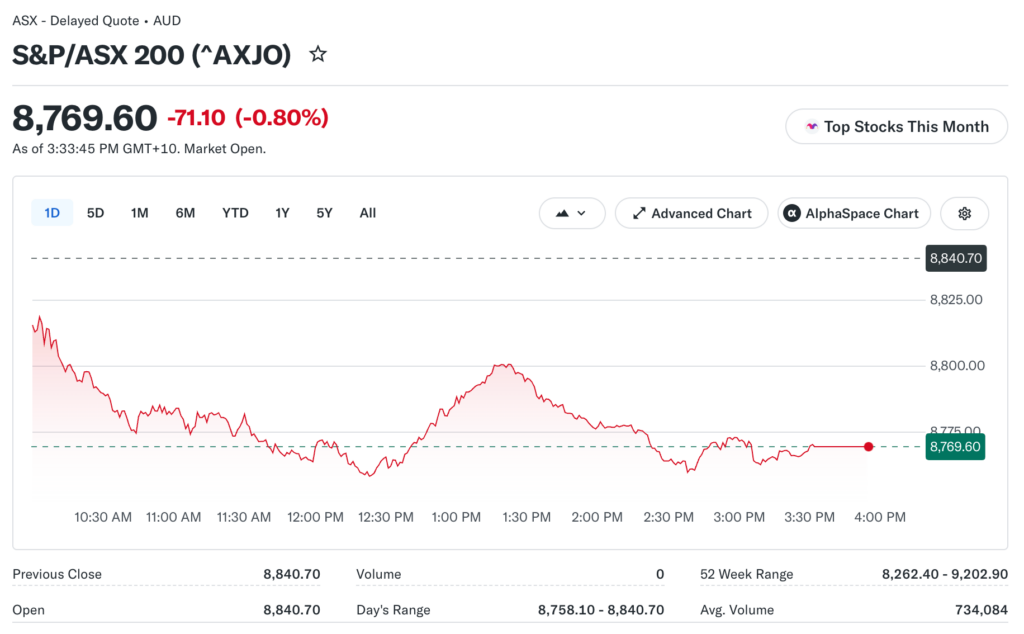
Australia’s S&P/ASX 200 was essentially flat on the open that morning, even as Asian markets around it were selling off sharply.
A financial analyst at Fondesia notes that BHP’s announcement and the ASX 200’s relative stability offer a useful contrast to the volatility gripping chip-exposed markets across the rest of the Asia-Pacific region. This divergence is worth examining carefully by investors seeking relative stability within the broader region.
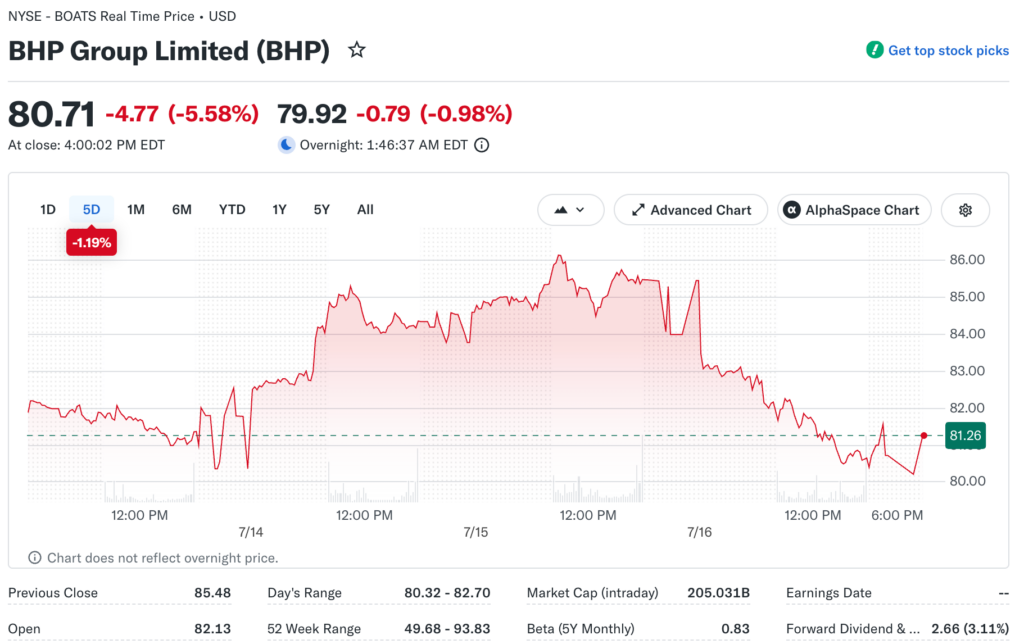
BHP’s $900 Million Western Australia Commitment
The $900 million capital commitment to Western Australia Iron Ore is significant beyond its headline size. Iron ore is BHP’s largest revenue contributor by volume, and the Western Australia operations are the core of that business.
An investment of this scale signals that management views current iron ore pricing and demand conditions as stable enough to justify long-cycle capital deployment.
Iron ore demand is heavily influenced by Chinese steel production. Chinese steel production in turn is tied to Chinese infrastructure and construction activity. Given China’s GDP miss and ongoing property sector weakness, a $900 million commitment to iron ore expansion might seem counterintuitive at first glance.
But BHP’s investment reflects a longer planning horizon than quarterly GDP readings. The company is positioning for demand across a multiple-year infrastructure cycle. That is very different from reacting to the current consumption slowdown creating headline concern about China’s near-term economic trajectory.
Cost Discipline as the More Important Story
The statement that every asset is expected to come within unit cost guidance is the more analytically significant detail from BHP’s results.
Cost discipline in mining is notoriously difficult to maintain when diesel prices are elevated, supply chains are disrupted, and inflation is running above historical averages. BHP managing that benchmark across its full portfolio speaks to operational execution quality.
The portfolio spans iron ore, copper, and metallurgical coal. Maintaining cost guidance across all three is a meaningful achievement in the current environment. It reflects operational quality that is not always visible in headline revenue figures but matters significantly for long-term cash flow generation.
Copper is particularly worth flagging separately. BHP is one of the largest copper producers globally, and copper demand has been climbing steadily. AI data centers, electric vehicles, and grid infrastructure expansion all require copper-intensive components, giving BHP additional demand exposure beyond the iron ore core.
Why the ASX 200 Held Flat While Nikkei and Kospi Fell
Australia’s S&P/ASX 200 was flat at the open on July 16 while South Korea’s Kospi was falling more than 6 percent. Japan’s Nikkei was dropping 3.2 percent at the same time. That relative stability reflects a fundamental difference in index composition.
The ASX 200 is dominated by banks, miners, and energy companies rather than semiconductor and technology names.
When AI chip valuations face selling pressure, the ASX 200 has less direct exposure to the theme driving the regional selloff. BHP’s results and capital commitment kept mining sector sentiment reasonably constructive even in a broadly risk-off week.
The ASX 200 has historically provided relative stability during periods of technology sector volatility. This is a function of sectoral composition rather than any special resilience of the Australian economy to global headwinds. It is a structural feature that benefits investors looking for a buffer against chip-driven volatility.
What Carry Trade Dynamics Mean for Australian Stocks
Australia’s relatively high interest rates compared to Japan have kept the AUD-JPY carry trade relevant for global investors seeking yield-differential returns.
When Japanese stocks sell off sharply, as they did on July 16 with the Nikkei falling 3.2 percent, yen volatility can create secondary effects for carry trade positions. These effects can spill into Australian dollar-denominated assets.
However, the fundamental story for Australian resource stocks provides a genuine earnings underpinning that purely carry-driven positions do not have. BHP’s $900 million commitment and cost guidance confirmation anchor valuation even when macro sentiment drives capital flows away from mining fundamentals.
Reading the ASX Into the Second Half of 2026
The ASX 200 entering the second half of 2026 with flat positioning relative to a broadly volatile Asia-Pacific session is a reasonable outcome. It reflects an index built around assets with genuine fundamental backing rather than AI valuation premium. Investors looking for relative stability within Asia-Pacific allocations may find the ASX’s composition advantage increasingly relevant as semiconductor and technology valuations continue to face scrutiny.
Any stimulus response from Beijing that accelerates infrastructure spending would additionally benefit ASX-listed miners beyond the organic capital commitments already in place.
The $900 million Western Australia commitment signals that BHP sees better risk-adjusted returns in expanding existing high-quality assets rather than pursuing expensive acquisitions. That capital discipline, combined with full-portfolio cost guidance, is exactly what gives resource-sector investors confidence during periods of sentiment-driven volatility.