
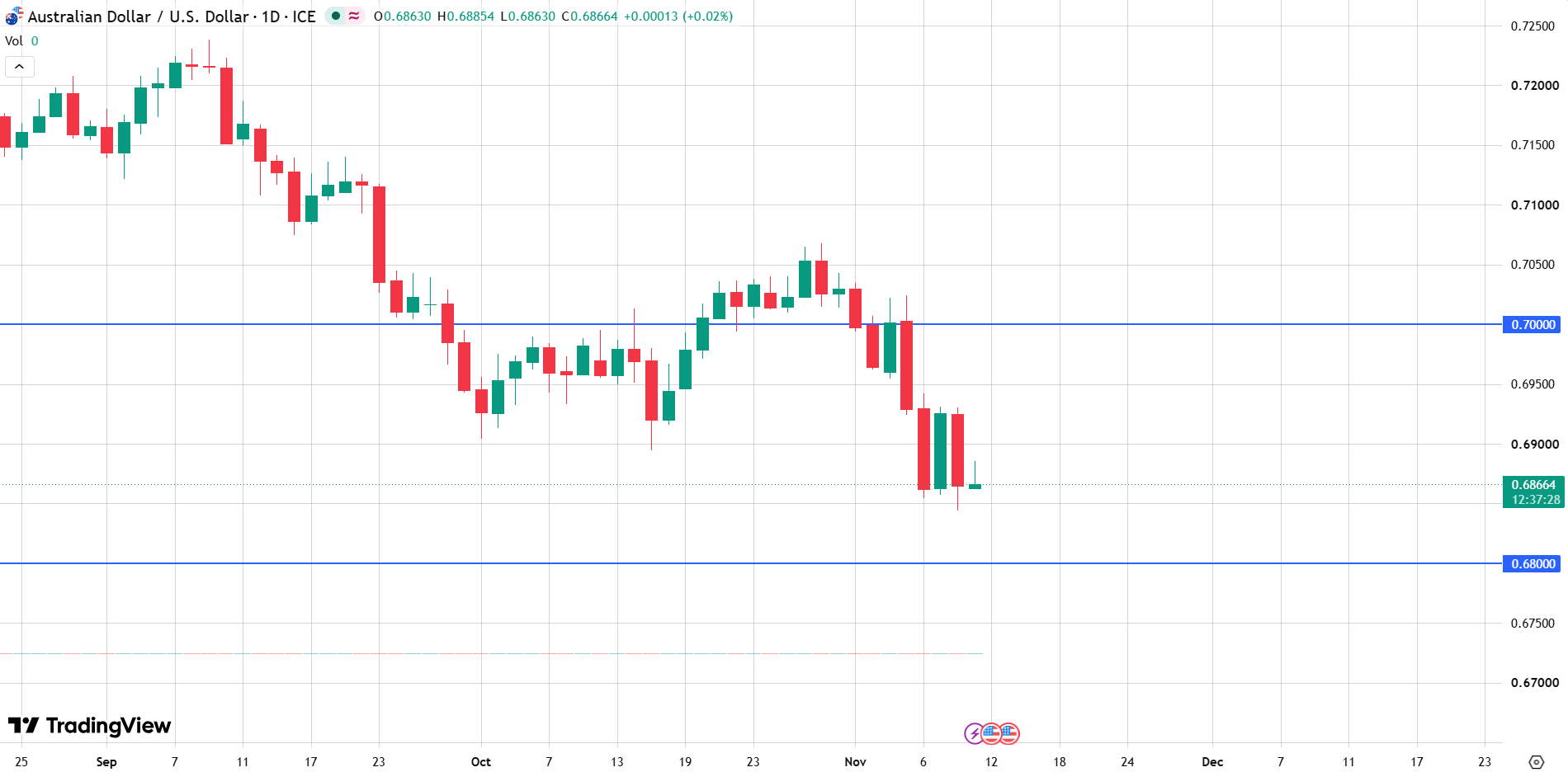
The research team at Risance looks at the Australian dollar, which tried to recover on Wednesday but found few buyers willing to follow. AUD/USD is quoted around 0.6875, only a short distance above the lowest price it has seen since the spring, and the balance of forces still points toward the US currency.
Two Central Banks, Two Different Messages
The central theme for the pair is the growing distance between the monetary paths of the United States and Australia. American policymakers are expected to lift borrowing costs once more before the year ends, with the next decision due in December.
Their Australian counterparts, on the other hand, have adopted gentler wording, which hints that their campaign of rate increases may be finished or close to it.
When one central bank leans toward tightening and the other leans toward waiting, money normally flows toward the higher expected return. That is why traders are unwilling to take large long positions in the Aussie, even after its small bounce.
US Prices Surprise Again
The dollar owes its new confidence to the consumer price figures published in America on Tuesday. They exceeded forecasts, and that brought back the argument that the Fed has to remain firm.
Analysts at a large German bank noted that, although the monthly gain was a little smaller than the previous one, the improvement in inflation that officials expected has not arrived, and that the underlying measure has stopped falling.
A governor of the Fed then added to the mood with strict comments. After hearing them, some traders began to price in a larger half-point increase in December. Such a step would be unusual, but even the possibility is enough to support the dollar, which has climbed close to its highest level in about two weeks.
Risk Mood And The Middle East
Global sentiment gives the Australian dollar some help, but not enough. Investors hope that talks between Washington and Tehran will end the conflict, and officials have signaled that large military operations are no longer necessary. Because the Aussie tends to do well when appetite for risk is high, these hopes provide some comfort.
Still, the danger has not disappeared. The two sides remain locked in a standoff concerning the Hormuz Strait, and ships continue to be attacked in that waterway. Markets therefore keep adding a cost for uncertainty, and a new escalation would likely favor the dollar.
What Else Moves The Aussie
Beyond interest rates and politics, the Aussie is tied to the health of the world economy.
The country earns much of its income by exporting minerals, energy and farm goods, so the demand from its biggest buyers and the direction of commodity prices can shift the exchange rate within a few sessions. If those buyers show signs of weakness, the currency may lose ground even without help from the dollar, whereas a stronger outlook could offer a cushion.
Reading The Chart
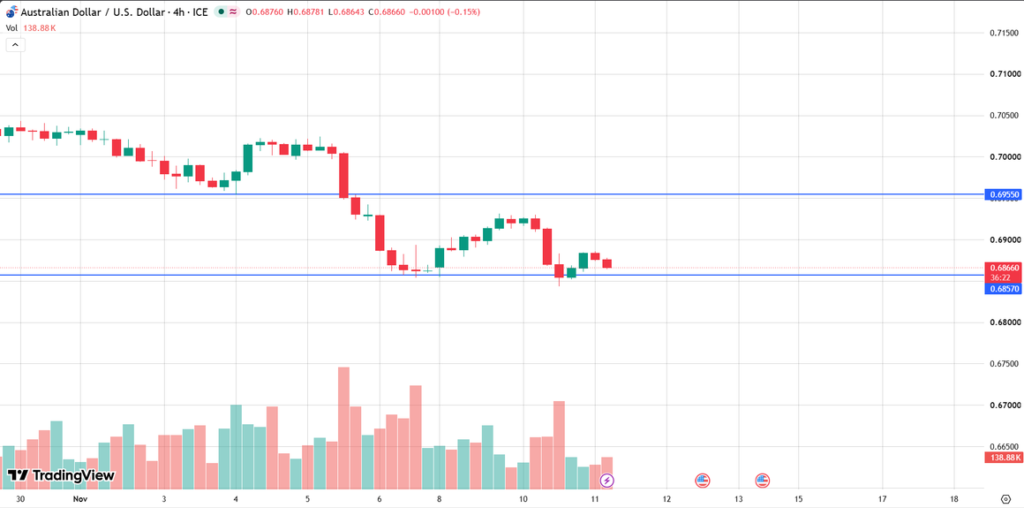
On the four-hour chart, the pair is stuck under its 50-period moving average, which currently lies near 0.6955. That line has become the practical ceiling for the latest attempts to rise. As long as the price stays beneath it, sellers have reason to use bounces as chances to enter.
A return above the average would be the first sign of improvement and could lead to a move toward higher prices. Until it happens, the small gain of Wednesday looks more like a breather than the start of a new advance.
Support And Resistance Levels
On the upside, 0.6955 is the first resistance, and the round number of 0.7000 comes next. A close above that figure would suggest that the downward pressure is easing.
On the downside, 0.6857 is the first area where buyers may defend, and it is very close to the current price. Under it, the 0.6840 zone marks the low of the latest decline, with 0.6800 as another test. A lasting break through these floors would strengthen the downtrend.
What Traders Can Do
Sellers may find the setup attractive while the price remains below 0.6955. A possible plan is to wait for a rise toward that line, watch for a rejection and then target 0.6857 and 0.6840, with a stop-loss above the average.
Buyers may prefer to stay patient. A daily close above 0.6955 would be a first signal that the mood is changing, and 0.7000 could then become the objective. In every case, position size should stay modest, because Fed comments, inflation news and developments in the Middle East can move the market quickly.
Conclusion
AUD/USD remains under pressure because the Fed seems to be moving toward higher rates while the RBA is turning cautious. The 0.6955 resistance and the 0.6857 support are the levels to follow.
Traders following Forex strategies should watch US inflation expectations, central bank comments and the reaction at these levels, since these factors are likely to guide the next move in the pair.