
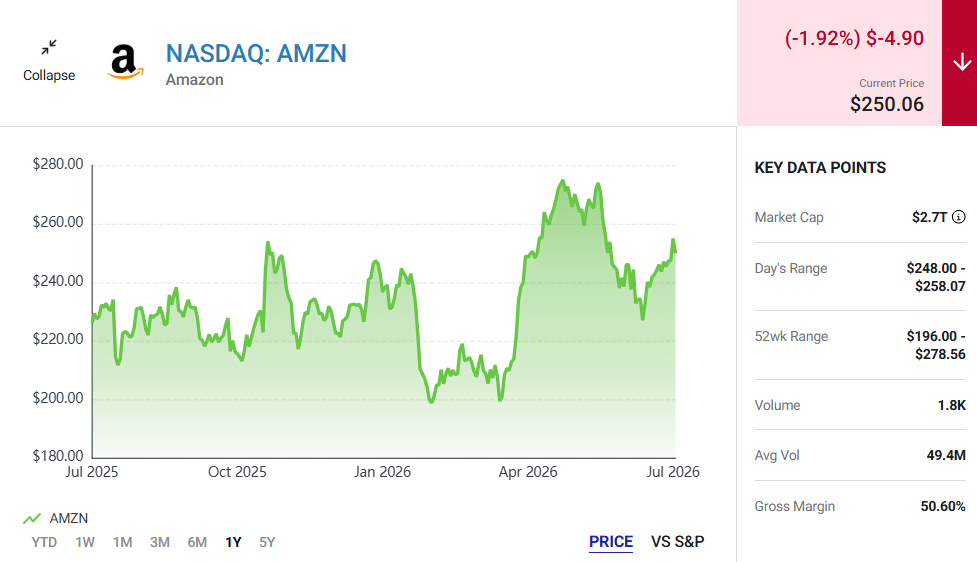
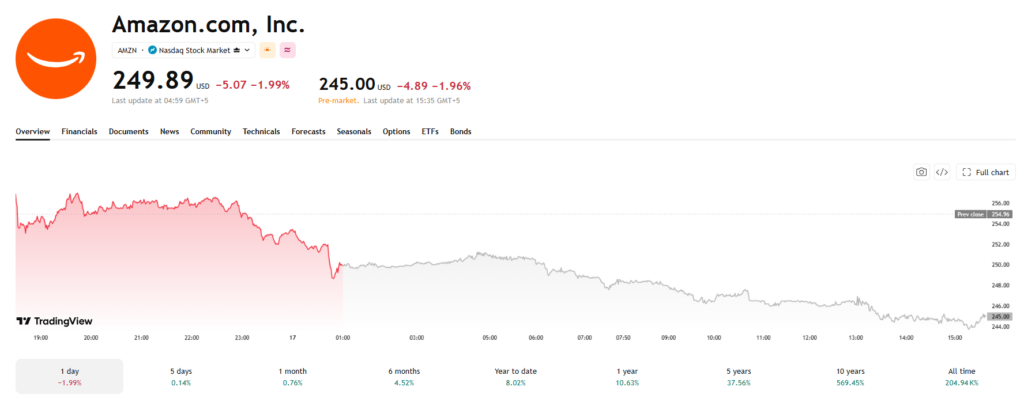
Amazon has long been one of the best-performing stocks in market history, but its recent run has lagged the broader market. Brokers from Fonndure dive into this topic, pointing out that the stock is up only about 7% year-to-date, placing it in the middle of the pack among the “Magnificent Seven” names.
Despite that sluggish start to the year, one Wall Street analyst believes the stock could still gain 50% over the next 12 months. If that forecast plays out, the company’s total market value would climb to roughly $4 trillion, a milestone only a handful of companies worldwide have ever reached.
That kind of upside call has renewed investor interest in whether the underlying business can actually support it.
The gap between the stock’s muted performance and the bullish analyst target raises an obvious question. Is the market simply mispricing a company still firing on all cylinders, or is the caution justified given how much capital is being poured into new infrastructure?
AI Is Lighting a Fire Under AWS
Artificial intelligence is emerging as the company’s biggest long-term growth driver, with Amazon Web Services (AWS) remaining the world’s largest cloud provider, holding nearly 30% of the global cloud market. As AI adoption accelerates, AWS is becoming the core engine of the company’s next phase of growth.
Demand for AWS’s AI services is rising rapidly. Spending on Bedrock increased 170% sequentially in the first quarter of 2026, while the number of developers using the AI coding assistant Kiro more than doubled, highlighting strong enterprise adoption of AI tools.
The broader cloud business is also gaining momentum, with AWS revenue rising 28% year over year in the first quarter, its fastest growth in 15 quarters. Company leadership believes AI adoption is unprecedented, suggesting AWS is capturing durable enterprise demand that could support sustained long-term growth and valuation expansion.
E-Commerce Is Still the Engine Room
E-commerce remains the company’s largest growth driver, generating more than 60% of first-quarter revenue and accounting for over 40% of U.S. e-commerce sales. The company has also become the world’s largest company by sales, highlighting its dominant position in global retail.
Delivery speed continues to strengthen its competitive edge, with one-hour delivery available in hundreds of markets, three-hour delivery in 2,000 markets, and same-day delivery expanding to 4,500 U.S. cities by year-end. These improvements boost customer satisfaction, increase purchase frequency, and reinforce long-term loyalty.
Beyond retail, the company is expanding into high-growth markets through its satellite internet initiative, which has already secured partnerships with a major airline and a leading consumer technology company.
Although these businesses remain relatively small today, they demonstrate the company’s strategy of investing in future growth opportunities while strengthening high-margin advertising and subscription revenue alongside its core retail operations.
Crunching the Numbers on $4 Trillion
Reaching a $4 trillion market valuation would require approximately 50% net income growth over the next year if the company’s valuation multiple remains unchanged. Although that is a challenging target following 31% net income growth in 2025, continued strong earnings growth could still support meaningful gains in the stock price.
In the short term, profit margins are likely to remain under pressure as the company continues investing heavily in AI infrastructure.
Management expects only modest operating income growth in the second quarter, with elevated spending on data centers and custom AI chips weighing on profitability. While this could limit near-term free cash flow, leadership views the investments as essential to strengthening the company’s long-term competitive advantage.
Risks That Could Derail the Rally
AI investment sentiment remains an important risk for the company and the broader technology sector. Investors are closely watching whether massive AI infrastructure spending will generate sufficient returns, and any slowdown in enterprise AI adoption could negatively impact the stock.
Another key risk is continued margin pressure from heavy AI-related capital spending. If operating income growth remains weak for several quarters, it could limit the stock’s upside, even if revenue continues to grow at a healthy pace.
So, Is $4 Trillion Realistic?
The stock currently trades at fewer than 30 times trailing earnings, near its lowest valuation in a decade, suggesting investors have not fully priced in the AI growth potential of AWS. If earnings growth accelerates, the shares could benefit from both stronger profits and valuation expansion.
Wall Street analysts currently see about 30% upside over the next year, implying a market value closer to $3.5 trillion rather than the more ambitious $4 trillion target. Even so, the combination of AI-driven AWS growth, continued e-commerce leadership, and an attractive valuation makes the stock one to watch heading into 2027.