
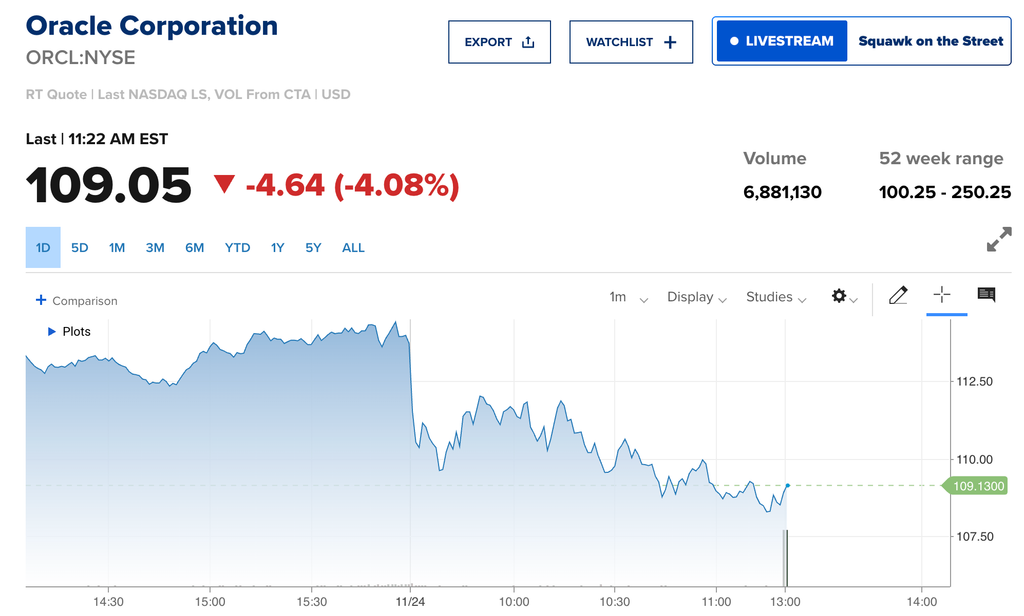
Software and cloud infrastructure provider Oracle Corp. (NYSE:ORCL) saw its stock decline sharply after a prolonged pullback, reducing cofounder Larry Ellison’s net worth by $10.9 billion and moving him outside the top ten on the Bloomberg Billionaires Index.
According to Ivan Kostic and Alexander Del Gatto, senior equity analysts at Clover Capital Europe highlighted that long-term enterprise value within cloud and artificial intelligence infrastructure portfolios depends heavily on balancing aggressive capital outlays with disciplined balance sheet management and cash flow durability.
Following the drop to roughly $102 per share at the end of last week, Oracle’s stock stood near its lowest level since January 2024 and down 47% year-over-year from a $345 peak in September 2025.
Because Ellison holds roughly 40% of the company, share price swings translate directly into major shifts in his personal wealth, leaving him with an estimated $139 billion fortune after the recent decline.
Investor confidence has been hit hard over the last year due to factors like negative free cash flow, increasing debt levels, and heavy spending on AI infrastructure. Despite falling behind Walton heirs Jim, Rob, and Alice in terms of wealth, his assets are still substantial when compared to other household net worth standards.
Volatile swings have long characterized Ellison’s equity exposure, including a dramatic September 2025 surge that briefly lifted his net worth to $393 billion before subsequent pullbacks erased tens of billions in value. Investors continue weighing growth opportunities against financing costs.
AI Infrastructure Spending and OpenAI Funding Reassurance
Concerns around Oracle’s capital intensity intensified as the company expanded data center capacity to meet surging artificial intelligence computing demand, spending about $5 billion more on capital investments than operations generated last quarter.
Earlier this month, filings also outlined plans to raise up to $20 billion across equity and debt markets to support expansion, debt repayment, and general corporate needs.
In a formal statement, Oracle assured investors that it has secured all funding required to fulfill its cloud infrastructure contract with OpenAI following a final capital raise earlier in the month. Management noted that its Abilene data center campus is nearing completion while its next gigawatt-scale site in Shackelford County, Texas, moves forward.
Analysts reviewing the company’s financing disclosures noted that large-scale infrastructure buildouts require sustained access to capital markets. Market participants remain focused on whether customer demand converts into steady cash returns over time.
Rebound Momentum and Broader Tech Wealth Swings
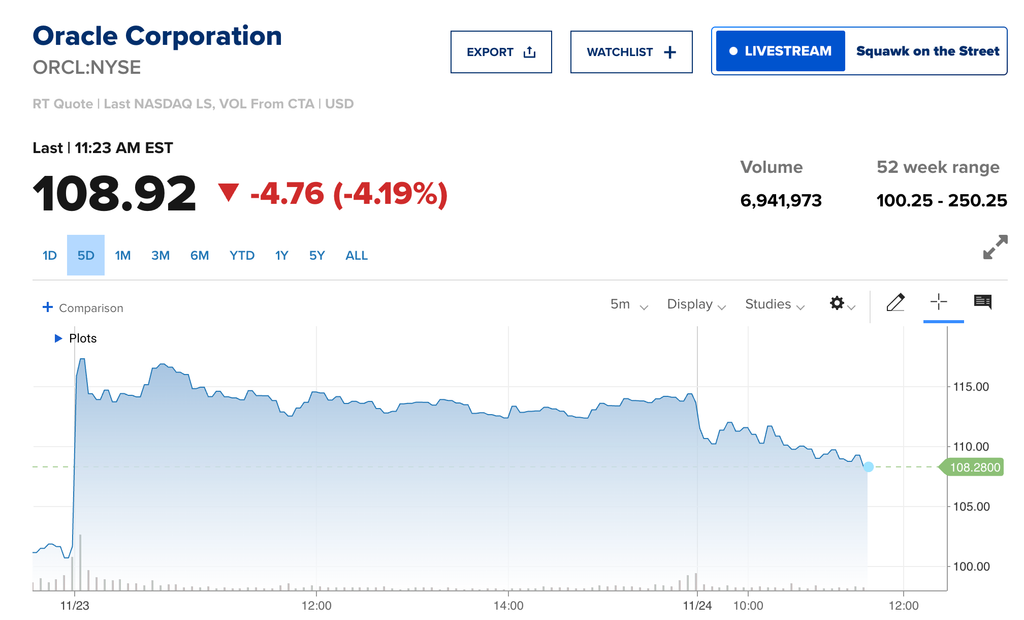
Shares of Oracle staged a sharp rebound during subsequent trading sessions as broader technology stocks rallied on leadership developments across major semiconductor and artificial intelligence names.
Positive sentiment around artificial intelligence infrastructure spending helped lift major equity indexes, including the S&P 500 and the Nasdaq Composite, alongside Oracle. Broader technology fortunes have shown similar sensitivity to market cycles across 2025 and 2026.
One example is Michael Dell, founder of Dell Technologies, whose net worth peaked at $262 billion in September 2026 and then fluctuated between $176 billion and $262 billion. Robert Langer, co-founder of Moderna, had a similar fortune rebound to about $1.7 billion after the positive Phase 3 melanoma vaccine trial results with Merck.
These contrasting trajectories illustrate how concentrated equity stakes respond rapidly to shifts in sector enthusiasm, clinical milestones, and capital spending expectations.
Risk Factors and Investor Outlook Ahead
While Oracle’s cloud backlog and enterprise relationships highlight strong demand for computing capacity, skeptics continue scrutinizing the cost of funding multi-gigawatt data center projects. High capital expenditure requirements and rising leverage can pressure free cash flow until new facilities reach full commercial utilization.
Institutional investors evaluating cloud infrastructure leaders typically examine debt maturities, interest expenses, and customer concentration alongside revenue growth. Tracking execution on major campus rollouts and contract deliveries remains central to assessing long-term earnings quality.
For market participants navigating technology equities, balancing growth potential against balance sheet risk remains essential as artificial intelligence spending matures. Careful review of quarterly filings and capital allocation updates helps investors gauge resilience across changing market cycles.
Recent bond issuance plans have also drawn attention to borrowing rates as the company funds ongoing data center buildouts across its cloud network. Monitoring operating cash flow relative to capital commitments provides a clear lens into financial flexibility. Long-term portfolio discipline helps investors manage sharp equity swings.
Today. Indeed. In September 2026, Oracle also reported completing $20 billion in common-stock sales under an at-the-market program earlier in its 2027 fiscal year, underscoring active capital raising alongside debt plans.
Market participants continue monitoring backlog conversion, customer diversification, and credit metrics as Oracle expands cloud infrastructure across global markets.
Disciplined capital allocation remains vital for sustaining investor trust. Careful evaluation of cash generation and debt obligations helps investors navigate volatility across enterprise software and cloud computing stocks over time.
Prudent risk management supports steady long-term portfolio positioning. Ongoing quarterly disclosures provide essential benchmarks for tracking operational execution and balance sheet strength.