
The research team at Sylverix examines Netflix, a streaming leader whose results look healthy while its shares keep getting cheaper. NFLX ended Tuesday at $63.26, only a little above the lowest price of the year, and the central question is whether the market is too pessimistic or simply right to be cautious.
Price Action Near The Floor
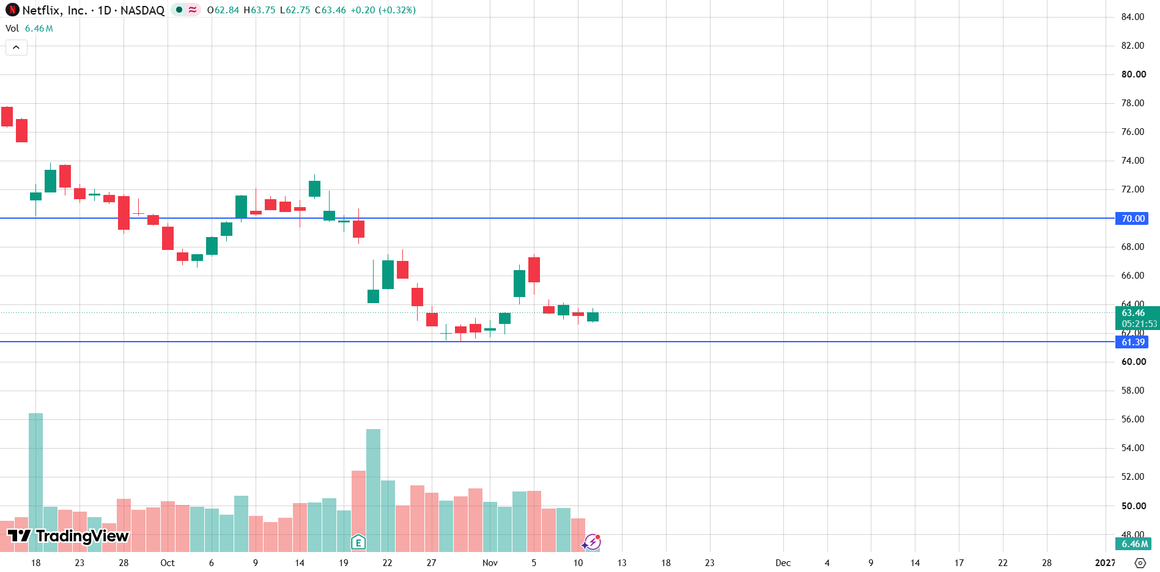
The shares have been falling for months. Compared with a year ago they are down about 44%, and since the start of January the loss is near 33%. The last four weeks were especially weak, with a drop of roughly 10%. Early trading on Wednesday suggested a price around $62.90, which would be even closer to the floor of the yearly range between $61.39 and $116.73.
At this price, Netflix has a market value of about $260 billion. That is still large, but it is only about half of what the company was worth when the stock was near its highs.
Multiples Shrink Fast
The decline is not only about lower earnings expectations. Mostly, it reflects a change in how much investors are willing to pay for each dollar of profit. The stock is valued at around 17.6 times the profit of the last year and 17.3 times the profit expected next, compared with a figure close to 40 at the peak of mid-2025.
Other indicators say something similar. The price-to-growth ratio is about 0.39, a level below 1 that is often read as a sign of low pricing against expected growth. In addition, the company’s yearly cash production equals about 4.4% of its market value, a respectable yield for a technology leader.
A Company That Now Makes Money
Behind these figures there is a business that has improved a lot. In 2021 Netflix was still burning a little cash. By fiscal 2025, it generated close to $9.5 billion after covering its investments. Sales rose from nearly $29.7 billion to about $45.2 billion over the same stretch.
Profitability changed as well. For every $100 of revenue, the company now keeps around $24 as net profit, while a few years ago it kept about $14. The return it earns on the capital it puts to work, close to 30%, shows how productive the spending has been. Bulls say that investors have been slow to recognize this change.
Why Bulls Stay Interested
Optimists point to several supports. The first is the global scale of the platform. Over 60% of its programming is produced outside the United States, and usage in other regions continues to grow, which spreads the risk across many markets.
The second is customer loyalty. A survey of 940 American consumers showed that 75% subscribe, and 37% name it as their top choice, close to double what the next competitor reaches.
A third of subscribers also try podcasts or games on the platform, so there is room to add new sources of income. Advertising is expected to lift revenue in North America, and big share repurchases suggest that managers believe the stock is cheap.
What Worries Investors
The picture is not free of problems. Estimates of the company’s worth have been reduced during the year, and some projections for profit and cash were cut. If growth slows or if American engagement weakens, a low multiple could stay low for a long time.
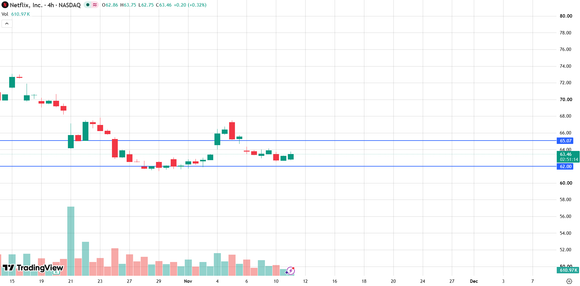
Price momentum also points down. The shares broke under the $65 low of October and kept sliding. Stocks that look cheap and continue to fall are often called value traps, and the fear is that forecasts keep dropping while the valuation never recovers.
Support And Resistance Levels
On the upside, the first resistance is $65, the old October low that now acts as a ceiling. Next is the round figure of $70, and a close above it would show that buyers are taking control.
On the downside, the first support is $62, followed by the yearly low at $61.39. Beneath that zone, $60 is the next level to watch, and a break through it could open the way to a deeper fall.
What Traders Can Do
Because the stock sits so close to a major floor, the reaction around $61.39 is the key. Buyers may wait for a bounce that holds above $62, or for a close over $65, and then look for $70, placing a stop-loss under the yearly low to keep the risk limited.
Sellers may prefer a daily close below $61.39, which would show that the floor has failed, with $60 as the next target. Position size should stay moderate, since a stock that has fallen this much can swing sharply in both directions, and a stop-loss should always be set before entering.
Conclusion
Netflix offers a lower valuation and stronger cash generation than a year ago, yet its shares remain near the floor of their range. The $65 resistance and the $61.39 support are the levels to follow.
Traders following Stocks strategies should watch earnings estimates, subscriber trends and the reaction at these levels, since these factors are likely to guide the next move in Netflix.