
The price of Brent has dropped to a level not seen since the summer, and traders are asking whether this is the start of a longer decline or only a pause in a very nervous market. The research team at Sylverix reviews the move in oil, the reasons behind it and the levels that may shape the coming sessions.
Oil Slides Toward A Three-Month Low
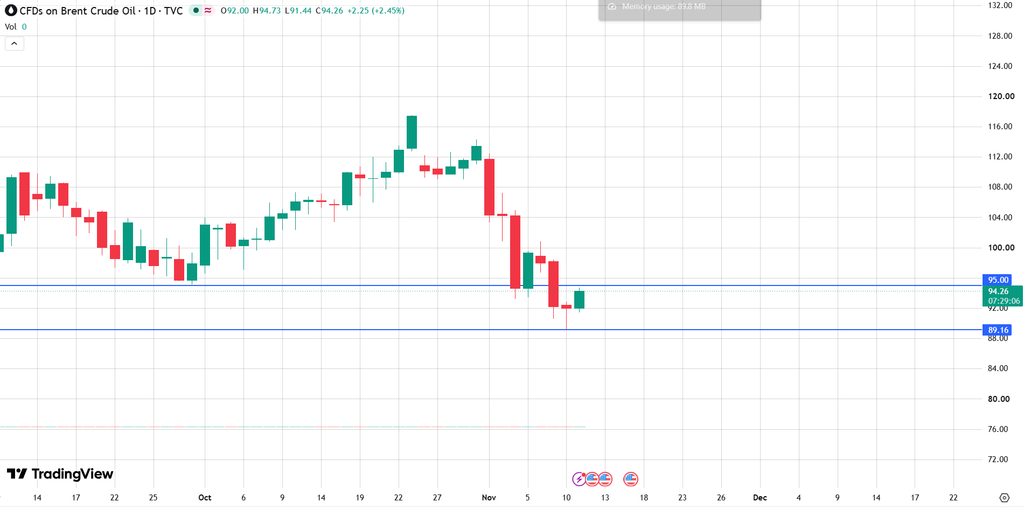
On Tuesday, Brent futures fell to $89.16 per barrel at their weakest point, which put the price under the psychological line of $90 for a short time. By the end of the day, the contract was back up at about $91.50, still lower by just over one percent compared with the previous session.
US crude followed the same direction and finished near $86, with a loss of roughly one percent. Both contracts are now far from their spring highs, and the decline shows that part of the fear that had kept prices elevated is leaving the market.
Hopes Of A Settlement Cool Supply Fears
The reason behind the fall is political. For almost nine months, the United States and Iran have been locked in a confrontation that has disturbed energy markets again and again. This week, officials in Washington described the situation more positively and suggested that the fighting could end before long. Traders took the message as a sign that the risk of new supply shocks is becoming smaller.
Physical conditions have improved as well. Crude shipments from the Gulf region have returned close to normal levels, and the passage near Hormuz is working again for most cargoes.
Some reports also mention that Tehran may become more flexible about the control of that route. When supply worries fade, the extra amount that buyers were paying for protection against disruption starts to shrink, and prices follow it down.
Not Everyone Is Convinced
Optimism is far from universal. An energy consultant said that the two governments are too far apart for any agreement, because Washington wants nuclear material removed from Iranian territory, while Tehran is unlikely to accept that demand or to restore the open shipping conditions of the past.
Other observers also noted that the direction of American policy is hard to predict, and that a stronger response remains possible despite the calm tone in the market. For traders, this means that the recent fall could reverse quickly with a single piece of bad news.
A Year Of Wild Swings
The price history of 2026 shows how nervous this market has been. At the beginning of the year, a barrel cost about $60. The spring brought an explosive move as military action intensified, and Brent reached roughly $130. A pullback followed during the summer, but the conflict seemed to settle in, and prices later climbed back toward the same area.
Against that background, a move under $90 is a big change, and it explains why every headline can produce a jump of several dollars within hours.
Why Fuel Costs Stay High
Cheaper crude does not automatically bring cheaper fuel. Attacks on energy facilities in several regions, other conflicts and tight refinery output have kept the cost of fuels for cars, trucks and planes high.
This means that households and companies may see little relief, and that inflation pressure could remain, which matters for central banks and for the whole financial market.
Support And Resistance Levels
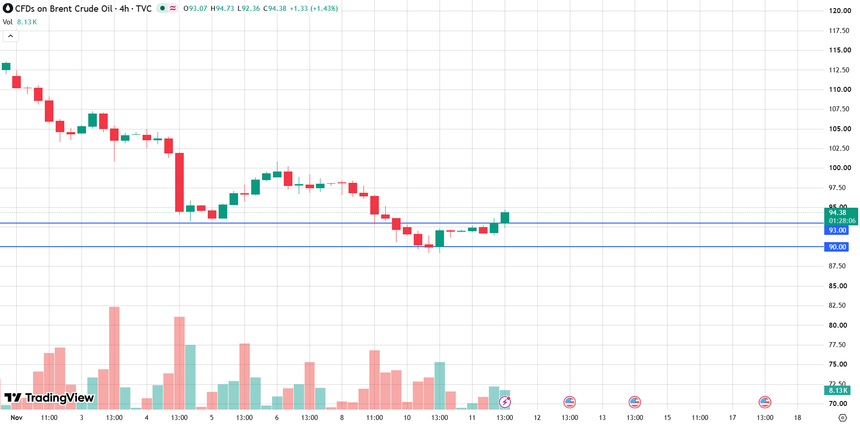
On the upside, the first resistance is the round number of $93, followed by $95. A return to $100 would need a new rise in tension, and the spring peak near $130 remains far away.
On the downside, $90 is the first support, followed by the low of Tuesday at $89.16. Under it, the $85 area is the next target, and a break through that figure would suggest that the market is removing more of its fear.
What Traders Can Do
With the market so dependent on political news, caution is sensible. Sellers may wait for a rebound toward $93 that fails, then aim for $90 and $89.16, with a stop-loss above $95. Buyers may prefer to wait for a daily close over $95 before considering long positions, with $100 as a possible target.
Position size should stay moderate, because a single headline can change the direction of oil within minutes, and a stop-loss should always be set before entering. Following the dollar and US inventory data can also add context to the decision.
Conclusion
Brent has fallen toward $90 as hopes of lower tension reduce the fear of supply problems, but doubts about a real agreement keep the market unstable. The $93 and $95 resistances and the $90 and $89.16 supports are the levels to follow.
Traders following Commodities strategies should watch news from the Middle East, the dollar and the reaction at these levels, since these factors are likely to guide the next move in Brent.