
The research team at Sylverix examines the US dollar against the Canadian dollar, a pair that has reached its highest level in more than three weeks. USD/CAD trades near 1.4210, and two strong forces, falling oil prices and expectations of tighter US policy, are pushing it higher.
Loonie Loses Ground
The Canadian dollar has been underperforming its American rival for several sessions. On Wednesday, USD/CAD gained about 0.17% and moved up to the 1.4213 area, the highest level in more than three weeks. The US Dollar Index, which measures the dollar against six major currencies, also rose slightly and trades near 102.37.
The move shows that the pair has a clear direction. Buyers of the US currency have been in control, and each small pullback has attracted new interest.
Cheaper Oil Hurts Canada
Canada is a large exporter of energy, so the value of its currency tends to follow the price of crude. When oil falls, export income looks weaker, and investors become less enthusiastic about the Canadian dollar.
That is exactly what is happening now. WTI crude has dropped by almost 18% from its recent peak of $104.03 and trades near $85.35. Hopes that Washington and Tehran may reach an agreement have reduced the fear of supply disruptions in the Middle East, and with it the premium that had been added to energy prices. For the loonie, this removes an important source of support.
The Fed Debate Changes Shape
The second force comes from the United States. The October inflation report was stronger than forecast, and analysts at a large Canadian bank said that it makes an interest rate increase in December almost certain. The discussion is no longer about whether the Federal Reserve will act, but about how much it will raise rates.
Remarks from a Fed governor before the data had already focused attention on the possibility of a move to catch up with inflation.
Some strategists think that policymakers may need to deliver a half-point increase to make up for lost time. Others, including the bank mentioned above, expect a quarter-point step in December, with a growing chance of another one in January and strong guidance to prepare markets for it.
Whatever the final size, the direction is clear: higher US rates. This supports the dollar and helps explain why USD/CAD keeps rising.
Technical Picture On The Daily Chart
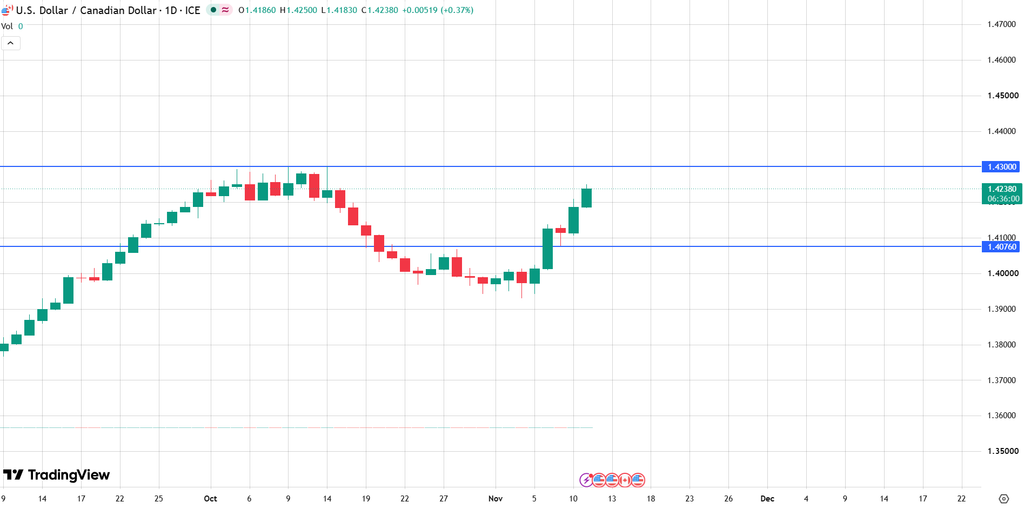
On the daily chart, the pair keeps a bullish bias. The price is trading above its 20-day exponential moving average, which stands near 1.4085 and now acts as a base for the advance. This average gives more weight to recent closes, so it reacts faster than a simple average and is popular among short-term traders.
The Relative Strength Index is close to 64. That is a positive reading, since it shows that buyers have the upper hand, but it is still below the overbought zone of 70, so the market has room to move. At the same time, after such a strong rise, a pause or small correction would not be surprising.
No Clear Barrier Overhead
One unusual feature of the chart is that the pair has reached an area with few obvious resistance levels nearby.
When the price breaks above a recent high, traders often use round numbers as reference points, and in this case the figures of 1.4250 and 1.4300 are the natural candidates. This makes the question of support more important: the key issue is whether buyers can defend the levels beneath the current price.
Support And Resistance Levels
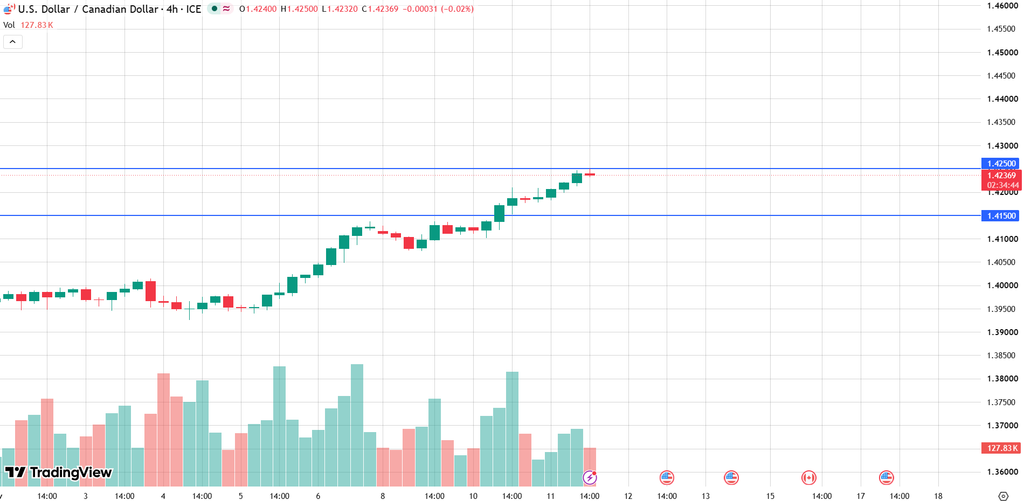
On the upside, the first resistance is the round number of 1.4250, followed by 1.4300. A close above the second level would confirm that the uptrend remains strong.
On the downside, the first support is around 1.4210, close to the current price. Below it, the 1.4150 area is the next level to watch, and then the 20-day average near 1.4085, where buyers may return if a pullback develops. A break beneath that line would be a sign that the advance is losing strength, with 1.4000 as a deeper floor.
What Traders Can Do
Buyers may consider entering on a pullback toward 1.4150 or the 1.4085 average, rather than chasing the pair at the highs. If the price holds those levels, a long position could aim for 1.4250 and 1.4300, with a stop-loss under the moving average.
Sellers may wait for a daily close below 1.4085, which would show that the trend is weakening, and then target 1.4000. Position size should stay moderate, since oil prices, US data and Fed comments can change the picture within hours, and a stop-loss should always be placed before entering.
Conclusion
USD/CAD is advancing because lower oil prices hurt the Canadian dollar while the debate about the size of the next Fed rate hike strengthens the US currency. The 1.4250 and 1.4300 levels on the upside and the 1.4085 average on the downside are the key references.
Traders following Forex strategies should watch oil prices, US inflation expectations and the reaction at these levels, since these factors are likely to guide the next move in the pair.