
The euro has made a modest advance against sterling in recent sessions, but it cannot hold the highest ground it has reached. The analysts at AchievementsAI review EUR/GBP, which stands near 0.8367, the data that influences both currencies and the levels that could decide the next step.
German Prices Lose Speed
The day began with the final report on German consumer prices for October, measured with the harmonized European index. It matched the early estimate. Compared with September, prices dropped by 0.1%, while the year-on-year rate eased to 2.8% from 3.3%. A month earlier, the monthly change had been a rise of 0.6%.
For households, this is good news, because it means that the cost of living is growing more slowly in the biggest economy of the eurozone. For the euro, the effect is less friendly. Cooler inflation gives the European Central Bank fewer reasons to keep tightening, and a currency tends to lose attraction when expectations for higher interest rates decline.
The United Kingdom Waits For Growth Figures
On the other side of the pair, the British calendar is almost empty today, and investors are looking ahead to Thursday, when the economy’s output for the third quarter will be published. Analysts expect growth at a moderate pace, with a solid contribution from manufacturing.
A result in line with those forecasts would encourage the idea that the Bank of England could raise rates once more early next year. That scenario would help the pound, so the euro has a reason to stay cautious before the release. A disappointing figure, on the other hand, would weaken the case for higher British rates and might allow EUR/GBP to move up.
Oil Returns To The Spotlight
Energy is the third factor. Crude prices moved higher after Tuesday’s drop, and Brent is once again trading over $90 per barrel. Doubts are growing about whether a diplomatic solution to the conflict in the Middle East is really close, since the talks have produced little visible progress.
Europe depends heavily on imported energy, so any increase in oil is a burden for its companies and consumers, and it can slow growth and keep inflation higher than desired. This is why traders watch the energy market closely when they trade the euro. Because of this link, a stronger oil price usually pulls the euro down, even when other markets are calm.
Risk Appetite Cannot Lift The Euro
The mood among investors is generally optimistic, and in normal conditions that would help the euro, which often gains when traders feel confident. Today, the support from sentiment is being cancelled by the move in oil.
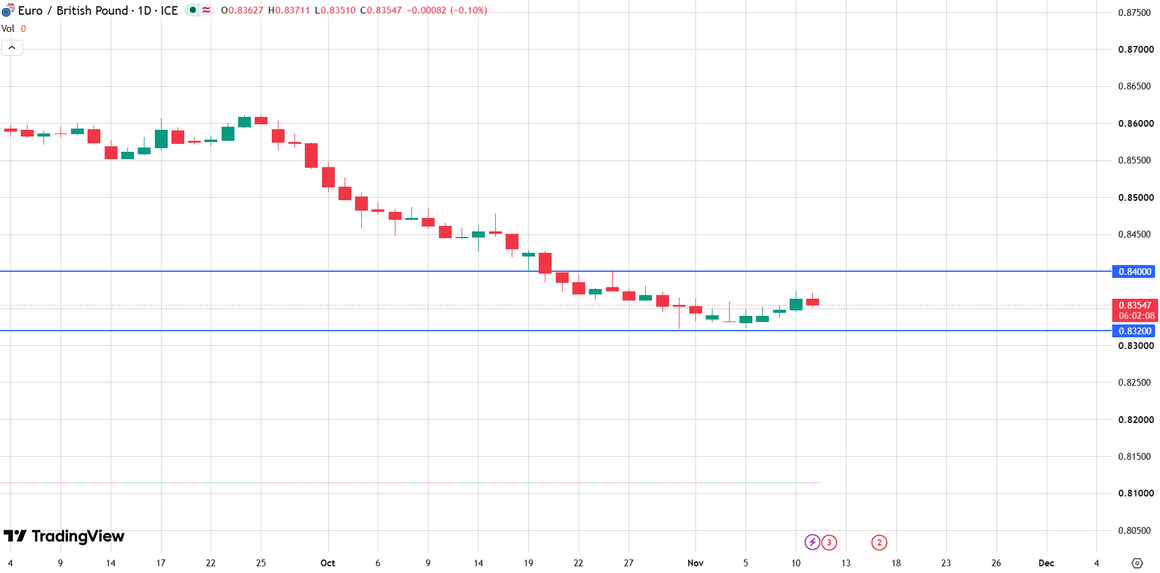
The result is a pair that is almost unchanged and that moves in a narrow corridor. Until one of these forces becomes stronger than the other, the market may keep moving sideways.
Reading The Chart
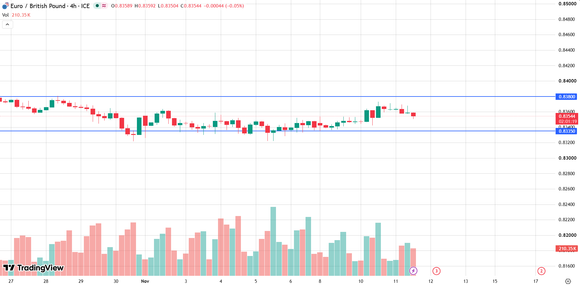
The technical picture is slightly positive. The pair has climbed over a zone near 0.8360 that used to cap rallies, and that area now works as a base. The RSI sits on the positive side of its scale and the MACD is a little above zero, which indicates that buyers still have the advantage as long as they defend that base.
The weakness lies in what happens above. Every try to settle beyond 0.8370 has failed, so the move lacks confirmation. If buyers cannot change that, the price could slide back into the range that it left.
Support And Resistance Levels
Above the market there is a short ladder of barriers. The first rung is 0.8370, the level that has stopped every advance so far. Just over it, the late-October peak near 0.8380 can attract sellers, and the highest recent point close to 0.8400 is the main target. A close beyond that round figure would show that buyers have taken control.
Below the price, 0.8360 is the first cushion, formed by several highs of the last two weeks that now act as a base. If it fails, the lows of the first days of November near 0.8335 come into view. The lowest point of the year, close to 0.8320, is the last floor, and a break through it would open the way to new yearly lows.
What Traders Can Do
Buyers may wait for a close over 0.8370 or for a successful retest of 0.8360, and then target 0.8380 and 0.8400, placing a stop-loss beneath 0.8335. Sellers may prefer to wait for a decline under 0.8360, aiming for 0.8335 and later 0.8320.
With British growth figures due on Thursday and oil headlines able to change the mood quickly, position size should stay moderate, and a stop-loss should always be set before entering. Following Brent during the day can also help to explain why the pair stalls near resistance.
Conclusion
EUR/GBP is holding above 0.8360 but cannot find room beyond 0.8370, pressed between cooling inflation, higher oil and a key UK growth report. The 0.8370 resistance and the 0.8360 support are the levels to follow.
Traders following Forex strategies should watch oil prices, UK growth data and the reaction at these levels, since these factors are likely to guide the next move in the pair.