
The research team at AchievementsAI is watching gold closely after the metal failed to build on a small rebound on Wednesday. XAU/USD trades near $4,050 per ounce, a short distance below the zone where buyers were rejected only a day earlier, and the next few sessions may decide whether the recent rally has ended.
Gold Fails To Rebuild Momentum
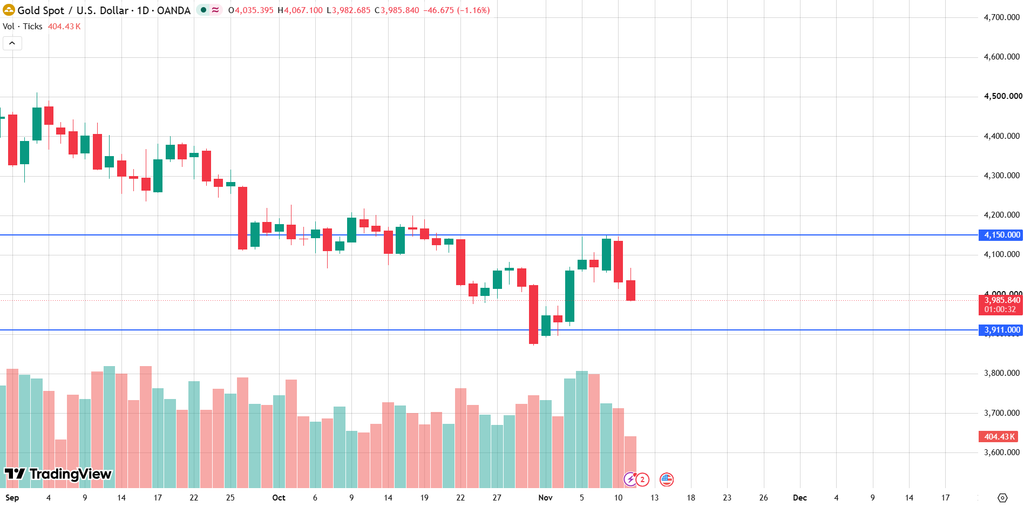
On Tuesday, the metal climbed toward $4,150 and then reversed sharply, closing the session with a large bearish candle. On Wednesday, it tried to recover during the European hours, but the attempt looked weak and the price remained stuck under $4,050.
This kind of behavior is worth attention. A strong reversal from a resistance zone, followed by a hesitant bounce, suggests that buyers are exhausted and that sellers are using every small rally to sell. Gold has not yet turned decisively lower, but the balance of power has moved toward the bears.
Hot Inflation Revives Rate Hike Bets
The main reason for the reversal was the US consumer price report for October, released on Tuesday. Inflation came in above forecasts, which strengthened the argument for another interest rate increase by the Federal Reserve in December. The US dollar had been soft for some time, but the data gave it a fresh boost, and it is now rising against most major currencies.
This matters for gold because the metal pays no interest. When rates are expected to rise, bonds and cash become more attractive, and a stronger dollar makes gold more expensive for buyers who hold other currencies. Both forces are now working against the metal at the same time.
Fed Officials Back The Tightening Case
Comments from the central bank on Wednesday added to the pressure. The head of the Philadelphia regional bank said that further gradual tightening is needed to bring inflation back to its goal. Later in the day, the head of the Dallas regional bank went further, stating that a minimum of two further hikes of a quarter point each is required.
Such remarks matter because markets try to guess how far the Fed will go. If more officials support a hawkish path, traders may price in additional hikes, and precious metals could stay under pressure for longer.
Energy prices also play a role in this story. Oil has started to recover from recent lows, which may keep inflation worries alive and give the Fed more reasons to stay cautious about easing.
A Possible Double Top Near $4,150
The daily chart has produced a bearish engulfing candle, a pattern in which a large red candle fully covers the previous one, and it often signals that buyers are losing control. The two recent highs near $4,150 also hint at a possible double top, a formation that appears when the price fails twice at the same ceiling.
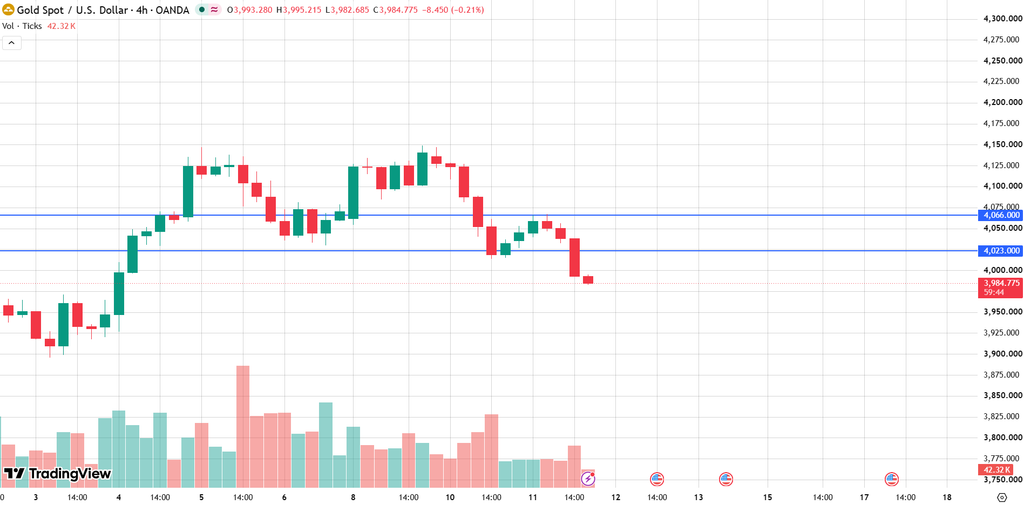
Short-term indicators lean in the same direction. On the four-hour chart, the RSI is below its neutral 50 line, and the MACD is under zero at -9.51, so momentum favors sellers. Even so, the market still trades above the lows of late October, which means the broader recovery has not been broken yet.
Support And Resistance Levels
The first support is the area from $4,023 up to $4,030, formed by the lows of November 6 and 10. Sustained trading under this zone would confirm the double top and open the way toward $3,970, where the highs of early November are found. The measured target of the formation is near $3,911, the low of November 3.
Higher up, the first resistance is the intraday high at $4,066. Above it, the key barrier remains at $4,150, where the peaks of the fifth and ninth of the month are located, so sellers will defend it. A daily close above that level would cancel the bearish setup and signal that buyers are back in control.
What Traders Can Do
With the price so close to support, patience is useful. Sellers may wait for a four-hour or daily close below $4,023, then target $3,970 and $3,911, placing a stop-loss above $4,066. Entries after small rebounds toward $4,066 that fail could also offer a better risk-to-reward ratio.
Buyers may prefer to stay aside until the price closes above $4,066. A move through $4,150 would be a stronger sign that the double top has failed, with the stop-loss placed under $4,023.
Position size should stay moderate, since gold reacts quickly to data and central bank comments, and a stop-loss should be set before every trade.
Conclusion
Gold is trading under pressure from a firmer dollar, hot inflation and a more hawkish Fed, while the chart shows a possible double top. The $4,023 to $4,030 support and the resistance at $4,150 are the levels to follow.
Traders following Commodities strategies should watch US inflation, Fed comments and the reaction at these levels, since these factors are likely to guide the next move in gold.